

280
P. Joe
by any meteorological targets encountered. Some of the scattered energy is reflected back to
the radar antenna and receiver. Between successive pulses, the receiver listens for any return
of the wave. The return signal from the target is commonly referred to as the radar echo.
The strength of the signal reflected back to the radar receiver from the target is a function of the
concentration, sizes and water phase of the precipitation particles comprising the target. The
power return, P" therefore provides some measure of the characteristics of the meteorological
target and is, but not uniquely, related to a precipitation rate for any given form of precipitation.
The radar range equation relates the power-return from the target to the radar characteristics
and parameters of the target.
The power measurements are determined by the total power backscattered by the target within
a volume being sampled at anyone instant - the pulse volume. The power may be integrated
later in both space and time. The pulse volume dimensions are dependent on the radar pulse
length in space (h) and the antenna beam widths in the vertical (
Since the power which arrives back at the radar at the same instant of time is involved in a twoway path, the pulse-volume-length is only one-half pulse length in space (h/2) and is invariant
with range. The location of the pulse volume in space is determined by the orientation of the
antenna in azimuth and elevation and the range to the target; the range (r) is determined
by the time required for the pulse to travel to the target and be reflected back to the radar.
The target is therefore uniquely defined in space by measurements of range and azimuth and
elevation angles, with due considerations for the resolution determined by h,
results in phase effects in the scattered signal and intensity fluctuations about the mean target
intensity. Little significance can be attached to a single echo intensity measurement from a
weather target, such as from a single pulse or hit. At least 25 to 30 pulses must be integrated
to obtain a reasonable mean intensity. This is normally done electronically in an integrator
circuit. Further averaging of pulses in range and azimuth and in time is frequently done to
increase the sampling size and accuracy of estimate. It follows that the space resolution is
coarser.
An alternative to the pulse weather radar is the frequency modulated continuous wave (FMCW) weather radar (Richter, 1969). Two antennae are needed since the radar system is listening
at the same time as transmission. Range is determined by frequency modulation. Often, a linear
chirp waveform is used where the frequency increases with time over a given period. Therefore,
echoes received at different frequencies are due to echoes at different ranges. These are usually
range limited and used in special applications (Russchenberg, 1995; van Gorp, 1995).
12.2.2 The radar range equation for precipitation targets
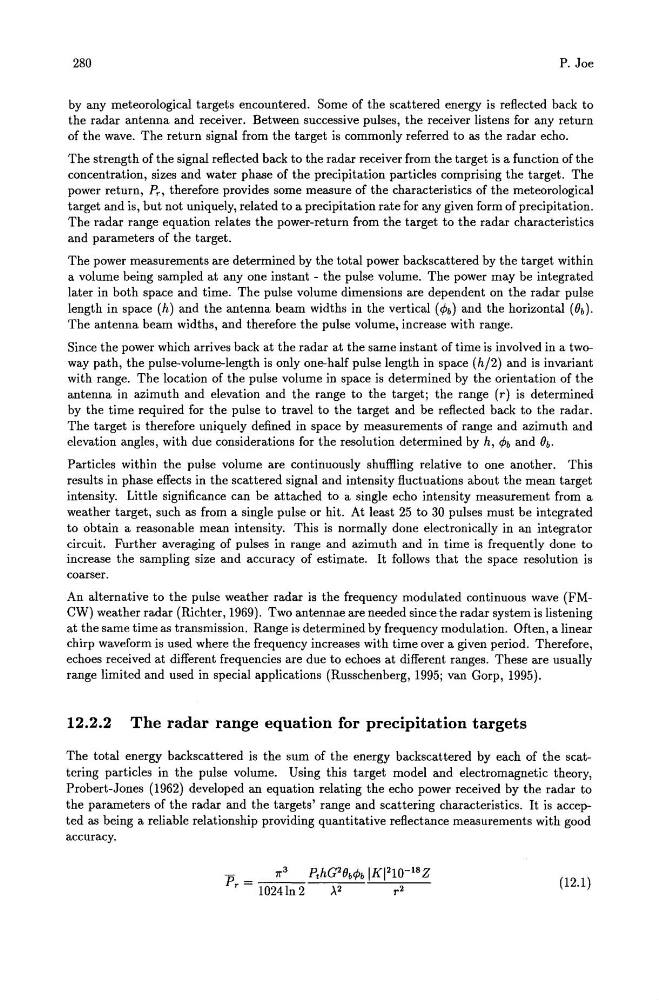
The total energy backscattered is the sum of the energy backscattered by each of the scattering particles in the pulse volume. Using this target model and electromagnetic theory,
Probert-Jones (1962) developed an equation relating the echo power received by the radar to
the parameters of the radar and the targets' range and scattering characteristics. It is accepted as being a reliable relationship providing quantitative reflectance measurements with good
accuracy.
p _ 71"3 Pt hG 2 (h
1024 In 2
A2
r2
(12.1 )
P. Joe
by any meteorological targets encountered. Some of the scattered energy is reflected back to
the radar antenna and receiver. Between successive pulses, the receiver listens for any return
of the wave. The return signal from the target is commonly referred to as the radar echo.
The strength of the signal reflected back to the radar receiver from the target is a function of the
concentration, sizes and water phase of the precipitation particles comprising the target. The
power return, P" therefore provides some measure of the characteristics of the meteorological
target and is, but not uniquely, related to a precipitation rate for any given form of precipitation.
The radar range equation relates the power-return from the target to the radar characteristics
and parameters of the target.
The power measurements are determined by the total power backscattered by the target within
a volume being sampled at anyone instant - the pulse volume. The power may be integrated
later in both space and time. The pulse volume dimensions are dependent on the radar pulse
length in space (h) and the antenna beam widths in the vertical (
Since the power which arrives back at the radar at the same instant of time is involved in a twoway path, the pulse-volume-length is only one-half pulse length in space (h/2) and is invariant
with range. The location of the pulse volume in space is determined by the orientation of the
antenna in azimuth and elevation and the range to the target; the range (r) is determined
by the time required for the pulse to travel to the target and be reflected back to the radar.
The target is therefore uniquely defined in space by measurements of range and azimuth and
elevation angles, with due considerations for the resolution determined by h,
results in phase effects in the scattered signal and intensity fluctuations about the mean target
intensity. Little significance can be attached to a single echo intensity measurement from a
weather target, such as from a single pulse or hit. At least 25 to 30 pulses must be integrated
to obtain a reasonable mean intensity. This is normally done electronically in an integrator
circuit. Further averaging of pulses in range and azimuth and in time is frequently done to
increase the sampling size and accuracy of estimate. It follows that the space resolution is
coarser.
An alternative to the pulse weather radar is the frequency modulated continuous wave (FMCW) weather radar (Richter, 1969). Two antennae are needed since the radar system is listening
at the same time as transmission. Range is determined by frequency modulation. Often, a linear
chirp waveform is used where the frequency increases with time over a given period. Therefore,
echoes received at different frequencies are due to echoes at different ranges. These are usually
range limited and used in special applications (Russchenberg, 1995; van Gorp, 1995).
12.2.2 The radar range equation for precipitation targets
The total energy backscattered is the sum of the energy backscattered by each of the scattering particles in the pulse volume. Using this target model and electromagnetic theory,
Probert-Jones (1962) developed an equation relating the echo power received by the radar to
the parameters of the radar and the targets' range and scattering characteristics. It is accepted as being a reliable relationship providing quantitative reflectance measurements with good
accuracy.
p _ 71"3 Pt hG 2 (h
1024 In 2
A2
r2
(12.1 )