

Precipitation at the Ground: Radar Techniques
Symbol
r
Z
Description
Units
The power received back at the radar, averaged over watts
several pulses
The peak power of the pulse transmitted by the radar
watts
The pulse length in space
meter
The gain of the antenna over an isotropic
The horizontal and vertical beamwidths respectively of radians
the antenna radiation pattern at the -3 dB level of one
way transmission
The wavelength of the transmitted wave
meter
The refractive index factor of the target
The slant range from the radar to the target
meter
The radar reflectance factor, usually taken as the equiva- mm 6 m- 3
lent reflectance factor Ze when the target characteristics
are not well known
Table 12.1: Radar equation symbols.
281
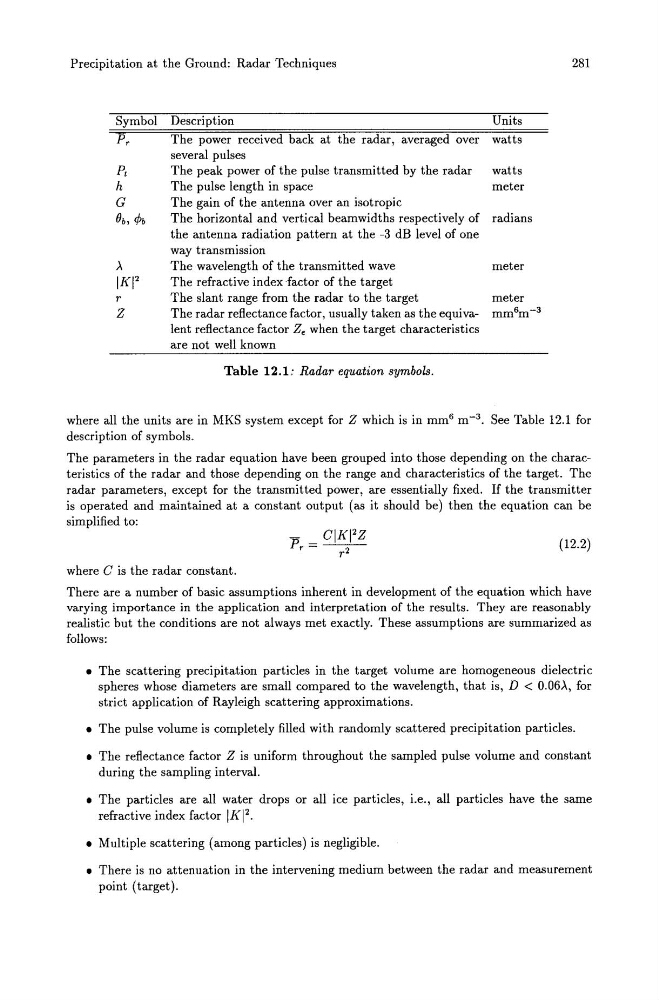
where all the units are in MKS system except for Z which is in mm 6 m- 3 • See Table 12.1 for
description of symbols.
The parameters in the radar equation have been grouped into those depending on the characteristics of the radar and those depending on the range and characteristics of the target. The
radar parameters, except for the transmitted power, are essentially fixed. If the transmitter
is operated and maintained at a constant output (as it should be) then the equation can be
simplified to:
p _ CJKJ 2 Z
r -
r2
(12.2)
where C is the radar constant.
There are a number of basic assumptions inherent in development of the equation which have
varying importance in the application and interpretation of the results. They are reasonably
realistic but the conditions are not always met exactly. These assumptions are summarized as
follows:
• The scattering precipitation particles in the target volume are homogeneous dielectric
spheres whose diameters are small compared to the wavelength, that is, D < 0.06>', for
strict application of Rayleigh scattering approximations.
• The pulse volume is completely filled with randomly scattered precipitation particles.
• The reflectance factor Z is uniform throughout the sampled pulse volume and constant
during the sampling interval.
• The particles are all water drops or all ice particles, i.e., all particles have the same
refractive index factor JKJ2.
• Multiple scattering (among particles) is negligible.
• There is no attenuation in the intervening medium between the radar and measurement
point (target).
Symbol
r
Z
Description
Units
The power received back at the radar, averaged over watts
several pulses
The peak power of the pulse transmitted by the radar
watts
The pulse length in space
meter
The gain of the antenna over an isotropic
The horizontal and vertical beamwidths respectively of radians
the antenna radiation pattern at the -3 dB level of one
way transmission
The wavelength of the transmitted wave
meter
The refractive index factor of the target
The slant range from the radar to the target
meter
The radar reflectance factor, usually taken as the equiva- mm 6 m- 3
lent reflectance factor Ze when the target characteristics
are not well known
Table 12.1: Radar equation symbols.
281
where all the units are in MKS system except for Z which is in mm 6 m- 3 • See Table 12.1 for
description of symbols.
The parameters in the radar equation have been grouped into those depending on the characteristics of the radar and those depending on the range and characteristics of the target. The
radar parameters, except for the transmitted power, are essentially fixed. If the transmitter
is operated and maintained at a constant output (as it should be) then the equation can be
simplified to:
p _ CJKJ 2 Z
r -
r2
(12.2)
where C is the radar constant.
There are a number of basic assumptions inherent in development of the equation which have
varying importance in the application and interpretation of the results. They are reasonably
realistic but the conditions are not always met exactly. These assumptions are summarized as
follows:
• The scattering precipitation particles in the target volume are homogeneous dielectric
spheres whose diameters are small compared to the wavelength, that is, D < 0.06>', for
strict application of Rayleigh scattering approximations.
• The pulse volume is completely filled with randomly scattered precipitation particles.
• The reflectance factor Z is uniform throughout the sampled pulse volume and constant
during the sampling interval.
• The particles are all water drops or all ice particles, i.e., all particles have the same
refractive index factor JKJ2.
• Multiple scattering (among particles) is negligible.
• There is no attenuation in the intervening medium between the radar and measurement
point (target).