

Lidar Measurements: Atmospheric Constituents ...
223
10.0
9.0
9.6
8.5
-,
E
<
~
9.2
8.0
...:
....
°"0.
I
()
W
8.8
7.5
I
8.4
7.0
.... ~
.. '
:
(a)
(b)
8.0
6.5
a
0.25
0.50
0.75
1
0.0
0.2
0.4
0.6
0.8
EXTINCTION COEF., km-1
EXTINCTION COEF., km-1
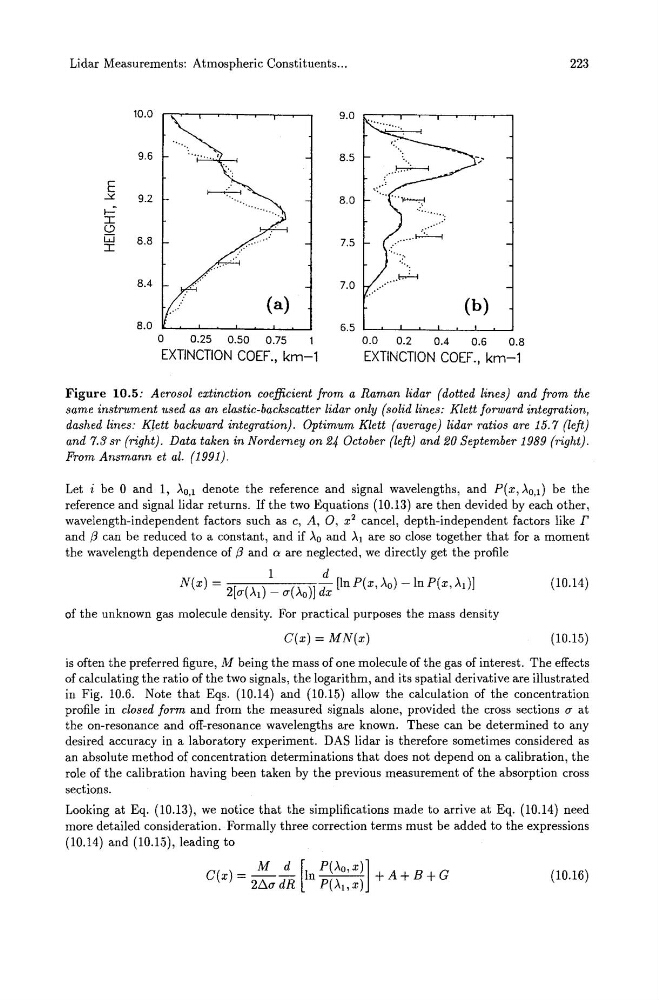
Figure 10.5: Aerosol extinction coefficient from a Raman lidar (dotted lines) and from the
same instrument used as an elastic-backscatter lidar only (solid lines: Klett forward integration,
dashed lines: Klett backward integration). Optimum Klett (average) lidar ratios are 15.7 (left)
and 7.3 sr (right). Data taken in Norderney on 24 October (left) and 20 September 1989 (right).
From Ansmann et al. (1991).
Let i be 0 and I, AO,l denote the reference and signal wavelengths, and P(x, Ao,l) be the
reference and signal Ii dar returns. If the two Equations (10.13) are then devided by each other,
wavelength-independent factors such as c, A, 0, x 2 cancel, depth-independent factors like r
and (3 can be reduced to a constant, and if Ao and Al are so close together that for a moment
the wavelength dependence of (3 and a are neglected, we directly get the profile
1
d
N(x) = 2[O'(Ad _ O'(Ao)J dx [In P(x, Ao) - In P(x, AdJ
(10.14)
of the unknown gas molecule density. For practical purposes the mass density
C(x) = MN(x)
(10.15)
is often the preferred figure, M being the mass of one molecule of the gas of interest. The effects
of calculating the ratio of the two signals, the logarithm, and its spatial derivative are illustrated
in Fig. 10.6. Note that Eqs. (10.14) and (10.15) allow the calculation of the concentration
profile in closed form and from the measured signals alone, provided the cross sections 0' at
the on-resonance and off-resonance wavelengths are known. These can be determined to any
desired accuracy in a laboratory experiment. DAS Ii dar is therefore sometimes considered as
an absolute method of concentration determinations that does not depend on a calibration, the
role of the calibration having been taken by the previous measurement of the absorption cross
sections.
Looking at Eq. (10.13), we notice that the simplifications made to arrive at Eq. (10.14) need
more detailed consideration. Formally three correction terms must be added to the expressions
(10.14) and (10.15), leading to
M d [ P(Ao,X)]
C(x)=2t;;.O'dR Inp(Ah x ) +A+B+G
(10.16)
223
10.0
9.0
9.6
8.5
-,
E
<
~
9.2
8.0
...:
....
°"0.
I
()
W
8.8
7.5
I
8.4
7.0
.... ~
.. '
:
(a)
(b)
8.0
6.5
a
0.25
0.50
0.75
1
0.0
0.2
0.4
0.6
0.8
EXTINCTION COEF., km-1
EXTINCTION COEF., km-1
Figure 10.5: Aerosol extinction coefficient from a Raman lidar (dotted lines) and from the
same instrument used as an elastic-backscatter lidar only (solid lines: Klett forward integration,
dashed lines: Klett backward integration). Optimum Klett (average) lidar ratios are 15.7 (left)
and 7.3 sr (right). Data taken in Norderney on 24 October (left) and 20 September 1989 (right).
From Ansmann et al. (1991).
Let i be 0 and I, AO,l denote the reference and signal wavelengths, and P(x, Ao,l) be the
reference and signal Ii dar returns. If the two Equations (10.13) are then devided by each other,
wavelength-independent factors such as c, A, 0, x 2 cancel, depth-independent factors like r
and (3 can be reduced to a constant, and if Ao and Al are so close together that for a moment
the wavelength dependence of (3 and a are neglected, we directly get the profile
1
d
N(x) = 2[O'(Ad _ O'(Ao)J dx [In P(x, Ao) - In P(x, AdJ
(10.14)
of the unknown gas molecule density. For practical purposes the mass density
C(x) = MN(x)
(10.15)
is often the preferred figure, M being the mass of one molecule of the gas of interest. The effects
of calculating the ratio of the two signals, the logarithm, and its spatial derivative are illustrated
in Fig. 10.6. Note that Eqs. (10.14) and (10.15) allow the calculation of the concentration
profile in closed form and from the measured signals alone, provided the cross sections 0' at
the on-resonance and off-resonance wavelengths are known. These can be determined to any
desired accuracy in a laboratory experiment. DAS Ii dar is therefore sometimes considered as
an absolute method of concentration determinations that does not depend on a calibration, the
role of the calibration having been taken by the previous measurement of the absorption cross
sections.
Looking at Eq. (10.13), we notice that the simplifications made to arrive at Eq. (10.14) need
more detailed consideration. Formally three correction terms must be added to the expressions
(10.14) and (10.15), leading to
M d [ P(Ao,X)]
C(x)=2t;;.O'dR Inp(Ah x ) +A+B+G
(10.16)