

222
C. Weitkamp
- The average aerosol Ii dar ratio must be constant during the measurement.
- The aerosol Ii dar ratio must be spatially constant over the region of interest.
- An appropriate gas absorption correction must have been carried out prior to the application of the Klett inversion algorithm.
10.0
9.6
E
.:Y.
9.2
~
:r:
0
G:i
8.8
:r:
8.4
8.0
0
O.s
EXTINCTION COEFFICIENT. km- 1
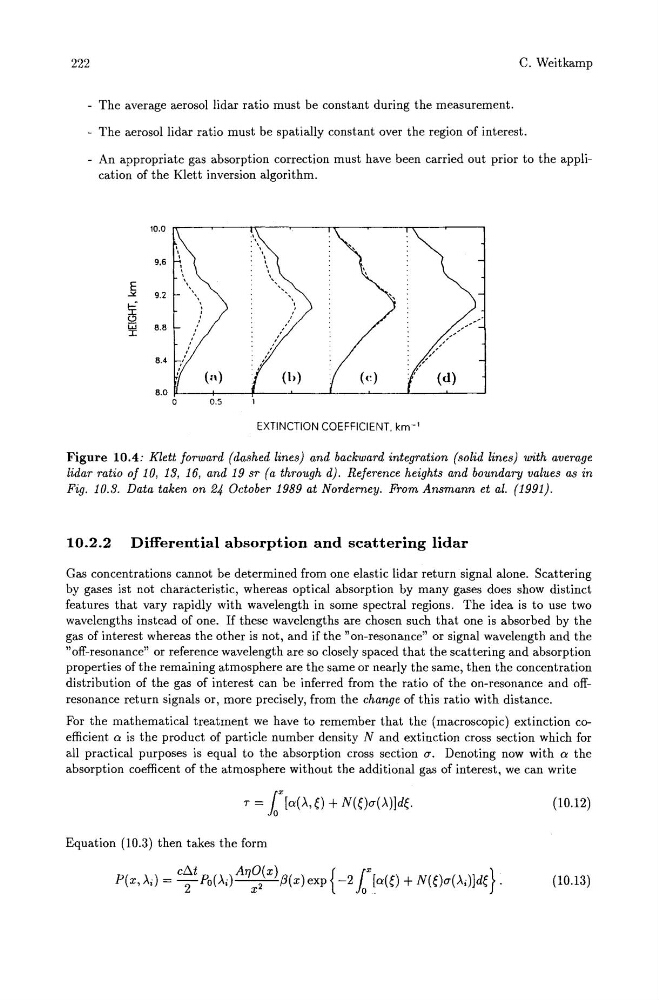
Figure 10.4: Klett forward (dashed lines) and backward integration (solid lines) with average
lidar ratio of 10, 13, 16, and 19 sr (a through d). Reference heights and boundary values as in
Fig. 10.3. Data taken on 24 October 1989 at Norderney. From Ansmann et al. (1991).
10.2.2 Differential absorption and scattering lidar
Gas concentrations cannot be determined from one elastic lidar return signal alone. Scattering
by gases ist not characteristic, whereas optical absorption by many gases does show distinct
features that vary rapidly with wavelength in some spectral regions. The idea is to use two
wavelengths instead of one. If these wavelengths are chosen such that one is absorbed by the
gas of interest whereas the other is not, and if the" on-resonance" or signal wavelength and the
"off-resonance" or reference wavelength are so closely spaced that the scattering and absorption
properties of the remaining atmosphere are the same or nearly the same, then the concentration
distribution of the gas of interest can be inferred from the ratio of the on-resonance and offresonance return signals or, more precisely, from the change of this ratio with distance.
For the mathematical treatment we have to remember that the (macroscopic) extinction coefficient n is the product of particle number density N and extinction cross section which for
all practical purposes is equal to the absorption cross section a. Denoting now with n the
absorption coefficent of the atmosphere without the additional gas of interest, we can write
(10.12)
Equation (10.3) then takes the form
ctlt
A1)O( x)
{r
}
P(X,Ai) = TPO(Ai)-x-2 -,B(x)exp -2 Jo[n(O + N(Oa(Ai)ld~ .
(10.13)
C. Weitkamp
- The average aerosol Ii dar ratio must be constant during the measurement.
- The aerosol Ii dar ratio must be spatially constant over the region of interest.
- An appropriate gas absorption correction must have been carried out prior to the application of the Klett inversion algorithm.
10.0
9.6
E
.:Y.
9.2
~
:r:
0
G:i
8.8
:r:
8.4
8.0
0
O.s
EXTINCTION COEFFICIENT. km- 1
Figure 10.4: Klett forward (dashed lines) and backward integration (solid lines) with average
lidar ratio of 10, 13, 16, and 19 sr (a through d). Reference heights and boundary values as in
Fig. 10.3. Data taken on 24 October 1989 at Norderney. From Ansmann et al. (1991).
10.2.2 Differential absorption and scattering lidar
Gas concentrations cannot be determined from one elastic lidar return signal alone. Scattering
by gases ist not characteristic, whereas optical absorption by many gases does show distinct
features that vary rapidly with wavelength in some spectral regions. The idea is to use two
wavelengths instead of one. If these wavelengths are chosen such that one is absorbed by the
gas of interest whereas the other is not, and if the" on-resonance" or signal wavelength and the
"off-resonance" or reference wavelength are so closely spaced that the scattering and absorption
properties of the remaining atmosphere are the same or nearly the same, then the concentration
distribution of the gas of interest can be inferred from the ratio of the on-resonance and offresonance return signals or, more precisely, from the change of this ratio with distance.
For the mathematical treatment we have to remember that the (macroscopic) extinction coefficient n is the product of particle number density N and extinction cross section which for
all practical purposes is equal to the absorption cross section a. Denoting now with n the
absorption coefficent of the atmosphere without the additional gas of interest, we can write
(10.12)
Equation (10.3) then takes the form
ctlt
A1)O( x)
{r
}
P(X,Ai) = TPO(Ai)-x-2 -,B(x)exp -2 Jo[n(O + N(Oa(Ai)ld~ .
(10.13)