

224
Transmitter
Receiver
Return
Pulse
Power
C. Weitkamp
iG.1LlJ~---- ,
" • .... ~, Reference
:
:
I "
I
I
, , ,
I
I
,
'"
I
I
"
', .... ~
:
:
.. ..
: 0'0 -
- - .1. - - -
--+
... -..........
Al Aa A.
.. .., ....... _-- ...
Distance
!"" l
Ratio l--------.....!...--~ . . . .
:---I ~'
Distance
concentration l, _________ ...-i '~ _ _ _ .L.' ~ _ _ _
,
L'L
Distance
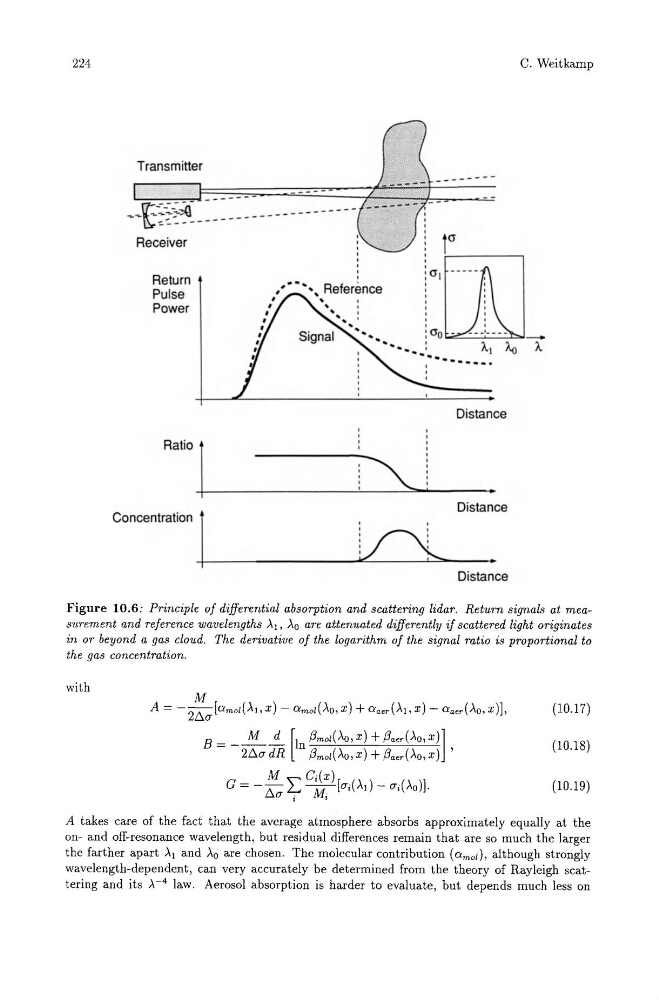
Figure 10.6: Principle of differential absorption and scattering !idar. Return signals at measurement and reference wavelengths >'1. >' 0 are attenuated differently if scattered light originates
in or beyond a gas cloud. The derivative of the logarithm of the signal ratio is proportional to
the gas concentration.
with
(10. 17)
(10.18)
(10.19)
A takes care of the fact that the average atmosphere absorbs approximately equally at the
on- and off-resonance wavelength, but residual differences remain that are so much the larger
the farther apart >' 1 and >' 0 are chosen. The molecular contribution (Qrnall, although strongly
wavelength-dependent, can very accurately be determined from the theory of Rayleigh scattering and its >.-4 law. Aerosol absorption is harder to evaluate, but depends much less on
Transmitter
Receiver
Return
Pulse
Power
C. Weitkamp
iG.1LlJ~---- ,
" • .... ~, Reference
:
:
I "
I
I
, , ,
I
I
,
'"
I
I
"
', .... ~
:
:
.. ..
: 0'0 -
- - .1. - - -
--+
... -..........
Al Aa A.
.. .., ....... _-- ...
Distance
!"" l
Ratio l--------.....!...--~ . . . .
:---I ~'
Distance
concentration l, _________ ...-i '~ _ _ _ .L.' ~ _ _ _
,
L'L
Distance
Figure 10.6: Principle of differential absorption and scattering !idar. Return signals at measurement and reference wavelengths >'1. >' 0 are attenuated differently if scattered light originates
in or beyond a gas cloud. The derivative of the logarithm of the signal ratio is proportional to
the gas concentration.
with
(10. 17)
(10.18)
(10.19)
A takes care of the fact that the average atmosphere absorbs approximately equally at the
on- and off-resonance wavelength, but residual differences remain that are so much the larger
the farther apart >' 1 and >' 0 are chosen. The molecular contribution (Qrnall, although strongly
wavelength-dependent, can very accurately be determined from the theory of Rayleigh scattering and its >.-4 law. Aerosol absorption is harder to evaluate, but depends much less on