

Properties of Clouds and Cloud Systems
203
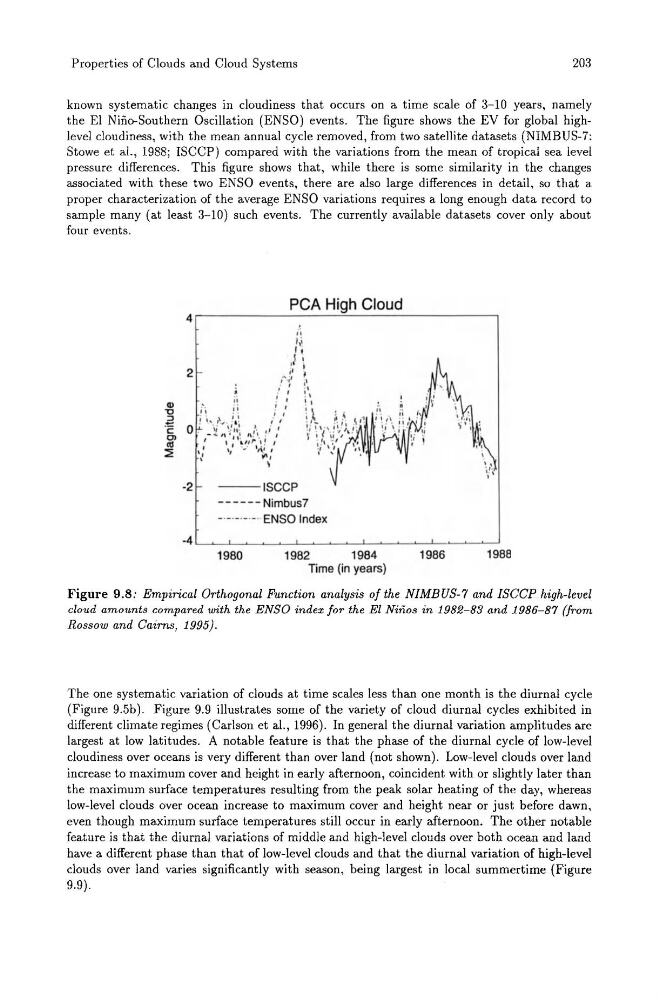
known systematic changes in cloudiness that occurs on a time scale of 3-10 years, namely
the El Nino-Southern Oscillation (ENSO) events. The figure shows the EV for global highlevel cloudiness, with the mean annual cycle removed, from two satellite datasets (NIMBUS-7:
Stowe et ai., 1988; ISCCP) compared with the variations from the mean of tropical sea level
pressure differences. This figure shows that, while there is some similarity in the changes
associated with these two ENSO events, there are also large differences in detail, so that a
proper characterization of the average ENSO variations requires a long enough data record to
sample many (at least 3-10) such events. The currently available datasets cover only about
four events.
PCA High Cloud
4 r---------------~~----------------,
2
QI
"C
.2
·c 0
Cl
-2
- - ISCCP
------Nimbus7
·ENSO Index
1980
1982
1984
1986
1988
TIme (in years)
Figure 9.8: Empirical Orthogonal Function analysis o/the NIMBUS-7 and ISCCP.high-level
cloud amounts compared with the ENSO index for the El Niiios in 1982-83 and 1986-87 (from
Rossow and Cairns, 1995).
The one systematic variation of clouds at time scales less than one month is the diurnal cycle
(Figure 9.5b). Figure 9.9 illustrates some of the variety of cloud diurnal cycles exhibited in
different climate regimes (Carlson et ai., 1996). In general the diurnal variation amplitudes are
largest at low latitudes. A notable feature is that the phase of the diurnal cycle of low-level
cloudiness over oceans is very different than over land (not shown). Low-level clouds over land
increase to maximum cover and height in early afternoon, coincident with or slightly later than
the maximum surface temperatures resulting from the peak solar heating of the day, whereas
low-level clouds over ocean increase to maximum cover and height near or just before dawn,
even though maximum surface temperatures still occur in early afternoon. The other notable
feature is that the diurnal variations of middle and high-level clouds over both ocean and land
have a different phase than that of low-level clouds and that the diurnal variation of high-level
clouds over land varies significantly with season, being largest in local summertime (Figure
9.9).
203
known systematic changes in cloudiness that occurs on a time scale of 3-10 years, namely
the El Nino-Southern Oscillation (ENSO) events. The figure shows the EV for global highlevel cloudiness, with the mean annual cycle removed, from two satellite datasets (NIMBUS-7:
Stowe et ai., 1988; ISCCP) compared with the variations from the mean of tropical sea level
pressure differences. This figure shows that, while there is some similarity in the changes
associated with these two ENSO events, there are also large differences in detail, so that a
proper characterization of the average ENSO variations requires a long enough data record to
sample many (at least 3-10) such events. The currently available datasets cover only about
four events.
PCA High Cloud
4 r---------------~~----------------,
2
QI
"C
.2
·c 0
Cl
-2
- - ISCCP
------Nimbus7
·ENSO Index
1980
1982
1984
1986
1988
TIme (in years)
Figure 9.8: Empirical Orthogonal Function analysis o/the NIMBUS-7 and ISCCP.high-level
cloud amounts compared with the ENSO index for the El Niiios in 1982-83 and 1986-87 (from
Rossow and Cairns, 1995).
The one systematic variation of clouds at time scales less than one month is the diurnal cycle
(Figure 9.5b). Figure 9.9 illustrates some of the variety of cloud diurnal cycles exhibited in
different climate regimes (Carlson et ai., 1996). In general the diurnal variation amplitudes are
largest at low latitudes. A notable feature is that the phase of the diurnal cycle of low-level
cloudiness over oceans is very different than over land (not shown). Low-level clouds over land
increase to maximum cover and height in early afternoon, coincident with or slightly later than
the maximum surface temperatures resulting from the peak solar heating of the day, whereas
low-level clouds over ocean increase to maximum cover and height near or just before dawn,
even though maximum surface temperatures still occur in early afternoon. The other notable
feature is that the diurnal variations of middle and high-level clouds over both ocean and land
have a different phase than that of low-level clouds and that the diurnal variation of high-level
clouds over land varies significantly with season, being largest in local summertime (Figure
9.9).