

202
W.E. Rossow
ISCCP Monthly Mean Cloud Amount
% Variance 71. 47
. .
, ~
.,
110
t
-"
.2
. 1
l . .
~ -.1
[ -.2
~ - .3
" -. .
-., 03 •• •• • • .., •• • • . . .1
,0
% Variance 1081
90
"
j .3
i
...
, 1
6 , .
~ -. 1
&. -"
5 - .J
-"
- ·'03 B< ~ 611 . , .. eo .. 0 1
. .
% Variance 2,91
. .
"
t
,3
"
k
, 1
,0
~ - _1
1--2
~ - .3
- "
-., 03 ., ••
611
.'
e • •• .., O!
. .
% Variance 153
. .
. .
~
.3
, .
i .1
11 ,0
~ - . 1
:'-2
~ - .3
-.,
-.,
••
N
., .. ., •• •• ""
0 1
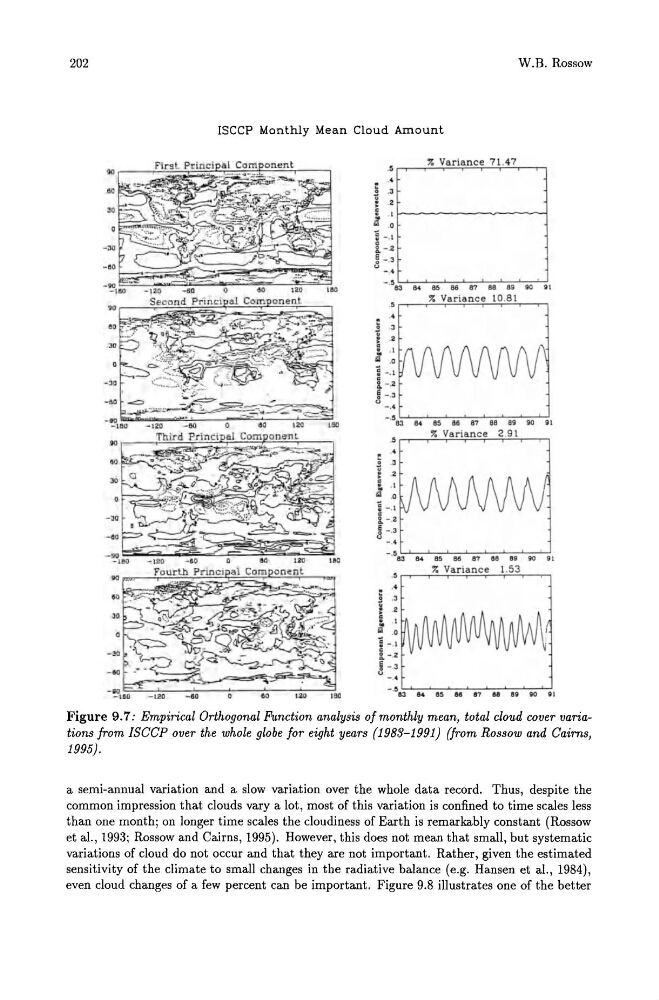
Figure 9.7: Empirical Orthogonal Function analysis of monthly mean, total cloud cover variations from [SCCP over the whole globe for eight years (1983-1991) (from Rossow and Cairns,
1995).
a semi-annual variation and a slow variation over the whole data record. Thus, despite the
common impression that clouds vary a lot, most of this variation is confined to time scales less
than one month; on longer time scales the cloudiness of Earth is remarkably constant (Rossow
et at., 1993; Rossow and Cairns, 1995). However, this does not mean that small, but systematic
variations of cloud do not occur and that they are not important . Rather, given the estimated
sensitivity of the climate to small changes in the radiative balance (e.g. Hansen et al., 1984),
even cloud changes of a few percent can be important . Figure 9.8 illustrates one of the better
W.E. Rossow
ISCCP Monthly Mean Cloud Amount
% Variance 71. 47
. .
, ~
.,
110
t
-"
.2
. 1
l . .
~ -.1
[ -.2
~ - .3
" -. .
-., 03 •• •• • • .., •• • • . . .1
,0
% Variance 1081
90
"
j .3
i
...
, 1
6 , .
~ -. 1
&. -"
5 - .J
-"
- ·'03 B< ~ 611 . , .. eo .. 0 1
. .
% Variance 2,91
. .
"
t
,3
"
k
, 1
,0
~ - _1
1--2
~ - .3
- "
-., 03 ., ••
611
.'
e • •• .., O!
. .
% Variance 153
. .
. .
~
.3
, .
i .1
11 ,0
~ - . 1
:'-2
~ - .3
-.,
-.,
••
N
., .. ., •• •• ""
0 1
Figure 9.7: Empirical Orthogonal Function analysis of monthly mean, total cloud cover variations from [SCCP over the whole globe for eight years (1983-1991) (from Rossow and Cairns,
1995).
a semi-annual variation and a slow variation over the whole data record. Thus, despite the
common impression that clouds vary a lot, most of this variation is confined to time scales less
than one month; on longer time scales the cloudiness of Earth is remarkably constant (Rossow
et at., 1993; Rossow and Cairns, 1995). However, this does not mean that small, but systematic
variations of cloud do not occur and that they are not important . Rather, given the estimated
sensitivity of the climate to small changes in the radiative balance (e.g. Hansen et al., 1984),
even cloud changes of a few percent can be important . Figure 9.8 illustrates one of the better