

Properties of Clouds and Cloud Systems
201
TOGAICOARE GMS-4 Average Row FFT
8,-------------------------------------------------~
--l-hour
--3-hour
---24-hour
7
--72-hour
--240-hour
3
21--------.-------.-------.r-------r-------,-------~
le-06
le-05
le-04
le-03
le-02
le-Ol
le+
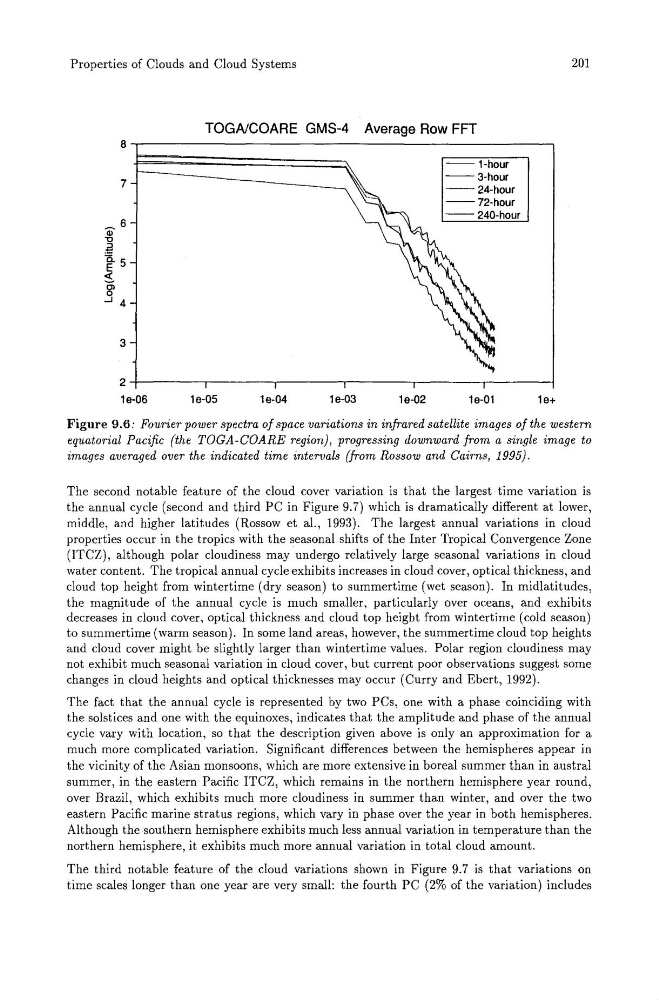
Figure 9_6: Fourier power spectra of space variations in infrared satellite images of the western
equatorial Pacific (the TOGA-COARE region), progressing downward from a single image to
images averaged over the indicated time intervals (from Rossow and Cairns, 1995).
The second notable feature of the cloud cover variation is that the largest time variation is
the annual cycle (second and third PC in Figure 9.7) which is dramatically different at lower,
middle, and higher latitudes (Rossow et al., 1993). The largest annual variations in cloud
properties occur in the tropics with the seasonal shifts of the Inter Tropical Convergence Zone
(ITCZ), although polar cloudiness may undergo relatively large seasonal variations in cloud
water content. The tropical annual cycle exhibits increases in cloud cover, optical thickness, and
cloud top height from wintertime (dry season) to summertime (wet season). In midlatitudes,
the magnitude of the annual cycle is much smaller, particularly over oceans, and exhibits
decreases in cloud cover, optical thickness and cloud top height from wintertime (cold season)
to summertime (warm season). In some land areas, however, the summertime cloud top heights
and cloud cover might be slightly larger than wintertime values. Polar region cloudiness may
not exhibit much seasonal variation in cloud cover, but current poor observations suggest some
changes in cloud heights and optical thicknesses may occur (Curry and Ebert, 1992).
The fact that the annual cycle is represented by two PCs, one with a phase coinciding with
the solstices and one with the equinoxes, indicates that the amplitude and phase of the annual
cycle vary with location, so that the description given above is only an approximation for a
much more complicated variation. Significant differences between the hemispheres appear in
the vicinity of the Asian monsoons, which are more extensive in boreal summer than in austral
summer, in the eastern Pacific ITCZ, which remains in the northern hemisphere year round,
over Brazil, which exhibits much more cloudiness in summer than winter, and over the two
eastern Pacific marine stratus regions, which vary in phase over the year in both hemispheres.
Although the southern hemisphere exhibits much less annual variation in temperature than the
northern hemisphere, it exhibits much more annual variation in total cloud amount.
The third notable feature of the cloud variations shown in Figure 9.7 is that variations on
time scales longer than one year are very small: the fourth PC (2% of the variation) includes
201
TOGAICOARE GMS-4 Average Row FFT
8,-------------------------------------------------~
--l-hour
--3-hour
---24-hour
7
--72-hour
--240-hour
3
21--------.-------.-------.r-------r-------,-------~
le-06
le-05
le-04
le-03
le-02
le-Ol
le+
Figure 9_6: Fourier power spectra of space variations in infrared satellite images of the western
equatorial Pacific (the TOGA-COARE region), progressing downward from a single image to
images averaged over the indicated time intervals (from Rossow and Cairns, 1995).
The second notable feature of the cloud cover variation is that the largest time variation is
the annual cycle (second and third PC in Figure 9.7) which is dramatically different at lower,
middle, and higher latitudes (Rossow et al., 1993). The largest annual variations in cloud
properties occur in the tropics with the seasonal shifts of the Inter Tropical Convergence Zone
(ITCZ), although polar cloudiness may undergo relatively large seasonal variations in cloud
water content. The tropical annual cycle exhibits increases in cloud cover, optical thickness, and
cloud top height from wintertime (dry season) to summertime (wet season). In midlatitudes,
the magnitude of the annual cycle is much smaller, particularly over oceans, and exhibits
decreases in cloud cover, optical thickness and cloud top height from wintertime (cold season)
to summertime (warm season). In some land areas, however, the summertime cloud top heights
and cloud cover might be slightly larger than wintertime values. Polar region cloudiness may
not exhibit much seasonal variation in cloud cover, but current poor observations suggest some
changes in cloud heights and optical thicknesses may occur (Curry and Ebert, 1992).
The fact that the annual cycle is represented by two PCs, one with a phase coinciding with
the solstices and one with the equinoxes, indicates that the amplitude and phase of the annual
cycle vary with location, so that the description given above is only an approximation for a
much more complicated variation. Significant differences between the hemispheres appear in
the vicinity of the Asian monsoons, which are more extensive in boreal summer than in austral
summer, in the eastern Pacific ITCZ, which remains in the northern hemisphere year round,
over Brazil, which exhibits much more cloudiness in summer than winter, and over the two
eastern Pacific marine stratus regions, which vary in phase over the year in both hemispheres.
Although the southern hemisphere exhibits much less annual variation in temperature than the
northern hemisphere, it exhibits much more annual variation in total cloud amount.
The third notable feature of the cloud variations shown in Figure 9.7 is that variations on
time scales longer than one year are very small: the fourth PC (2% of the variation) includes