

Clouds and the Radiative Heating .. .
~ ~-------------------------.
~lu" 0100,,(1 t.:Ip. (Ma-lOOOhPa)
==:tat c.:=d ~:. (tltito-:..':~O~, •• ~
~ ,
i
i.
i
I:
r--;'
I;
~ :
I ~
L-------~--L ---I T
:
,
:
I
:
I
c_~.~~-~3~-~2~~-~I~O~~I~~2~~3~
LW-CGRH in K/Day
~,--------------------------------------,
o
N
= low cloud lops (650-1000bPa)
~ mid cloud lop. (450 - 650hPa)
~ hilh cloud top. (150-450bPa)
IF,
I:
I:
I:
I:
r:
01nrrrrrrrrrrrrrrmmnmnrrrlerrrrrrrrm~~TIITTIITrrrrrrrrmmmm~
-4
-3
- 2
- 1
0
1
2
3
4
NET-CGRH in K/Day
169
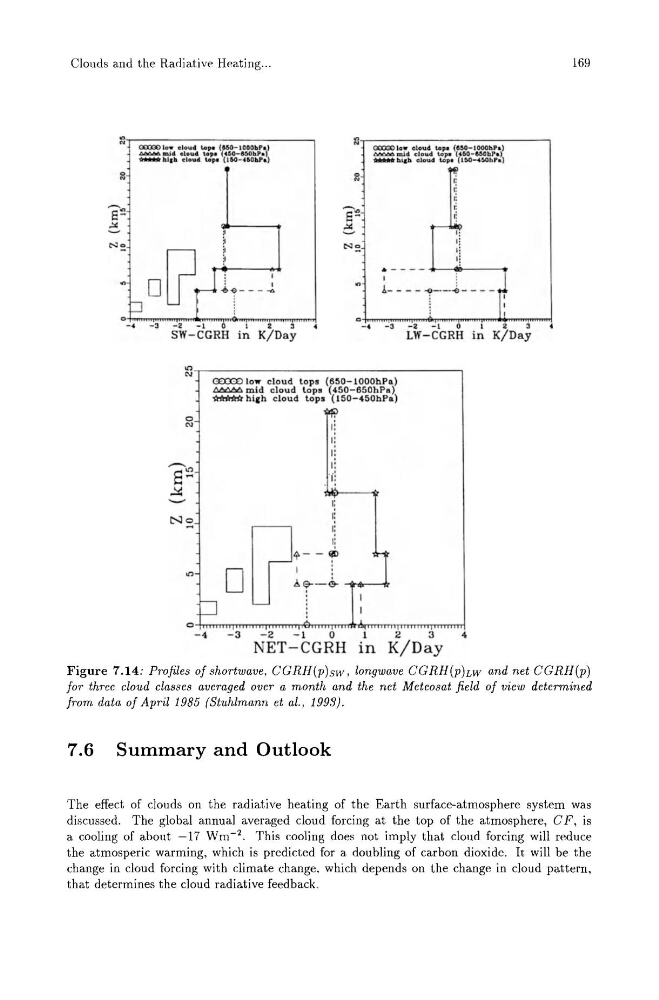
Figure 7.14: Profiles of shortwave, CGRH(p)sw, longwave CGRH(p)LW and net CGRH(p)
for three cloud classes averaged over a month and the net Meteosat field of view determined
from data of April 1985 (Stuhlmann et al., 1998).
7.6 Summary and Outlook
The effect of clouds on the radiative heating of the Earth surface-atmosphere system was
discussed. The global annual averaged cloud forcing at the top of the atmosphere, C F, is
a cooling of about -17 Wm- 2 . This cooling does not imply that cloud forcing will reduce
the atmosperic warming, which is predicted for a doubling of carbon dioxide. It will be the
change in cloud forcing with climate change. which depends on the change in cloud pattern,
that determines the cloud radiative feedback.
~ ~-------------------------.
~lu" 0100,,(1 t.:Ip. (Ma-lOOOhPa)
==:tat c.:=d ~:. (tltito-:..':~O~, •• ~
~ ,
i
i.
i
I:
r--;'
I;
~ :
I ~
L-------~--L ---I T
:
,
:
I
:
I
c_~.~~-~3~-~2~~-~I~O~~I~~2~~3~
LW-CGRH in K/Day
~,--------------------------------------,
o
N
= low cloud lops (650-1000bPa)
~ mid cloud lop. (450 - 650hPa)
~ hilh cloud top. (150-450bPa)
IF,
I:
I:
I:
I:
r:
01nrrrrrrrrrrrrrrmmnmnrrrlerrrrrrrrm~~TIITTIITrrrrrrrrmmmm~
-4
-3
- 2
- 1
0
1
2
3
4
NET-CGRH in K/Day
169
Figure 7.14: Profiles of shortwave, CGRH(p)sw, longwave CGRH(p)LW and net CGRH(p)
for three cloud classes averaged over a month and the net Meteosat field of view determined
from data of April 1985 (Stuhlmann et al., 1998).
7.6 Summary and Outlook
The effect of clouds on the radiative heating of the Earth surface-atmosphere system was
discussed. The global annual averaged cloud forcing at the top of the atmosphere, C F, is
a cooling of about -17 Wm- 2 . This cooling does not imply that cloud forcing will reduce
the atmosperic warming, which is predicted for a doubling of carbon dioxide. It will be the
change in cloud forcing with climate change. which depends on the change in cloud pattern,
that determines the cloud radiative feedback.