

168
R. Stuhlmann
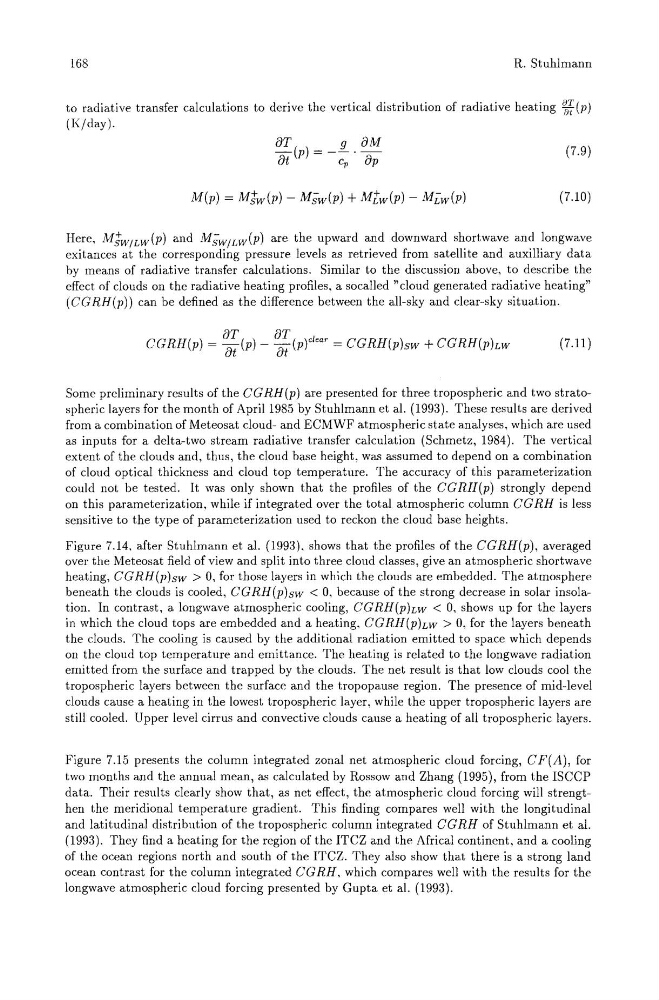
to radiative transfer calculations to derive the vertical distribution of radiative heating ~~ (p)
(Kjday).
oT
9 oM
- ( p ) = - - . -
ot
cp op
(7.9)
(7.10)
Here. Mtw/Lw(p) and Msw/Lw(p) are the upward and downward shortwave and longwave
exitances at the corresponding pressure levels as retrieved from satellite and auxilliary data
by means of radiative transfer calculations. Similar to the discussion above. to describe the
effect of clouds on the radiative heating profiles. a socalled "cloud generated radiative heating"
(CGRH(p)) can be defined as the difference between the all-sky and clear-sky situation.
CGRH(p) = ~~ (p) - ~~ (p)clear = CGRH(p)sw + CGRH(p)LW
(7.11)
Some preliminary results of the CGRH(p) are presented for three tropospheric and two stratospheric layers for the month of April 1985 by Stuhlmann et al. (1993). These results are derived
from a combination of Meteosat cloud- and ECMWF atmospheric state analyses. which are used
as inputs for a delta-two stream radiative transfer calculation (Schmetz, 1984). The vertical
extent of the clouds and. thus, the cloud base height, was assumed to depend on a combination
of cloud optical thickness and cloud top temperature. The accuracy of this parameterization
could not be tested. It was only shown that the profiles of the CGRH(p) strongly depend
on this parameterization. while if integrated over the total atmospheric column CG RH is less
sensitive to the type of parameterization used to reckon the cloud base heights.
Figure 7.14. after Stuhlmann et al. (1993). shows that the profiles of the CGRH(p), averaged
over the Meteosat field of view and split into three cloud classes, give an atmospheric shortwave
heating. CGRH(p)sw > O. for those layers in which the clouds are embedded. The atmosphere
beneath the clouds is cooled, CGRH(p)sw < 0, because of the strong decrease in solar insolation. In contrast, a longwave atmospheric cooling, CGRH(p)LW < O. shows up for the layers
in which the cloud tops are embedded and a heating. CGRH(p)LW > 0, for the layers beneath
the clouds. The cooling is caused by the additional radiation emitted to space which depends
on the cloud top temperature and emittance. The heating is related to the longwave radiation
emitted from the surface and trapped by the clouds. The net result is that low clouds cool the
tropospheric layers between the surface and the tropopause region. The presence of mid-level
clouds cause a heating in the lowest tropospheric layer, while the upper tropospheric layers are
still cooled. Upper level cirrus and convective clouds cause a heating of all tropospheric layers.
Figure 7.15 presents the column integrated zonal net atmospheric cloud forcing, CF(A), for
two months and the annual mean, as calculated by Rossow and Zhang (1995), from the ISCCP
data. Their results clearly show that, as net effect, the atmospheric cloud forcing will strengthen the meridional temperature gradient. This finding compares well with the longitudinal
and latitudinal distribution of the tropospheric column integrated CG RH of Stuhlmann et al.
(1993). They find a heating for the region of the ITCZ and the Africal continent, and a cooling
of the ocean regions north and south of the ITCZ. They also show that there is a strong land
ocean contrast for the column integrated CGRH. which compares well with the results for the
longwave atmospheric cloud forcing presented by Gupta et al. (1993).
R. Stuhlmann
to radiative transfer calculations to derive the vertical distribution of radiative heating ~~ (p)
(Kjday).
oT
9 oM
- ( p ) = - - . -
ot
cp op
(7.9)
(7.10)
Here. Mtw/Lw(p) and Msw/Lw(p) are the upward and downward shortwave and longwave
exitances at the corresponding pressure levels as retrieved from satellite and auxilliary data
by means of radiative transfer calculations. Similar to the discussion above. to describe the
effect of clouds on the radiative heating profiles. a socalled "cloud generated radiative heating"
(CGRH(p)) can be defined as the difference between the all-sky and clear-sky situation.
CGRH(p) = ~~ (p) - ~~ (p)clear = CGRH(p)sw + CGRH(p)LW
(7.11)
Some preliminary results of the CGRH(p) are presented for three tropospheric and two stratospheric layers for the month of April 1985 by Stuhlmann et al. (1993). These results are derived
from a combination of Meteosat cloud- and ECMWF atmospheric state analyses. which are used
as inputs for a delta-two stream radiative transfer calculation (Schmetz, 1984). The vertical
extent of the clouds and. thus, the cloud base height, was assumed to depend on a combination
of cloud optical thickness and cloud top temperature. The accuracy of this parameterization
could not be tested. It was only shown that the profiles of the CGRH(p) strongly depend
on this parameterization. while if integrated over the total atmospheric column CG RH is less
sensitive to the type of parameterization used to reckon the cloud base heights.
Figure 7.14. after Stuhlmann et al. (1993). shows that the profiles of the CGRH(p), averaged
over the Meteosat field of view and split into three cloud classes, give an atmospheric shortwave
heating. CGRH(p)sw > O. for those layers in which the clouds are embedded. The atmosphere
beneath the clouds is cooled, CGRH(p)sw < 0, because of the strong decrease in solar insolation. In contrast, a longwave atmospheric cooling, CGRH(p)LW < O. shows up for the layers
in which the cloud tops are embedded and a heating. CGRH(p)LW > 0, for the layers beneath
the clouds. The cooling is caused by the additional radiation emitted to space which depends
on the cloud top temperature and emittance. The heating is related to the longwave radiation
emitted from the surface and trapped by the clouds. The net result is that low clouds cool the
tropospheric layers between the surface and the tropopause region. The presence of mid-level
clouds cause a heating in the lowest tropospheric layer, while the upper tropospheric layers are
still cooled. Upper level cirrus and convective clouds cause a heating of all tropospheric layers.
Figure 7.15 presents the column integrated zonal net atmospheric cloud forcing, CF(A), for
two months and the annual mean, as calculated by Rossow and Zhang (1995), from the ISCCP
data. Their results clearly show that, as net effect, the atmospheric cloud forcing will strengthen the meridional temperature gradient. This finding compares well with the longitudinal
and latitudinal distribution of the tropospheric column integrated CG RH of Stuhlmann et al.
(1993). They find a heating for the region of the ITCZ and the Africal continent, and a cooling
of the ocean regions north and south of the ITCZ. They also show that there is a strong land
ocean contrast for the column integrated CGRH. which compares well with the results for the
longwave atmospheric cloud forcing presented by Gupta et al. (1993).