

170
R Stuhlmann
FCfl '}RI. IOASt£Dl. vU.Y (THICK) AN> NUJAL (LIGHT sa..1D)
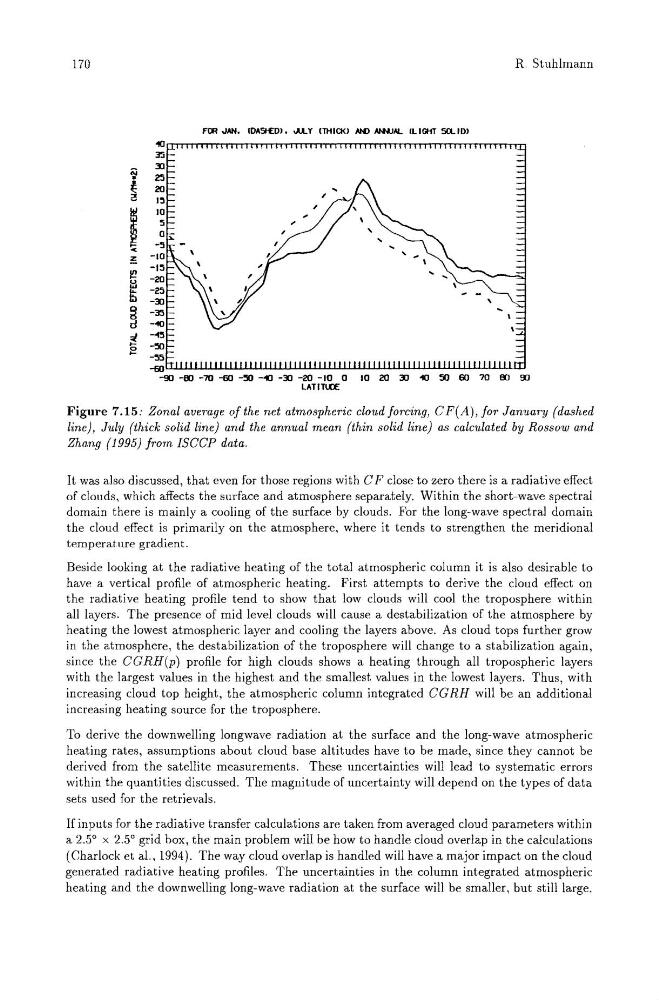
Figure 7.15: Zonal average of the net atmospheric cloud forcing, C F(A), for January (dashed
line), July (thick solid line) and the annual mean (thin solid line) as calculated by Rossow and
Zhang (1995) from ISCCP data.
It was also discussed, that even for those regions with C F close to zero there is a radiative effect
of clouds, which affects the surface and atmosphere separately. Within the short-wave spectral
domain there is mainly a cooling of the surface by clouds. For the long-wave spectral domain
the cloud effect is primarily on the atmosphere, where it tends to strengthen the meridional
temperature gradient.
Beside looking at the radiative heating of the total atmospheric column it is also desirable to
have a vertical profile of atmospheric heating. First attempts to derive the cloud effect on
the radiative heating profile tend to show that low clouds will cool the troposphere within
all layers. The presence of mid level clouds will cause a destabilization of the atmosphere by
heating the lowest atmospheric layer and cooling the layers above. As cloud tops further grow
in the atmosphere, the destabilization of the troposphere will change to a stabilization again,
since the CGRH(p) profile for high clouds shows a heating through all tropospheric layers
with the largest values in the highest and the smallest values in the lowest layers. Thus, with
increasing cloud top height, the atmospheric column integrated CGRH will be an additional
increasing heating source for the troposphere.
To derive the downwelling longwave radiation at the surface and the long-wave atmospheric
heating rates, assumptions about cloud base altitudes have to be made, since they cannot be
derived from the satellite measurements. These uncertainties will lead to systematic errors
within the quantities discussed. The magnitude of uncertainty will depend on the types of data
sets used for the retrievals.
If inputs for the radiative transfer calculations are taken from averaged cloud parameters within
a 2.5 0 x 2.5 0 grid box, the main problem will be how to handle cloud overlap in the calculations
(eharlock et al., 1994). The way cloud overlap is handled will have a major impact on the cloud
generated radiative heating profiles. The uncertainties in the column integrated atmospheric
heating and the downwelling long-wave radiation at the surface will be smaller, but still large.
R Stuhlmann
FCfl '}RI. IOASt£Dl. vU.Y (THICK) AN> NUJAL (LIGHT sa..1D)
Figure 7.15: Zonal average of the net atmospheric cloud forcing, C F(A), for January (dashed
line), July (thick solid line) and the annual mean (thin solid line) as calculated by Rossow and
Zhang (1995) from ISCCP data.
It was also discussed, that even for those regions with C F close to zero there is a radiative effect
of clouds, which affects the surface and atmosphere separately. Within the short-wave spectral
domain there is mainly a cooling of the surface by clouds. For the long-wave spectral domain
the cloud effect is primarily on the atmosphere, where it tends to strengthen the meridional
temperature gradient.
Beside looking at the radiative heating of the total atmospheric column it is also desirable to
have a vertical profile of atmospheric heating. First attempts to derive the cloud effect on
the radiative heating profile tend to show that low clouds will cool the troposphere within
all layers. The presence of mid level clouds will cause a destabilization of the atmosphere by
heating the lowest atmospheric layer and cooling the layers above. As cloud tops further grow
in the atmosphere, the destabilization of the troposphere will change to a stabilization again,
since the CGRH(p) profile for high clouds shows a heating through all tropospheric layers
with the largest values in the highest and the smallest values in the lowest layers. Thus, with
increasing cloud top height, the atmospheric column integrated CGRH will be an additional
increasing heating source for the troposphere.
To derive the downwelling longwave radiation at the surface and the long-wave atmospheric
heating rates, assumptions about cloud base altitudes have to be made, since they cannot be
derived from the satellite measurements. These uncertainties will lead to systematic errors
within the quantities discussed. The magnitude of uncertainty will depend on the types of data
sets used for the retrievals.
If inputs for the radiative transfer calculations are taken from averaged cloud parameters within
a 2.5 0 x 2.5 0 grid box, the main problem will be how to handle cloud overlap in the calculations
(eharlock et al., 1994). The way cloud overlap is handled will have a major impact on the cloud
generated radiative heating profiles. The uncertainties in the column integrated atmospheric
heating and the downwelling long-wave radiation at the surface will be smaller, but still large.