

Extratropical Cyclones: Their Mesoscale Structure, ...
141
4 ~··--------··--·---+--------·---···--·-------1---------.-.. ------~--------------.----.---~-------~
o
5
10
15
20
Range (km)
- 5
o
5
10
15
20
25
Reflectivity Factor (d8Z)
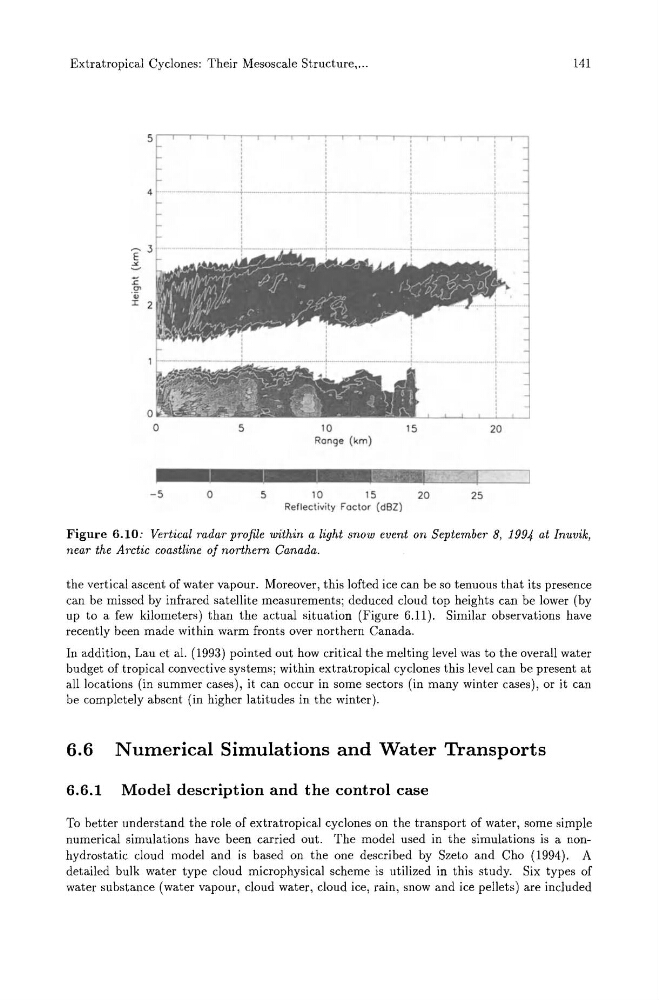
Figure 6.10: Vertical radar profile within a light snow event on September 8, 1994 at Inuvik,
near the Arctic coastline of northern Canada.
the vertical ascent of water vapour. Moreover, this lofted ice can be so tenuous that its presence
can be missed by infrared satellite measurements; deduced cloud top heights can be lower (by
up to a few kilometers) than the actual situation (Figure 6.11). Similar observations have
recently been made within warm fronts over northern Canada.
In addition, Lau et al. (1993) pointed out how critical the melting level was to the overall water
budget of tropical convective systems; within extratropical cyclones this level can be present at
all locations (in summer cases), it can occur in some sectors (in many winter cases), or it can
be completely absent (in higher latitudes in the winter).
6.6 Numerical Simulations and Water Transports
6.6.1 Model description and the control case
To better understand the role of extratropical cyclones on the transport of water, some simple
numerical simulations have been carried out. The model used in the simulations is a nonhydrostatic cloud model and is based on the one described by Szeto and Cho (1994) . A
detailed bulk water type cloud microphysical scheme is utilized in this study. Six types of
water substance (water vapour, cloud water, cloud ice, rain, snow and ice pellets) are included
141
4 ~··--------··--·---+--------·---···--·-------1---------.-.. ------~--------------.----.---~-------~
o
5
10
15
20
Range (km)
- 5
o
5
10
15
20
25
Reflectivity Factor (d8Z)
Figure 6.10: Vertical radar profile within a light snow event on September 8, 1994 at Inuvik,
near the Arctic coastline of northern Canada.
the vertical ascent of water vapour. Moreover, this lofted ice can be so tenuous that its presence
can be missed by infrared satellite measurements; deduced cloud top heights can be lower (by
up to a few kilometers) than the actual situation (Figure 6.11). Similar observations have
recently been made within warm fronts over northern Canada.
In addition, Lau et al. (1993) pointed out how critical the melting level was to the overall water
budget of tropical convective systems; within extratropical cyclones this level can be present at
all locations (in summer cases), it can occur in some sectors (in many winter cases), or it can
be completely absent (in higher latitudes in the winter).
6.6 Numerical Simulations and Water Transports
6.6.1 Model description and the control case
To better understand the role of extratropical cyclones on the transport of water, some simple
numerical simulations have been carried out. The model used in the simulations is a nonhydrostatic cloud model and is based on the one described by Szeto and Cho (1994) . A
detailed bulk water type cloud microphysical scheme is utilized in this study. Six types of
water substance (water vapour, cloud water, cloud ice, rain, snow and ice pellets) are included