

140
UJ
a:
:::l
en
en
UJ
a:
c..
Ronald E. Stewart
DISTA NCE (KM)
400.-__ -_4rOO __ -r_-_2rO_O __ .-~O--_.~~_,,_~
PACIFIC STANDARD T IME
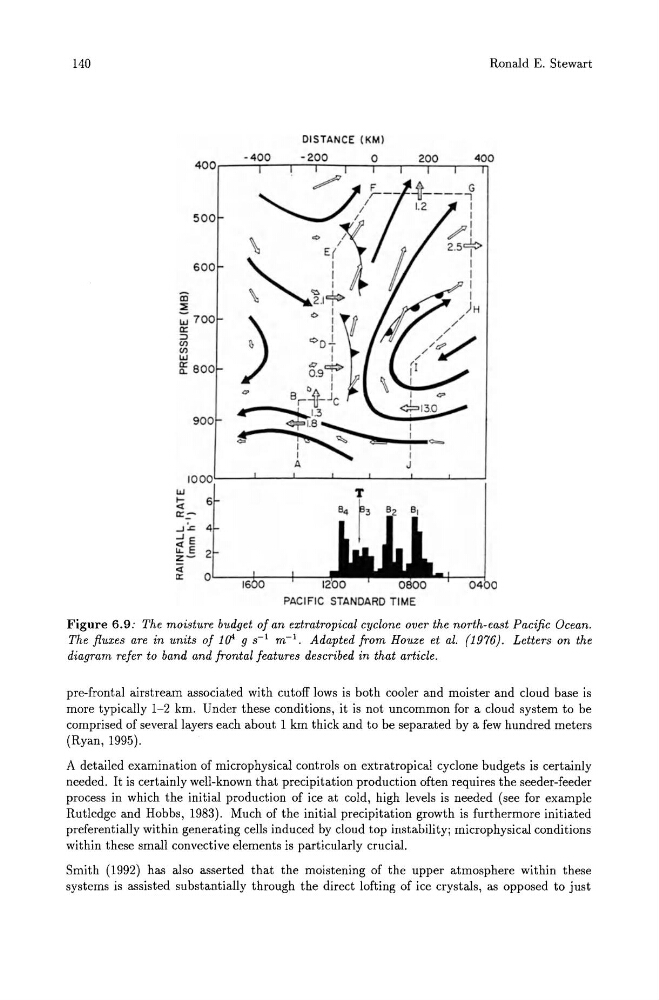
Figure 6.9: The moisture budget of an extratropical cyclone over the north-east Pacific Ocean.
The fluxes are in units of 1rr g S-1 m- l . Adapted from Houze et al. (1976). Letters on the
diagram refer to band and frontal features described in that article.
pre-frontal airstream associated with cutoff lows is both cooler and moister and cloud base is
more typically 1-2 km. Under these conditions, it is not uncommon for a cloud system to be
comprised of several layers each about 1 km thick and to be separated by a few hundred meters
(Ryan, 1995).
A detailed examination of microphysical controls on extratropical cyclone budgets is certainly
needed. It is certainly well-known that precipitation production often requires the seeder-feeder
process in which the initial production of ice at cold, high levels is needed (see for example
Rutledge and Hobbs, 1983). Much of the initial precipitation growth is furthermore initiated
preferentially within generating cells induced by cloud top instability; microphysical conditions
within these small convective elements is particularly crucial.
Smith (1992) has also asserted that the moistening of the upper atmosphere within these
systems is assisted substantially through the direct lofting of ice crystals, as opposed to just
UJ
a:
:::l
en
en
UJ
a:
c..
Ronald E. Stewart
DISTA NCE (KM)
400.-__ -_4rOO __ -r_-_2rO_O __ .-~O--_.~~_,,_~
PACIFIC STANDARD T IME
Figure 6.9: The moisture budget of an extratropical cyclone over the north-east Pacific Ocean.
The fluxes are in units of 1rr g S-1 m- l . Adapted from Houze et al. (1976). Letters on the
diagram refer to band and frontal features described in that article.
pre-frontal airstream associated with cutoff lows is both cooler and moister and cloud base is
more typically 1-2 km. Under these conditions, it is not uncommon for a cloud system to be
comprised of several layers each about 1 km thick and to be separated by a few hundred meters
(Ryan, 1995).
A detailed examination of microphysical controls on extratropical cyclone budgets is certainly
needed. It is certainly well-known that precipitation production often requires the seeder-feeder
process in which the initial production of ice at cold, high levels is needed (see for example
Rutledge and Hobbs, 1983). Much of the initial precipitation growth is furthermore initiated
preferentially within generating cells induced by cloud top instability; microphysical conditions
within these small convective elements is particularly crucial.
Smith (1992) has also asserted that the moistening of the upper atmosphere within these
systems is assisted substantially through the direct lofting of ice crystals, as opposed to just