

Extratropical Cyclones: Their Mesoscale Structure, ...
<..
....
f/)
cr
200
180
160
I
140
I
120
100
80
60
40
20
o o
I
J
.3
4
5
6
Prec;p;tat;on Rate (mm/h)
G--ElT. ec
+--+T_ -sc
~T __ 1C111C
)+--?(T __ ISC
<)---(> Ta_aec:
I!r--f:l, T--2se
-
T--3ec
8
9
139
10
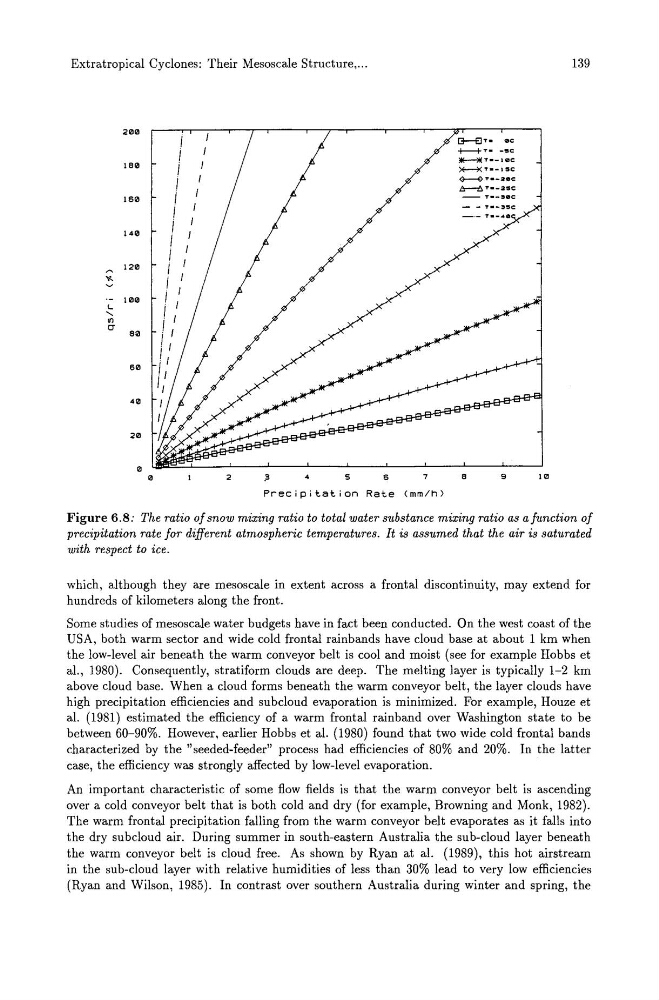
Figure 6.8: The ratio of snow mixing ratio to total water substance mixing ratio as a function of
precipitation rate for different atmospheric temperatures. It is assumed that the air is saturated
with respect to ice.
which, although they are mesoscale in extent across a frontal discontinuity, may extend for
hundreds of kilometers along the front.
Some studies of mesoscale water budgets have in fact been conducted. On the west coast of the
USA, both warm sector and wide cold frontal rainbands have cloud base at about 1 km when
the low-level air beneath the warm conveyor belt is cool and moist (see for example Hobbs et
al., 1980). Consequently, stratiform clouds are deep. The melting layer is typically 1-2 km
above cloud base. When a cloud forms beneath the warm conveyor belt, the layer clouds have
high precipitation efficiencies and subcloud evaporation is minimized. For example, Houze et
al. (1981) estimated the efficiency of a warm frontal rainband over Washington state to be
between 60-90%. However, earlier Hobbs et al. (1980) found that two wide cold frontal bands
characterized by the "seeded-feeder" process had efficiencies of 80% and 20%. In the latter
case, the efficiency was strongly affected by low-level evaporation.
An important characteristic of some flow fields is that the warm conveyor belt is ascending
over a cold conveyor belt that is both cold and dry (for example, Browning and Monk, 1982).
The warm frontal precipitation falling from the warm conveyor belt evaporates as it falls into
the dry subcloud air. During summer in south-eastern Australia the sub-cloud layer beneath
the warm conveyor belt is cloud free. As shown by Ryan at al. (1989), this hot airstream
in the sub-cloud layer with relative humidities of less than 30% lead to very low efficiencies
(Ryan and Wilson, 1985). In contrast over southern Australia during winter and spring, the
<..
....
f/)
cr
200
180
160
I
140
I
120
100
80
60
40
20
o o
I
J
.3
4
5
6
Prec;p;tat;on Rate (mm/h)
G--ElT. ec
+--+T_ -sc
~T __ 1C111C
)+--?(T __ ISC
<)---(> Ta_aec:
I!r--f:l, T--2se
-
T--3ec
8
9
139
10
Figure 6.8: The ratio of snow mixing ratio to total water substance mixing ratio as a function of
precipitation rate for different atmospheric temperatures. It is assumed that the air is saturated
with respect to ice.
which, although they are mesoscale in extent across a frontal discontinuity, may extend for
hundreds of kilometers along the front.
Some studies of mesoscale water budgets have in fact been conducted. On the west coast of the
USA, both warm sector and wide cold frontal rainbands have cloud base at about 1 km when
the low-level air beneath the warm conveyor belt is cool and moist (see for example Hobbs et
al., 1980). Consequently, stratiform clouds are deep. The melting layer is typically 1-2 km
above cloud base. When a cloud forms beneath the warm conveyor belt, the layer clouds have
high precipitation efficiencies and subcloud evaporation is minimized. For example, Houze et
al. (1981) estimated the efficiency of a warm frontal rainband over Washington state to be
between 60-90%. However, earlier Hobbs et al. (1980) found that two wide cold frontal bands
characterized by the "seeded-feeder" process had efficiencies of 80% and 20%. In the latter
case, the efficiency was strongly affected by low-level evaporation.
An important characteristic of some flow fields is that the warm conveyor belt is ascending
over a cold conveyor belt that is both cold and dry (for example, Browning and Monk, 1982).
The warm frontal precipitation falling from the warm conveyor belt evaporates as it falls into
the dry subcloud air. During summer in south-eastern Australia the sub-cloud layer beneath
the warm conveyor belt is cloud free. As shown by Ryan at al. (1989), this hot airstream
in the sub-cloud layer with relative humidities of less than 30% lead to very low efficiencies
(Ryan and Wilson, 1985). In contrast over southern Australia during winter and spring, the