

Priciples of Active and Passive Remote Measurements ...
113
5.5.3 Calculation of monochromatic transmittance
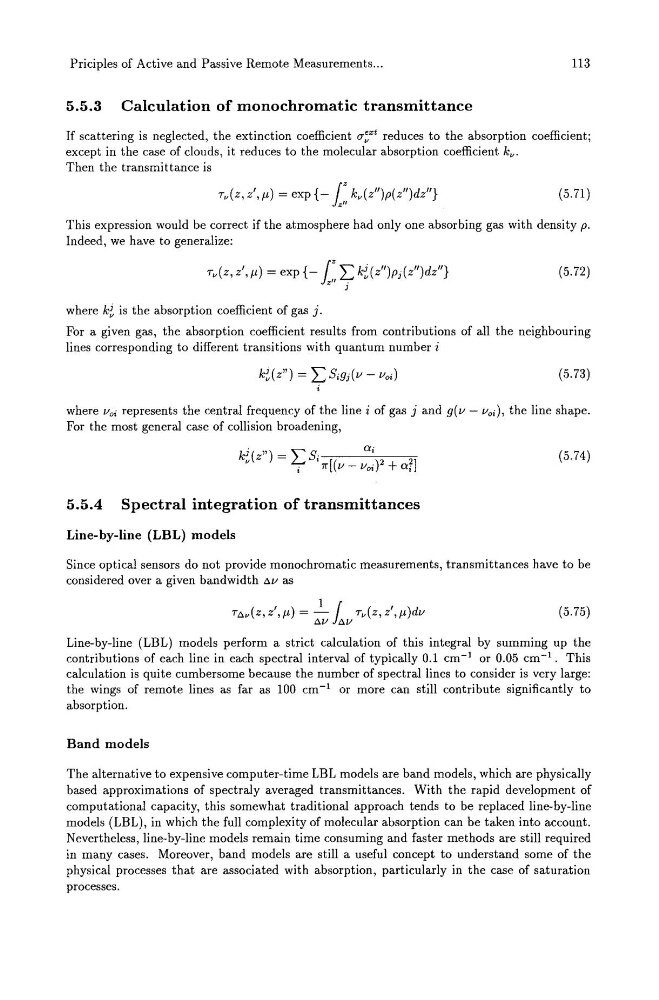
If scattering is neglected, the extinction coefficient <7~xt reduces to the absorption coefficient;
except in the case of clouds, it reduces to the molecular absorption coefficient kv.
Then the transmittance is
Tv(Z, z', Jl) = exp {-l
z kv(z")p(z")dz"}
z"
(5.71)
This expression would be correct if the atmosphere had only one absorbing gas with density p.
Indeed, we have to generalize:
Tv(Z, z', Jl) = exp {- E L k~(z")pj(z")dz"}
J
(5.72)
where k~ is the absorption coefficient of gas j.
For a given gas, the absorption coefficient results from contributions of all the neighbouring
lines corresponding to different transitions with quantum number i
(5.73)
where Voi represents the central frequency of the line i of gas j and g(v - vo;), the line shape.
For the most general case of collision broadening,
(5.74)
5.5.4 Spectral integration of transmittances
Line-by-line (LBL) models
Since optical sensors do not provide monochromatic measurements, transmittances have to be
considered over a given bandwidth t;.v as
Tt;.v(Z,Z',Jl) = J...- r Tv(z,z',Jl)dv
t;.v}t;.v
(5.75)
Line-by-line (LBL) models perform a strict calculation of this integral by summing up the
contributions of each line in each spectral interval of typically 0.1 cm- 1 or 0.05 cm- 1 . This
calculation is quite cumbersome because the number of spectral lines to consider is very large:
the wings of remote lines as far as 100 cm- 1 or more can still contribute significantly to
absorption.
Band models
The alternative to expensive computer-time LBL models are band models, which are physically
based approximations of spectraly averaged transmittances. With the rapid development of
computational capacity, this somewhat traditional approach tends to be replaced line-by-line
models (LBL), in which the full complexity of molecular absorption can be taken into account.
Nevertheless, line-by-line models remain time consuming and faster methods are still required
in many cases. Moreover, band models are still a useful concept to understand some of the
physical processes that are associated with absorption, particularly in the case of saturation
processes.
113
5.5.3 Calculation of monochromatic transmittance
If scattering is neglected, the extinction coefficient <7~xt reduces to the absorption coefficient;
except in the case of clouds, it reduces to the molecular absorption coefficient kv.
Then the transmittance is
Tv(Z, z', Jl) = exp {-l
z kv(z")p(z")dz"}
z"
(5.71)
This expression would be correct if the atmosphere had only one absorbing gas with density p.
Indeed, we have to generalize:
Tv(Z, z', Jl) = exp {- E L k~(z")pj(z")dz"}
J
(5.72)
where k~ is the absorption coefficient of gas j.
For a given gas, the absorption coefficient results from contributions of all the neighbouring
lines corresponding to different transitions with quantum number i
(5.73)
where Voi represents the central frequency of the line i of gas j and g(v - vo;), the line shape.
For the most general case of collision broadening,
(5.74)
5.5.4 Spectral integration of transmittances
Line-by-line (LBL) models
Since optical sensors do not provide monochromatic measurements, transmittances have to be
considered over a given bandwidth t;.v as
Tt;.v(Z,Z',Jl) = J...- r Tv(z,z',Jl)dv
t;.v}t;.v
(5.75)
Line-by-line (LBL) models perform a strict calculation of this integral by summing up the
contributions of each line in each spectral interval of typically 0.1 cm- 1 or 0.05 cm- 1 . This
calculation is quite cumbersome because the number of spectral lines to consider is very large:
the wings of remote lines as far as 100 cm- 1 or more can still contribute significantly to
absorption.
Band models
The alternative to expensive computer-time LBL models are band models, which are physically
based approximations of spectraly averaged transmittances. With the rapid development of
computational capacity, this somewhat traditional approach tends to be replaced line-by-line
models (LBL), in which the full complexity of molecular absorption can be taken into account.
Nevertheless, line-by-line models remain time consuming and faster methods are still required
in many cases. Moreover, band models are still a useful concept to understand some of the
physical processes that are associated with absorption, particularly in the case of saturation
processes.