

114
Y. Fouquart and M. Vesperini
a) Homogeneous path, equivalent width of an absorbing line
First, we consider the homogeneous case (p and T constant) for a unique gas with density p,
such that
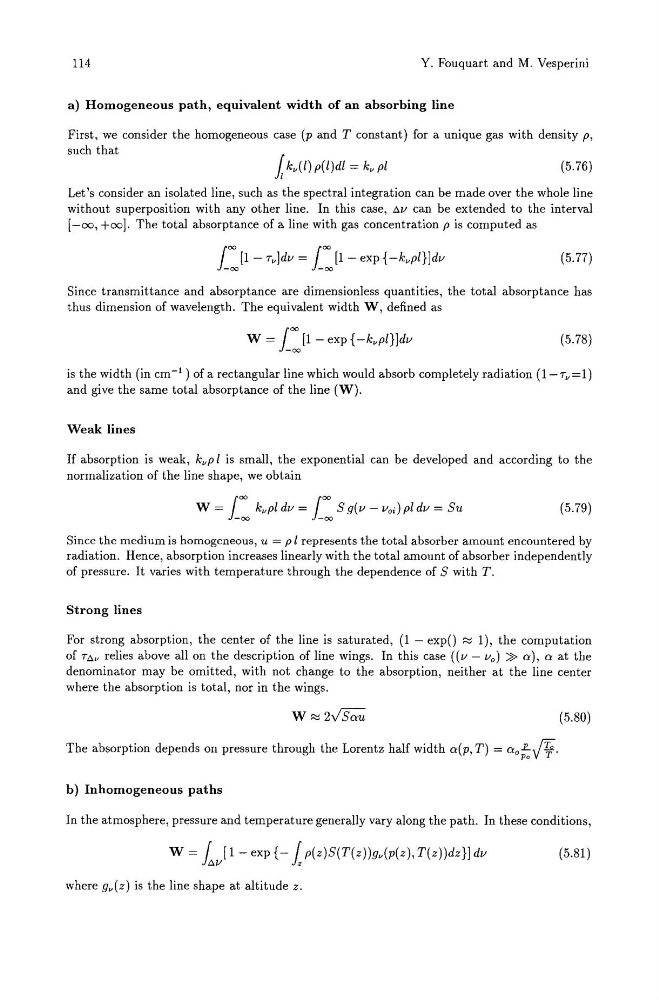
(5.76)
Let's consider an isolated line, such as the spectral integration can be made over the whole line
without superposition with any other line. In this case, /}.v can be extended to the interval
[-00, +00). The total absorptance of a line with gas concentration p is computed as
(5.77)
Since transmittance and absorptance are dimensionless quantities, the total absorptance has
thus dimension of wavelength. The equivalent width W, defined as
W = 1: [1 - exp { -kvpl})dv
(5.78)
is the width (in cm- l ) of a rectangular line which would absorb completely radiation (1- Tv =1)
and give the same total absorptance of the line (W).
Weak lines
If absorption is weak, kvp I is small, the exponential can be developed and according to the
normalization of the line shape, we obtain
W = 1: kvpl dv = 1: S g(v - Voi) pi dv = Su
(5.79)
Since the medium is homogeneous, u = p I represents the total absorber amount encountered by
radiation. Hence, absorption increases linearly with the total amount of absorber independently
of pressure. It varies with temperature through the dependence of S with T.
Strong lines
For strong absorption, the center of the line is saturated, (1 - expO ~ 1), the computation
of T/}.v relies above all on the description of line wings. In this case ((v - vo ) » a), a at the
denominator may be omitted, with not change to the absorption, neither at the line center
where the absorption is total, nor in the wings.
(5.80)
The absorption depends on pressure through the Lorentz half width a(p, T) = ao:;;/fj.
b) Inhomogeneous paths
In the atmosphere, pressure and temperature generally vary along the path. In these conditions,
W = ( [1-ex p {-lp(z)S(T(z))gv(p(z),T(z))dz})dv
J~v
z
(5.81)
where gv(z) is the line shape at altitude z.
Y. Fouquart and M. Vesperini
a) Homogeneous path, equivalent width of an absorbing line
First, we consider the homogeneous case (p and T constant) for a unique gas with density p,
such that
(5.76)
Let's consider an isolated line, such as the spectral integration can be made over the whole line
without superposition with any other line. In this case, /}.v can be extended to the interval
[-00, +00). The total absorptance of a line with gas concentration p is computed as
(5.77)
Since transmittance and absorptance are dimensionless quantities, the total absorptance has
thus dimension of wavelength. The equivalent width W, defined as
W = 1: [1 - exp { -kvpl})dv
(5.78)
is the width (in cm- l ) of a rectangular line which would absorb completely radiation (1- Tv =1)
and give the same total absorptance of the line (W).
Weak lines
If absorption is weak, kvp I is small, the exponential can be developed and according to the
normalization of the line shape, we obtain
W = 1: kvpl dv = 1: S g(v - Voi) pi dv = Su
(5.79)
Since the medium is homogeneous, u = p I represents the total absorber amount encountered by
radiation. Hence, absorption increases linearly with the total amount of absorber independently
of pressure. It varies with temperature through the dependence of S with T.
Strong lines
For strong absorption, the center of the line is saturated, (1 - expO ~ 1), the computation
of T/}.v relies above all on the description of line wings. In this case ((v - vo ) » a), a at the
denominator may be omitted, with not change to the absorption, neither at the line center
where the absorption is total, nor in the wings.
(5.80)
The absorption depends on pressure through the Lorentz half width a(p, T) = ao:;;/fj.
b) Inhomogeneous paths
In the atmosphere, pressure and temperature generally vary along the path. In these conditions,
W = ( [1-ex p {-lp(z)S(T(z))gv(p(z),T(z))dz})dv
J~v
z
(5.81)
where gv(z) is the line shape at altitude z.