

112
Y. Fouquart and M. Vesperini
then for Oy = 0 that is at the top of the atmosphere,
(5.62)
and if « 1,
(5.63)
5.5.2 Longwave case
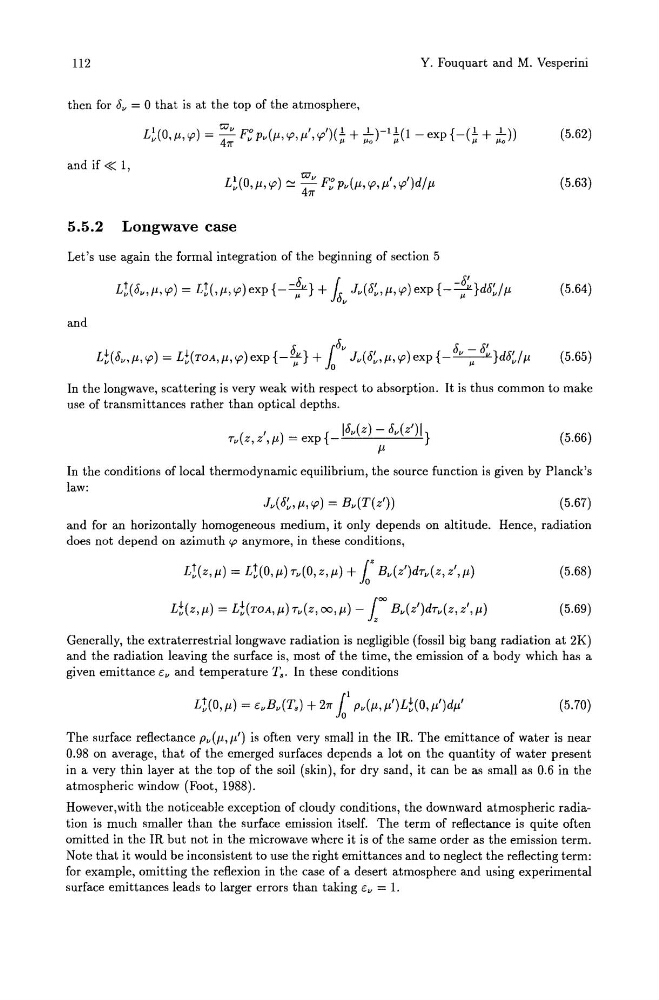
Let's use again the formal integration of the beginning of section 5
(5.64)
and
( 5.65)
In the longwave, scattering is very weak with respect to absorption. It is thus common to make
use of transmittances rather than optical depths.
( ' )
{Ioy(z) - oy(z')I}
Ty z, z ,/1 = exp
/1
(5.66)
In the conditions of local thermodynamic equilibrium, the source function is given by Planck's
law:
(5.67)
and for an horizontally homogeneous medium, it only depends on altitude. Hence, radiation
does not depend on azimuth 'P anymore, in these conditions,
(5.68)
Lt(z,/1) = Lt(TOA,/1) Ty(Z, 00,/1) - [" BAz')dTy(Z,Z',/1)
(5.69)
Generally, the extraterrestriallongwave radiation is negligible (fossil big bang radiation at 2K)
and the radiation leaving the surface is, most of the time, the emission of a body which has a
given emittance Cy and temperature Ts. In these conditions
(5.70)
The surface reflectance PY(/1, /1') is often very small in the IR. The emittance of water is near
0.98 on average, that of the emerged surfaces depends a lot on the quantity of water present
in a very thin layer at the top of the soil (skin), for dry sand, it can be as small as 0.6 in the
atmospheric window (Foot, 1988).
However,with the noticeable exception of cloudy conditions, the downward atmospheric radiation is much smaller than the surface emission itself. The term of reflectance is quite often
omitted in the IR but not in the microwave where it is of the same order as the emission term.
Note that it would be inconsistent to use the right emittances and to neglect the reflecting term:
for example, omitting the reflexion in the case of a desert atmosphere and using experimental
surface emittances leads to larger errors than taking Cy = 1.
Y. Fouquart and M. Vesperini
then for Oy = 0 that is at the top of the atmosphere,
(5.62)
and if « 1,
(5.63)
5.5.2 Longwave case
Let's use again the formal integration of the beginning of section 5
(5.64)
and
( 5.65)
In the longwave, scattering is very weak with respect to absorption. It is thus common to make
use of transmittances rather than optical depths.
( ' )
{Ioy(z) - oy(z')I}
Ty z, z ,/1 = exp
/1
(5.66)
In the conditions of local thermodynamic equilibrium, the source function is given by Planck's
law:
(5.67)
and for an horizontally homogeneous medium, it only depends on altitude. Hence, radiation
does not depend on azimuth 'P anymore, in these conditions,
(5.68)
Lt(z,/1) = Lt(TOA,/1) Ty(Z, 00,/1) - [" BAz')dTy(Z,Z',/1)
(5.69)
Generally, the extraterrestriallongwave radiation is negligible (fossil big bang radiation at 2K)
and the radiation leaving the surface is, most of the time, the emission of a body which has a
given emittance Cy and temperature Ts. In these conditions
(5.70)
The surface reflectance PY(/1, /1') is often very small in the IR. The emittance of water is near
0.98 on average, that of the emerged surfaces depends a lot on the quantity of water present
in a very thin layer at the top of the soil (skin), for dry sand, it can be as small as 0.6 in the
atmospheric window (Foot, 1988).
However,with the noticeable exception of cloudy conditions, the downward atmospheric radiation is much smaller than the surface emission itself. The term of reflectance is quite often
omitted in the IR but not in the microwave where it is of the same order as the emission term.
Note that it would be inconsistent to use the right emittances and to neglect the reflecting term:
for example, omitting the reflexion in the case of a desert atmosphere and using experimental
surface emittances leads to larger errors than taking Cy = 1.