

Priciples of Active and Passive Remote Measurements ...
111
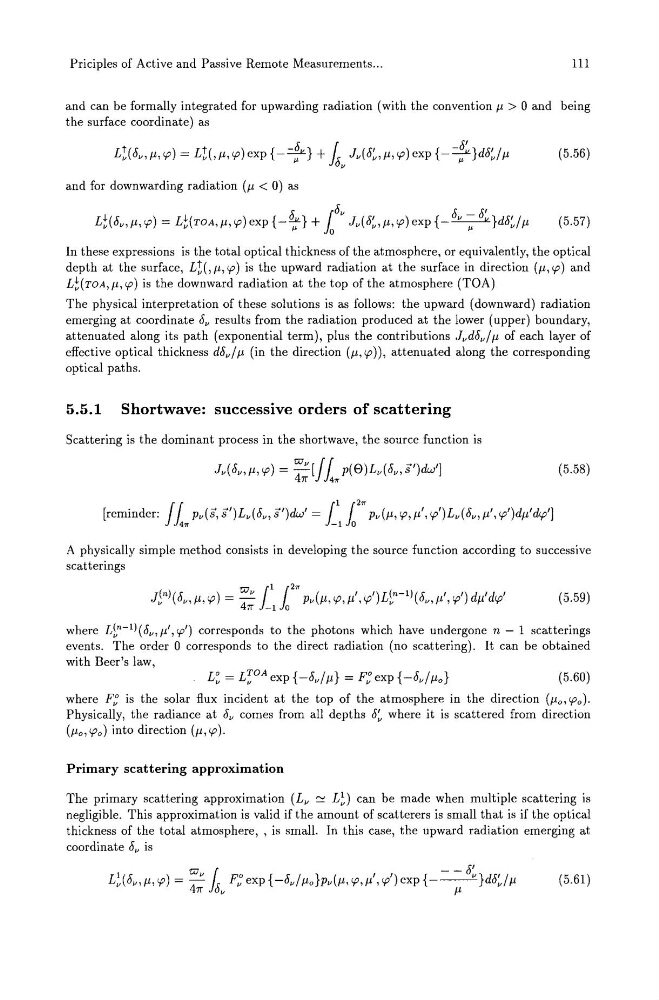
and can be formally integrated for upwarding radiation (with the convention f.1 > 0 and being
the surface coordinate) as
L1(5v,f.1,
and for downwarding radiation (f.1 < 0) as
Lt(5v,f.1,
I'
( 5.56)
(5.57)
In these expressions is the total optical thickness of the atmosphere, or equivalently, the optical
depth at the surface, L1(,f.1,
emerging at coordinate 5v results from the radiation produced at the lower (upper) boundary,
attenuated along its path (exponential term), plus the contributions Jvd5v/fl of each layer of
effective optical thickness d5v/ f.1 (in the direction (f.1,
5.5.1 Shortwave: successive orders of scattering
Scattering is the dominant process in the shortwave, the source function is
(5.58)
A physically simple method consists in developing the source function according to successive
scatterings
(5.59)
where LSn-l) (5v, f.1',
with Beer's law,
(5.60)
where F~ is the solar flux incident at the top of the atmosphere in the direction (f.10,
(f.10,
The primary scattering approximation (Lv '::c: L~) can be made when multiple scattering is
negligible. This approximation is valid if the amount of scatterers is small that is if the optical
thickness of the total atmosphere, , is small. In this case, the upward radiation emerging at
coordinate 5v is
(5.61 )
111
and can be formally integrated for upwarding radiation (with the convention f.1 > 0 and being
the surface coordinate) as
L1(5v,f.1,
Lt(5v,f.1,
I'
( 5.56)
(5.57)
In these expressions is the total optical thickness of the atmosphere, or equivalently, the optical
depth at the surface, L1(,f.1,
emerging at coordinate 5v results from the radiation produced at the lower (upper) boundary,
attenuated along its path (exponential term), plus the contributions Jvd5v/fl of each layer of
effective optical thickness d5v/ f.1 (in the direction (f.1,
5.5.1 Shortwave: successive orders of scattering
Scattering is the dominant process in the shortwave, the source function is
(5.58)
A physically simple method consists in developing the source function according to successive
scatterings
(5.59)
where LSn-l) (5v, f.1',
with Beer's law,
(5.60)
where F~ is the solar flux incident at the top of the atmosphere in the direction (f.10,
(f.10,
The primary scattering approximation (Lv '::c: L~) can be made when multiple scattering is
negligible. This approximation is valid if the amount of scatterers is small that is if the optical
thickness of the total atmosphere, , is small. In this case, the upward radiation emerging at
coordinate 5v is
(5.61 )