

110
Y. Fouquart and M. Vesperini
and
(5.47)
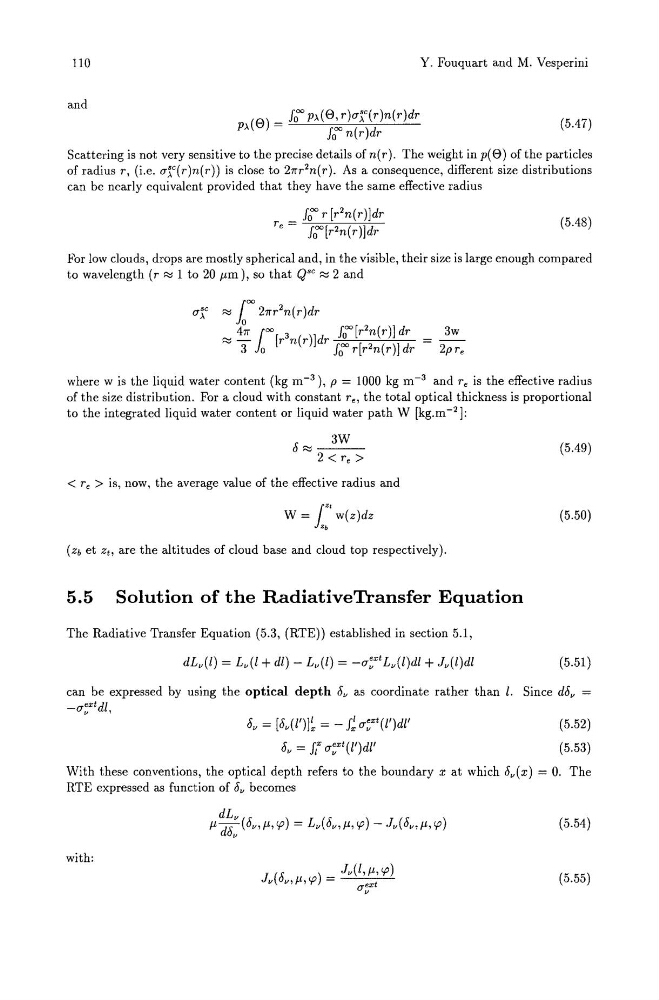
Scattering is not very sensitive to the precise details of n( r). The weight in p( e) of the particles
of radius r, (i.e. O"~C( r )n( r)) is close to 27rr 2 n( r). As a consequence, different size distributions
can be nearly equivalent provided that they have the same effective radius
(5.48)
For low clouds, drops are mostly spherical and, in the visible, their size is large enough compared
to wavelength (r ~ 1 to 20 J.lm), so that QSc ~ 2 and
3w
2p r e
where w is the liquid water content (kg m- 3 ), p = 1000 kg m- 3 and re is the effective radius
of the size distribution. For a cloud with constant r., the total optical thickness is proportional
to the integrated liquid water content or liquid water path W [kg.m -2 J:
rS~
3W
2 < re >
(5.49)
< re > is, now, the average value of the effective radius and
l
Z '
W =
w(z)dz
Zb
(5.50)
(Zb et Zt, are the altitudes of cloud base and cloud top respectively).
5.5 Solution of the RadiativeTransfer Equation
The Radiative Transfer Equation (5.3, (RTE)) established in section 5.1,
(5.51)
can be expressed by using the optical depth rSv as coordinate rather than I. Since drSv =
_O"~xtdl,
rSv = [rSv(l')J~ = - I; O"~xt(l')dl'
rSv = It O"~xt( I')dl'
(5.52)
(5.53)
With these conventions, the optical depth refers to the boundary x at which rSv( x) = O. The
RTE expressed as function of rSv becomes
(5.54)
with:
(5.55)
Y. Fouquart and M. Vesperini
and
(5.47)
Scattering is not very sensitive to the precise details of n( r). The weight in p( e) of the particles
of radius r, (i.e. O"~C( r )n( r)) is close to 27rr 2 n( r). As a consequence, different size distributions
can be nearly equivalent provided that they have the same effective radius
(5.48)
For low clouds, drops are mostly spherical and, in the visible, their size is large enough compared
to wavelength (r ~ 1 to 20 J.lm), so that QSc ~ 2 and
3w
2p r e
where w is the liquid water content (kg m- 3 ), p = 1000 kg m- 3 and re is the effective radius
of the size distribution. For a cloud with constant r., the total optical thickness is proportional
to the integrated liquid water content or liquid water path W [kg.m -2 J:
rS~
3W
2 < re >
(5.49)
< re > is, now, the average value of the effective radius and
l
Z '
W =
w(z)dz
Zb
(5.50)
(Zb et Zt, are the altitudes of cloud base and cloud top respectively).
5.5 Solution of the RadiativeTransfer Equation
The Radiative Transfer Equation (5.3, (RTE)) established in section 5.1,
(5.51)
can be expressed by using the optical depth rSv as coordinate rather than I. Since drSv =
_O"~xtdl,
rSv = [rSv(l')J~ = - I; O"~xt(l')dl'
rSv = It O"~xt( I')dl'
(5.52)
(5.53)
With these conventions, the optical depth refers to the boundary x at which rSv( x) = O. The
RTE expressed as function of rSv becomes
(5.54)
with:
(5.55)