

Priciples of Active and Passive Remote Measurements ...
107
Doppler broadening
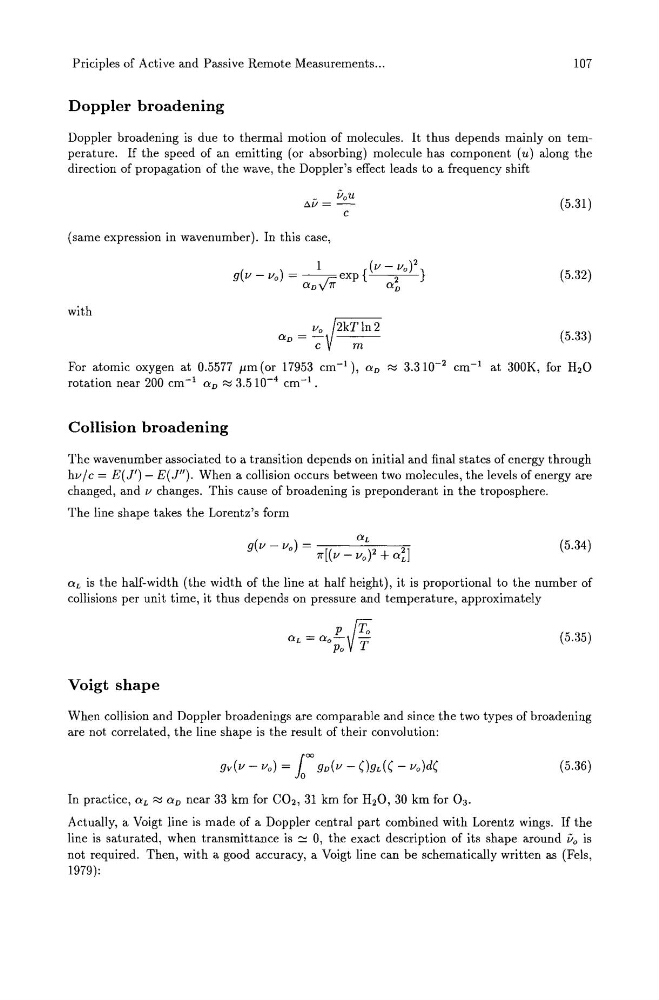
Doppler broadening is due to thermal motion of molecules. It thus depends mainly on temperature. If the speed of an emitting (or absorbing) molecule has component (u) along the
direction of propagation of the wave, the Doppler's effect leads to a frequency shift
(5.31)
(same expression in wavenumber). In this case,
(5.32)
with
~D __ Vo j2kT In 2
~
(5.33)
c
m
For atomic oxygen at 0.5577 11m (or 17953 em-I), aD ::::; 3.310- 2 cm- 1 at 300K, for H20
rotation near 200 cm- 1 aD ::::; 3.510- 4 em-I.
Collision broadening
The wavenumber associated to a transition depends on initial and final states of energy through
hv / c = E( J') - E( JII). When a collision occurs between two molecules, the levels of energy are
changed, and v changes. This cause of broadening is preponderant in the troposphere.
The line shape takes the Lorentz's form
(5.34)
a L is the half-width (the width of the line at half height), it is proportional to the number of
collisions per unit time, it thus depends on pressure and temperature, approximately
(5.35 )
Voigt shape
When collision and Doppler broadenings are comparable and since the two types of broadening
are not correlated, the line shape is the result of their convolution:
(5.36)
In practice, a L ::::; aD near 33 km for CO 2 , 31 km for H20, 30 km for 0 3 ,
Actually, a Voigt line is made of a Doppler central part combined with Lorentz wings. If the
line is saturated, when transmittance is ~ 0, the exact description of its shape around i/o is
not required. Then, with a good accuracy, a Voigt line can be schematically written as (Fels,
1979):
107
Doppler broadening
Doppler broadening is due to thermal motion of molecules. It thus depends mainly on temperature. If the speed of an emitting (or absorbing) molecule has component (u) along the
direction of propagation of the wave, the Doppler's effect leads to a frequency shift
(5.31)
(same expression in wavenumber). In this case,
(5.32)
with
~D __ Vo j2kT In 2
~
(5.33)
c
m
For atomic oxygen at 0.5577 11m (or 17953 em-I), aD ::::; 3.310- 2 cm- 1 at 300K, for H20
rotation near 200 cm- 1 aD ::::; 3.510- 4 em-I.
Collision broadening
The wavenumber associated to a transition depends on initial and final states of energy through
hv / c = E( J') - E( JII). When a collision occurs between two molecules, the levels of energy are
changed, and v changes. This cause of broadening is preponderant in the troposphere.
The line shape takes the Lorentz's form
(5.34)
a L is the half-width (the width of the line at half height), it is proportional to the number of
collisions per unit time, it thus depends on pressure and temperature, approximately
(5.35 )
Voigt shape
When collision and Doppler broadenings are comparable and since the two types of broadening
are not correlated, the line shape is the result of their convolution:
(5.36)
In practice, a L ::::; aD near 33 km for CO 2 , 31 km for H20, 30 km for 0 3 ,
Actually, a Voigt line is made of a Doppler central part combined with Lorentz wings. If the
line is saturated, when transmittance is ~ 0, the exact description of its shape around i/o is
not required. Then, with a good accuracy, a Voigt line can be schematically written as (Fels,
1979):