

108
Y. Fouquart and M. Vesperini
9v(V - vol = C
if 1 v - VO I::; I>.Vo
9 (V
II) -
a L
elsewhere
v
-
0
-
(
)2
7r V - Vo
The normalization condition implies
I: 9v(V - Vol dv = 1 = 2CI>.Vo + :~!io
(5.37)
that is
C=_I __ ~
21>.Vo
71" (ll.Vo)2
( 5.38)
I>.Vo depends on the Lorentz and Doppler widths
I>.Vo = 2(1 + ()~ + (3aD
(5.39)
( and (3 are empirical coefficients, they guarantee matching the extreme cases, namely Lorentz
and Doppler. The best approximation for the average transmittance of an entire line is obtained
for ( = 0.25 and (3 = 1.25.
5.4 Scattering
Scattering is extremely important in the solar range but its influence is generally small in
thermal infrared, because of the ratio between the particle size and the wavelength.
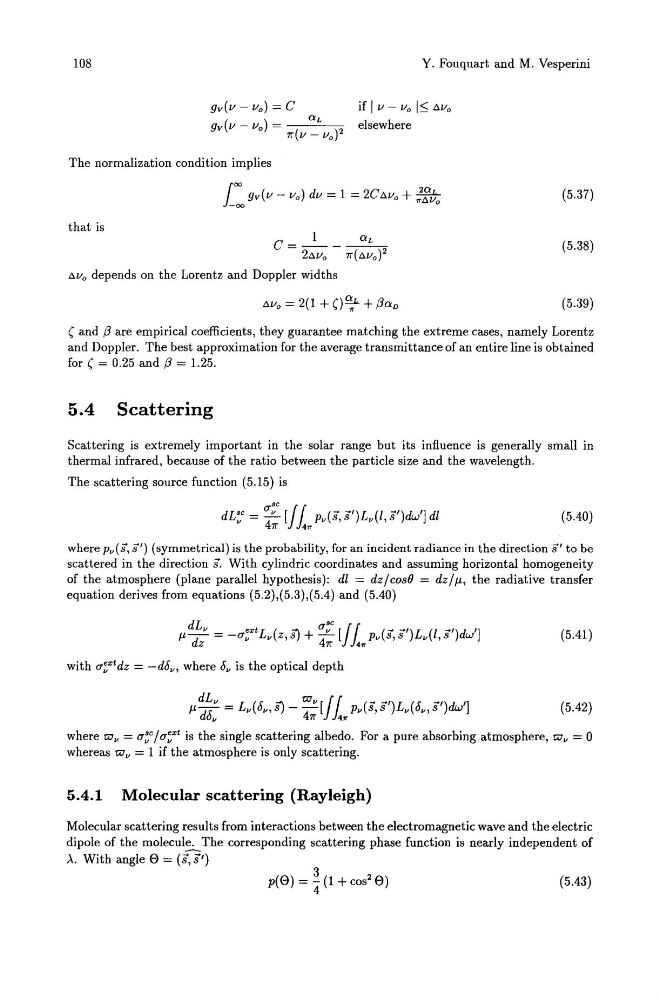
The scattering source function (5.15) is
(5.40)
where PvC;, S") (symmetrical) is the probability, for an incident radiance in the direction S" to be
scattered in the direction 8. With cylindric coordinates and assuming horizontal homogeneity
of the atmosphere (plane parallel hypothesis): dl = dz / cosO = dz //1-, the radiative transfer
equation derives from equations (5.2),(5.3),(5.4) and (5.40)
dL v
extL ( ~ aZ c [J. f (~ ~')L (l ~')dw/l
/1-~ = -av v z,s, + 471" 14"Pv S,S v ,s
(5.41 )
with a~xtdz = -d8v, where 8v is the optical depth
(5.42)
where tvv = a~c / a~xt is the single scattering albedo. For a pure absorbing atmosphere, tvv = 0
whereas tvv = 1 if the atmosphere is only scattering.
5.4.1 Molecular scattering (Rayleigh)
Molecular scattering results from interactions between the electromagnetic wave and the electric
dipole of the molecule. The corresponding scattering phase function is nearly independent of
A. With angle 8 = (8,8 ' )
3
p(8) = 4 (1 + cos 2 8)
(5.43)
Y. Fouquart and M. Vesperini
9v(V - vol = C
if 1 v - VO I::; I>.Vo
9 (V
II) -
a L
elsewhere
v
-
0
-
(
)2
7r V - Vo
The normalization condition implies
I: 9v(V - Vol dv = 1 = 2CI>.Vo + :~!io
(5.37)
that is
C=_I __ ~
21>.Vo
71" (ll.Vo)2
( 5.38)
I>.Vo depends on the Lorentz and Doppler widths
I>.Vo = 2(1 + ()~ + (3aD
(5.39)
( and (3 are empirical coefficients, they guarantee matching the extreme cases, namely Lorentz
and Doppler. The best approximation for the average transmittance of an entire line is obtained
for ( = 0.25 and (3 = 1.25.
5.4 Scattering
Scattering is extremely important in the solar range but its influence is generally small in
thermal infrared, because of the ratio between the particle size and the wavelength.
The scattering source function (5.15) is
(5.40)
where PvC;, S") (symmetrical) is the probability, for an incident radiance in the direction S" to be
scattered in the direction 8. With cylindric coordinates and assuming horizontal homogeneity
of the atmosphere (plane parallel hypothesis): dl = dz / cosO = dz //1-, the radiative transfer
equation derives from equations (5.2),(5.3),(5.4) and (5.40)
dL v
extL ( ~ aZ c [J. f (~ ~')L (l ~')dw/l
/1-~ = -av v z,s, + 471" 14"Pv S,S v ,s
(5.41 )
with a~xtdz = -d8v, where 8v is the optical depth
(5.42)
where tvv = a~c / a~xt is the single scattering albedo. For a pure absorbing atmosphere, tvv = 0
whereas tvv = 1 if the atmosphere is only scattering.
5.4.1 Molecular scattering (Rayleigh)
Molecular scattering results from interactions between the electromagnetic wave and the electric
dipole of the molecule. The corresponding scattering phase function is nearly independent of
A. With angle 8 = (8,8 ' )
3
p(8) = 4 (1 + cos 2 8)
(5.43)