

106
Y. Fouquart and M. Vesperini
0 .8
0.6
0.4
0.2
o
2700 2702 2704 2706 2708 2710
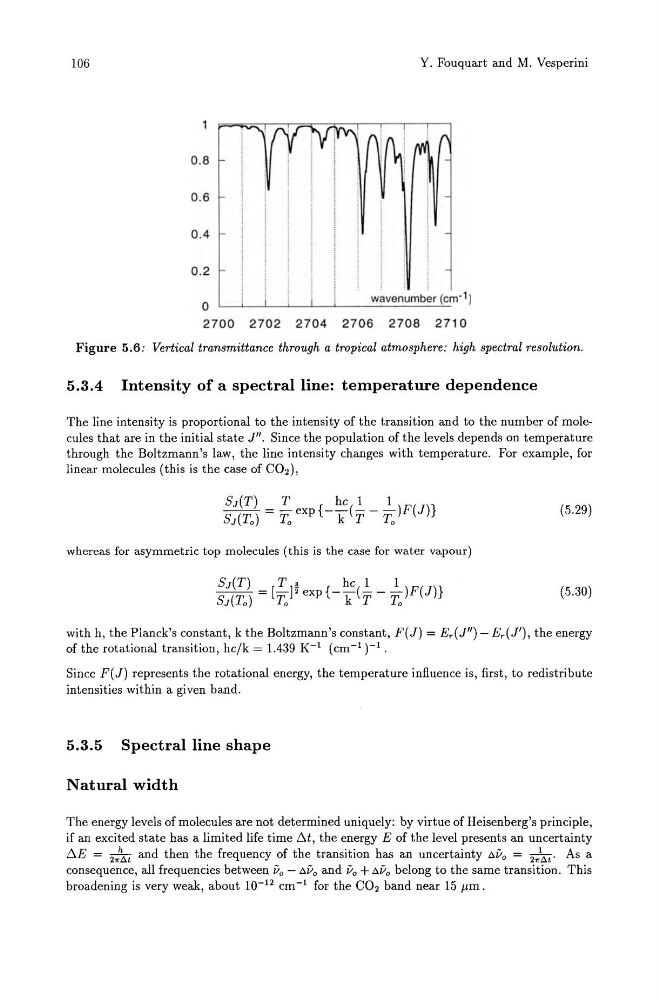
Figure 5.6: Vertical transmittance through a tropical atmosphere: high spectral resolution.
5.3.4 Intensity of a spectral line: temperature dependence
The line intensity is proportional to the intensity of the transition and to the number of molecules that are in the initial state J". Since the population of the levels depends on temperature
through the Boltzmann's law, the line intensity changes with temperature. For example, for
linear molecules (this is the case of CO2 ),
(5.29)
whereas for asymmetric top molecules (this is the case for water vapour)
(5.30)
with h, the Planck's constant, k the Boltzmann's constant, F(J) = Er(J") - Er (J') , the energy
of the rotational transition, hc/k = 1.439 K- 1 (cm- 1 )-1.
Since F(J) represents the rotational energy, the temperature influence is, first, to redistribute
intensities within a given band.
5.3.5 Spectral line shape
Natural width
The energy levels of molecules are not determined uniquely: by virtue of Heisenberg's principle,
if an excited state has a limited life time 6.t, the energy E of the level presents an uncertainty
6.E = 27r"t,t and then the frequency of the transition has an uncertainty L>Vo = 27r~t. As a
consequence, all frequencies between Vo - L>Vo and Vo + L>Vo belong to the same transition. This
broadening is very weak, about 10- 12 cm -1 for the CO 2 band near 15 /lm.
Y. Fouquart and M. Vesperini
0 .8
0.6
0.4
0.2
o
2700 2702 2704 2706 2708 2710
Figure 5.6: Vertical transmittance through a tropical atmosphere: high spectral resolution.
5.3.4 Intensity of a spectral line: temperature dependence
The line intensity is proportional to the intensity of the transition and to the number of molecules that are in the initial state J". Since the population of the levels depends on temperature
through the Boltzmann's law, the line intensity changes with temperature. For example, for
linear molecules (this is the case of CO2 ),
(5.29)
whereas for asymmetric top molecules (this is the case for water vapour)
(5.30)
with h, the Planck's constant, k the Boltzmann's constant, F(J) = Er(J") - Er (J') , the energy
of the rotational transition, hc/k = 1.439 K- 1 (cm- 1 )-1.
Since F(J) represents the rotational energy, the temperature influence is, first, to redistribute
intensities within a given band.
5.3.5 Spectral line shape
Natural width
The energy levels of molecules are not determined uniquely: by virtue of Heisenberg's principle,
if an excited state has a limited life time 6.t, the energy E of the level presents an uncertainty
6.E = 27r"t,t and then the frequency of the transition has an uncertainty L>Vo = 27r~t. As a
consequence, all frequencies between Vo - L>Vo and Vo + L>Vo belong to the same transition. This
broadening is very weak, about 10- 12 cm -1 for the CO 2 band near 15 /lm.