

Priciples of Active and Passive Remote Measurements ...
105
(i) the atmosphere is not opaque, and (ii) they are located near the maximum of emission by
the atmosphere and the surface. Nevertheless, the main absorber in the atmospheric window
remains water vapour, with a continuum structure due to the superposition of the line wings
of the bands surrounding the window.
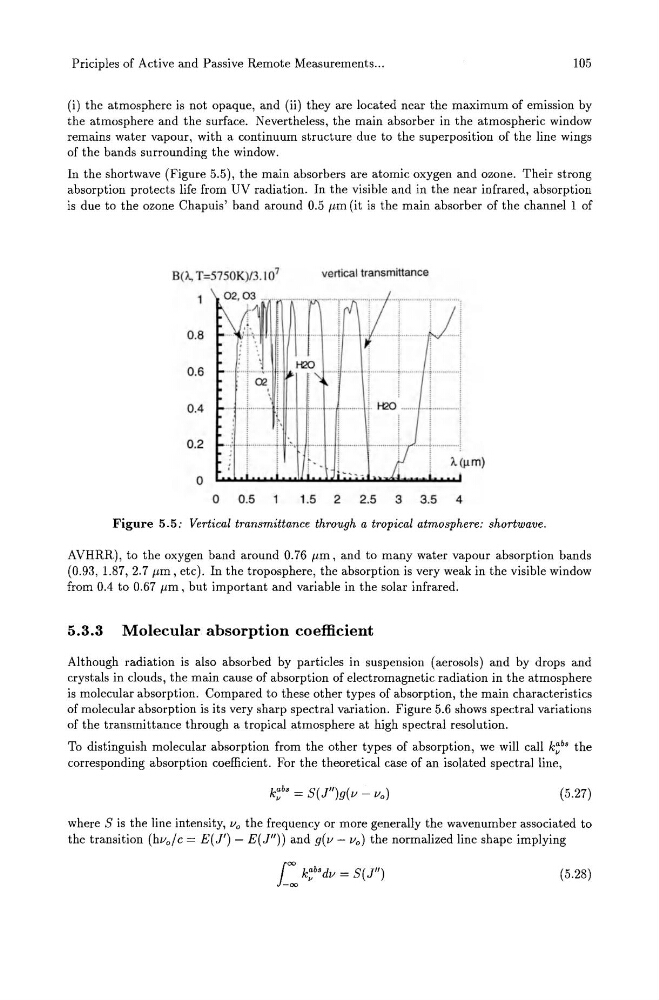
In the shortwave (Figure 5.5), the main absorbers are atomic oxygen and ozone. Their strong
absorption protects life from UV radiation. In the visible and in the near infrared, absorption
is due to the ozone Chapuis' band around 0.5 pm (it is the main absorber of the channell of
B( A, T =5750K)/3.10 7
vertical transmittance
0.8
0.6
0.4
·····,,,··1
0.2
o
o 0.5
1.5
2
2.5
3
3.5
4
Figure 5.5 : Vertical transmittance through a tropical atmosphere: shortwave.
AVHRR), to the oxygen band around 0.76 pm, and to many water vapour absorption bands
(0.93, 1.87,2.7 pm, etc). In the troposphere, the absorption is very weak in the visible window
from 0.4 to 0.67 pm, but important and variable in the solar infrared.
5.3.3 Molecular absorption coefficient
Although radiation is also absorbed by particles in suspension (aerosols) and by drops and
crystals in clouds, the main cause of absorption of electromagnetic radiation in the atmosphere
is molecular absorption. Compared to these other types of absorption, the main characteristics
of molecular absorption is its very sharp spectral variation. Figure 5.6 shows spectral variations
of the transmittance through a tropical atmosphere at high spectral resolution.
To distinguish molecular absorption from the other types of absorption, we will call k~bs the
corresponding absorption coefficient. For the theoretical case of an isolated spectral line,
k~bs = S( JII)g(V - vol
(5.27)
where S is the line intensity, Vo the frequency or more generally the wavenumber associated to
the transition (hvo/c = E(J') - E(J")) and g(v - vol the normalized line shape implying
( 5.28)
105
(i) the atmosphere is not opaque, and (ii) they are located near the maximum of emission by
the atmosphere and the surface. Nevertheless, the main absorber in the atmospheric window
remains water vapour, with a continuum structure due to the superposition of the line wings
of the bands surrounding the window.
In the shortwave (Figure 5.5), the main absorbers are atomic oxygen and ozone. Their strong
absorption protects life from UV radiation. In the visible and in the near infrared, absorption
is due to the ozone Chapuis' band around 0.5 pm (it is the main absorber of the channell of
B( A, T =5750K)/3.10 7
vertical transmittance
0.8
0.6
0.4
·····,,,··1
0.2
o
o 0.5
1.5
2
2.5
3
3.5
4
Figure 5.5 : Vertical transmittance through a tropical atmosphere: shortwave.
AVHRR), to the oxygen band around 0.76 pm, and to many water vapour absorption bands
(0.93, 1.87,2.7 pm, etc). In the troposphere, the absorption is very weak in the visible window
from 0.4 to 0.67 pm, but important and variable in the solar infrared.
5.3.3 Molecular absorption coefficient
Although radiation is also absorbed by particles in suspension (aerosols) and by drops and
crystals in clouds, the main cause of absorption of electromagnetic radiation in the atmosphere
is molecular absorption. Compared to these other types of absorption, the main characteristics
of molecular absorption is its very sharp spectral variation. Figure 5.6 shows spectral variations
of the transmittance through a tropical atmosphere at high spectral resolution.
To distinguish molecular absorption from the other types of absorption, we will call k~bs the
corresponding absorption coefficient. For the theoretical case of an isolated spectral line,
k~bs = S( JII)g(V - vol
(5.27)
where S is the line intensity, Vo the frequency or more generally the wavenumber associated to
the transition (hvo/c = E(J') - E(J")) and g(v - vol the normalized line shape implying
( 5.28)