

104
Y. Fouquart and M. Vesperini
intensity of an electric dipole transition is proportional to the square of the matrix element of
the dipole moment (Goody and Young, 1989)
R;j = J ' 117M'll jdV
(5.26)
The'll j are the wave functions (solutions of the Schrodinger's equation) corresponding to the
initial state i and final state j. dV is a volume element and the asterisk denotes complex
conjugation. Since the wave functions are orthogonal, the intensity of a transition is zero
(Rij = 0) if the dipole moment M does not change during the transition. For symmetric linear
molecules such as CO2 and for diatomic molecules, the dipole moment is not changed by a
rotational transition. These molecules have no pure rotational spectrum but only vibrationrotation bands which contain much more energy and thus correspond to smaller wavelengths.
5.3.2 Main absorption bands of atmospheric gases
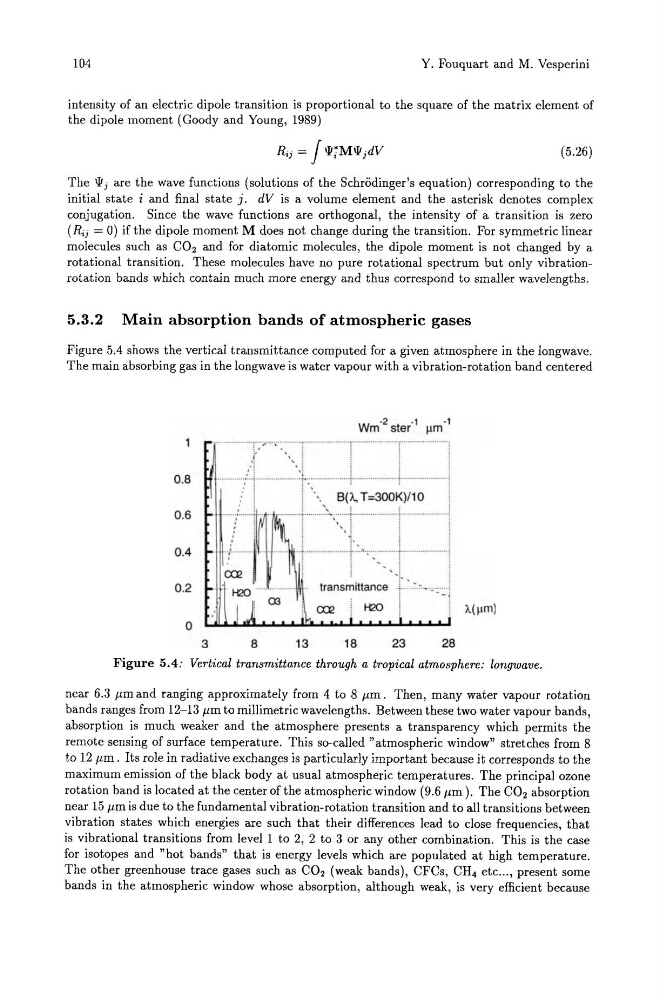
Figure 5.4 shows the vertical transmittance computed for a given atmosphere in the longwave.
The main absorbing gas in the longwave is water vapour with a vibration-rotation band centered
0.8
0.6
0.4
0.2
o
3
8
13
18
23
28
Figure 5.4: Vertical transmittance through a tropical atmosphere: longwave.
near 6.3 (lm and ranging approximately from 4 to 8 (lm. Then, many water vapour rotation
bands ranges from 12-13 (lm to millimetric wavelengths. Between these two water vapour bands,
absorption is much weaker and the atmosphere presents a transparency which permits the
remote sensing of surface temperature. This so-called "atmospheric window" stretches from 8
to 12 f1m. Its role in radiative exchanges is particularly important because it corresponds to the
maximum emission of the black body at usual atmospheric temperatures. The principal ozone
rotation band is located at the center of the atmospheric window (9.6 (lm). The CO2 absorption
near 15 (lm is due to the fundamental vibration-rotation transition and to all transitions between
vibration states which energies are such that their differences lead to close frequencies, that
is vibrational transitions from level 1 to 2, 2 to 3 or any other combination. This is the case
for isotopes and "hot bands" that is energy levels which are populated at high temperature.
The other greenhouse trace gases such as CO2 (weak bands)' CFCs, CH4 etc ... , present some
bands in the atmospheric window whose absorption, although weak, is very efficient because
Y. Fouquart and M. Vesperini
intensity of an electric dipole transition is proportional to the square of the matrix element of
the dipole moment (Goody and Young, 1989)
R;j = J ' 117M'll jdV
(5.26)
The'll j are the wave functions (solutions of the Schrodinger's equation) corresponding to the
initial state i and final state j. dV is a volume element and the asterisk denotes complex
conjugation. Since the wave functions are orthogonal, the intensity of a transition is zero
(Rij = 0) if the dipole moment M does not change during the transition. For symmetric linear
molecules such as CO2 and for diatomic molecules, the dipole moment is not changed by a
rotational transition. These molecules have no pure rotational spectrum but only vibrationrotation bands which contain much more energy and thus correspond to smaller wavelengths.
5.3.2 Main absorption bands of atmospheric gases
Figure 5.4 shows the vertical transmittance computed for a given atmosphere in the longwave.
The main absorbing gas in the longwave is water vapour with a vibration-rotation band centered
0.8
0.6
0.4
0.2
o
3
8
13
18
23
28
Figure 5.4: Vertical transmittance through a tropical atmosphere: longwave.
near 6.3 (lm and ranging approximately from 4 to 8 (lm. Then, many water vapour rotation
bands ranges from 12-13 (lm to millimetric wavelengths. Between these two water vapour bands,
absorption is much weaker and the atmosphere presents a transparency which permits the
remote sensing of surface temperature. This so-called "atmospheric window" stretches from 8
to 12 f1m. Its role in radiative exchanges is particularly important because it corresponds to the
maximum emission of the black body at usual atmospheric temperatures. The principal ozone
rotation band is located at the center of the atmospheric window (9.6 (lm). The CO2 absorption
near 15 (lm is due to the fundamental vibration-rotation transition and to all transitions between
vibration states which energies are such that their differences lead to close frequencies, that
is vibrational transitions from level 1 to 2, 2 to 3 or any other combination. This is the case
for isotopes and "hot bands" that is energy levels which are populated at high temperature.
The other greenhouse trace gases such as CO2 (weak bands)' CFCs, CH4 etc ... , present some
bands in the atmospheric window whose absorption, although weak, is very efficient because