

Priciples of Active and Passive Remote Measurements ...
103
are responsible for optical radiation: UV to IR, respectively of wavelength>. = 0.3 to 100 ""m,
wavenumber v = 1/>. = 33000 to 100 cm- 1 ,frequency v = cv = 10 15 to 10 12 Hz. Electronic
transitions correspond to higher frequencies (UV). The transitions which involve the smallest
changes of energy are pure rotational (30 ""m to a few cm, or a few hundreds of cm- 1 to 0.1
cm- 1 , 3 . 10 9 to 10 13 Hz), and thus concern the microwave and the far infrared. Pure vibrational
transitions are more energetic (> 500 cm- 1 ).
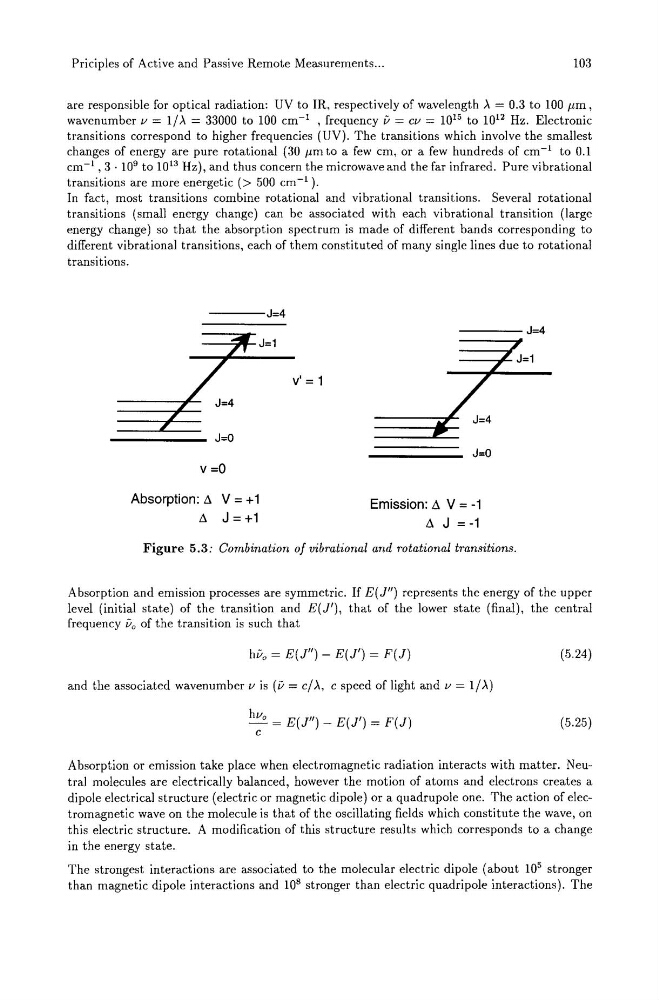
In fact, most transitions combine rotational and vibrational transitions. Several rotational
transitions (small energy change) can be associated with each vibrational transition (large
energy change) so that the absorption spectrum is made of different bands corresponding to
different vibrational transitions, each of them constituted of many single lines due to rotational
transitions.
----J=4
J=O
v =0
Absorption: t.. V = + 1
t.. J = +1
v' = 1
- - - - J = 4
--~J=1
J=O
Emission: t.. V =-1
t.. J =-1
Figure 5.3: Combination of vibrational and rotational transitions.
Absorption and emission processes are symmetric. If E(J") represents the energy of the upper
level (initial state) of the transition and E(J ' ), that of the lower state (final), the central
frequency Vo of the transition is such that
hVa = E(J") - E(J') = F(J)
(5.24)
and the associated wavenumber v is (v = c/ >., c speed of light and v = 1/>.)
hV a = E(J") _ E(J') = F(J)
c
(5.25)
Absorption or emission take place when electromagnetic radiation interacts with matter. Neutral molecules are electrically balanced, however the motion of atoms and electrons creates a
dipole electrical structure (electric or magnetic dipole) or a quadrupole one. The action of electromagnetic wave on the molecule is that of the oscillating fields which constitute the wave, on
this electric structure. A modification of this structure results which corresponds to a change
in the energy state.
The strongest interactions are associated to the molecular electric dipole (about 10 5 stronger
than magnetic dipole interactions and 10 8 stronger than electric quadripole interactions). The
103
are responsible for optical radiation: UV to IR, respectively of wavelength>. = 0.3 to 100 ""m,
wavenumber v = 1/>. = 33000 to 100 cm- 1 ,frequency v = cv = 10 15 to 10 12 Hz. Electronic
transitions correspond to higher frequencies (UV). The transitions which involve the smallest
changes of energy are pure rotational (30 ""m to a few cm, or a few hundreds of cm- 1 to 0.1
cm- 1 , 3 . 10 9 to 10 13 Hz), and thus concern the microwave and the far infrared. Pure vibrational
transitions are more energetic (> 500 cm- 1 ).
In fact, most transitions combine rotational and vibrational transitions. Several rotational
transitions (small energy change) can be associated with each vibrational transition (large
energy change) so that the absorption spectrum is made of different bands corresponding to
different vibrational transitions, each of them constituted of many single lines due to rotational
transitions.
----J=4
J=O
v =0
Absorption: t.. V = + 1
t.. J = +1
v' = 1
- - - - J = 4
--~J=1
J=O
Emission: t.. V =-1
t.. J =-1
Figure 5.3: Combination of vibrational and rotational transitions.
Absorption and emission processes are symmetric. If E(J") represents the energy of the upper
level (initial state) of the transition and E(J ' ), that of the lower state (final), the central
frequency Vo of the transition is such that
hVa = E(J") - E(J') = F(J)
(5.24)
and the associated wavenumber v is (v = c/ >., c speed of light and v = 1/>.)
hV a = E(J") _ E(J') = F(J)
c
(5.25)
Absorption or emission take place when electromagnetic radiation interacts with matter. Neutral molecules are electrically balanced, however the motion of atoms and electrons creates a
dipole electrical structure (electric or magnetic dipole) or a quadrupole one. The action of electromagnetic wave on the molecule is that of the oscillating fields which constitute the wave, on
this electric structure. A modification of this structure results which corresponds to a change
in the energy state.
The strongest interactions are associated to the molecular electric dipole (about 10 5 stronger
than magnetic dipole interactions and 10 8 stronger than electric quadripole interactions). The