

102
Y. Fouquart and M. Vesperini
Wm -~ter-1~m-1
B(A, T = 300K)
Wm-2ster -I~m-I
B(A, T = 5750K)
10
30
8
25
20
6
15
4
10
2
5
A(~m)
0
0
0
5
10
15
20
25
30
35
0
0.5
1.5 2
2.5
3
3.5
4
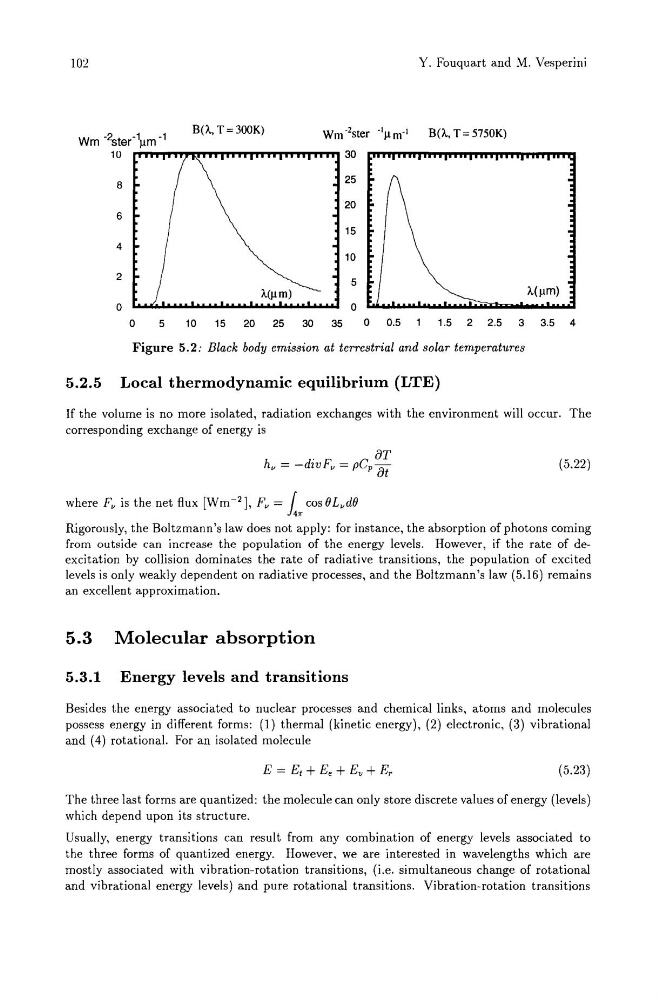
Figure 5.2: Black body emission at terrestrial and solar temperatures
5.2.5 Local thermodynamic equilibrium (LTE)
If the volume is no more isolated, radiation exchanges with the environment will occur. The
corresponding exchange of energy is
(5.22)
where Fv is the net flux [Wm- 2 ], Fv = r cosfJLvdfJ
J47r
Rigorously, the Boltzmann's law does not apply: for instance, the absorption of photons coming
from outside can increase the population of the energy levels. However, if the rate of deexcitation by collision dominates the rate of radiative transitions, the population of excited
levels is only weakly dependent on radiative processes, and the Boltzmann's law (5.16) remains
an excellent approximation.
5.3 Molecular absorption
5.3.1 Energy levels and transitions
Besides the energy associated to nuclear processes and chemical links, atoms and molecules
possess energy in different forms: (1) thermal (kinetic energy), (2) electronic, (3) vibrational
and (4) rotational. For an isolated molecule
( 5.23)
The three last forms are quantized: the molecule can only store discrete values of energy (levels)
which depend upon its structure.
Usually, energy transitions can result from any combination of energy levels associated to
the three forms of quantized energy. However, we are interested in wavelengths which are
mostly associated with vibration-rotation transitions, (i.e. simultaneous change of rotational
and vibrational energy levels) and pure rotational transitions. Vibration-rotation transitions
Y. Fouquart and M. Vesperini
Wm -~ter-1~m-1
B(A, T = 300K)
Wm-2ster -I~m-I
B(A, T = 5750K)
10
30
8
25
20
6
15
4
10
2
5
A(~m)
0
0
0
5
10
15
20
25
30
35
0
0.5
1.5 2
2.5
3
3.5
4
Figure 5.2: Black body emission at terrestrial and solar temperatures
5.2.5 Local thermodynamic equilibrium (LTE)
If the volume is no more isolated, radiation exchanges with the environment will occur. The
corresponding exchange of energy is
(5.22)
where Fv is the net flux [Wm- 2 ], Fv = r cosfJLvdfJ
J47r
Rigorously, the Boltzmann's law does not apply: for instance, the absorption of photons coming
from outside can increase the population of the energy levels. However, if the rate of deexcitation by collision dominates the rate of radiative transitions, the population of excited
levels is only weakly dependent on radiative processes, and the Boltzmann's law (5.16) remains
an excellent approximation.
5.3 Molecular absorption
5.3.1 Energy levels and transitions
Besides the energy associated to nuclear processes and chemical links, atoms and molecules
possess energy in different forms: (1) thermal (kinetic energy), (2) electronic, (3) vibrational
and (4) rotational. For an isolated molecule
( 5.23)
The three last forms are quantized: the molecule can only store discrete values of energy (levels)
which depend upon its structure.
Usually, energy transitions can result from any combination of energy levels associated to
the three forms of quantized energy. However, we are interested in wavelengths which are
mostly associated with vibration-rotation transitions, (i.e. simultaneous change of rotational
and vibrational energy levels) and pure rotational transitions. Vibration-rotation transitions