

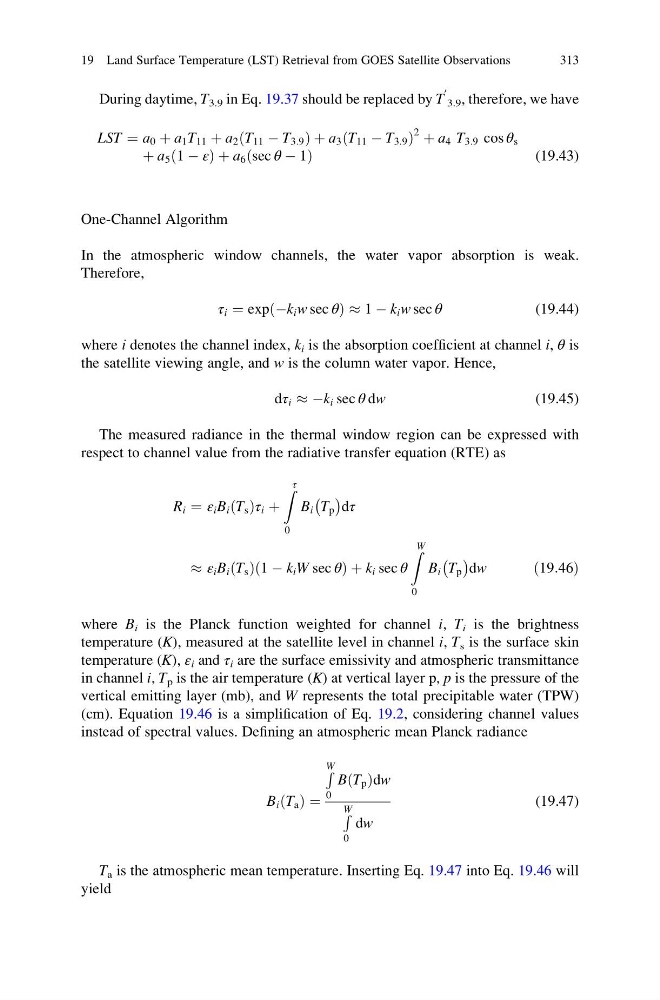
During daytime, T 3.9 in Eq. 19.37 should be replaced by T
0
3.9 , therefore, we have
LST ¼ a 0 þ a 1 T 11 þ a 2 T 11 À T 3:9
ð
Þþa 3 T 11 À T 3:9
ð
Þ
2 þ a 4 T 3:9 cos θ s
þ a 5 ð1 À εÞ þ a 6 ðsec θ À 1Þ
(19.43)
One-Channel Algorithm
In the atmospheric window channels, the water vapor absorption is weak.
Therefore,
τ i ¼ exp Àk i w sec θ
ð
Þ%1 À k i w sec θ
(19.44)
where i denotes the channel index, k i is the absorption coefficient at channel i, θ is
the satellite viewing angle, and w is the column water vapor. Hence,
dτ i % Àk i sec θ dw
(19.45)
The measured radiance in the thermal window region can be expressed with
respect to channel value from the radiative transfer equation (RTE) as
R i ¼ ε i B i T s
ð Þτ i þ
Z τ
0
B i T p
À Á
dτ
% ε i B i T s
ð Þ 1 À k i W sec θ
ð
Þ þ k i sec θ
Z W
0
B i T p
À Á
dw
ð19:46Þ
where B i is the Planck function weighted for channel i, T i is the brightness
temperature (K), measured at the satellite level in channel i, T s is the surface skin
temperature (K), ε i and τ i are the surface emissivity and atmospheric transmittance
in channel i, T p is the air temperature (K) at vertical layer p, p is the pressure of the
vertical emitting layer (mb), and W represents the total precipitable water (TPW)
(cm). Equation 19.46 is a simplification of Eq. 19.2, considering channel values
instead of spectral values. Defining an atmospheric mean Planck radiance
B i T a
ð Þ ¼
R W
0
BðT p Þdw
R W
0
dw
(19.47)
T a is the atmospheric mean temperature. Inserting Eq. 19.47 into Eq. 19.46 will
yield
19 Land Surface Temperature (LST) Retrieval from GOES Satellite Observations
313
0
3.9 , therefore, we have
LST ¼ a 0 þ a 1 T 11 þ a 2 T 11 À T 3:9
ð
Þþa 3 T 11 À T 3:9
ð
Þ
2 þ a 4 T 3:9 cos θ s
þ a 5 ð1 À εÞ þ a 6 ðsec θ À 1Þ
(19.43)
One-Channel Algorithm
In the atmospheric window channels, the water vapor absorption is weak.
Therefore,
τ i ¼ exp Àk i w sec θ
ð
Þ%1 À k i w sec θ
(19.44)
where i denotes the channel index, k i is the absorption coefficient at channel i, θ is
the satellite viewing angle, and w is the column water vapor. Hence,
dτ i % Àk i sec θ dw
(19.45)
The measured radiance in the thermal window region can be expressed with
respect to channel value from the radiative transfer equation (RTE) as
R i ¼ ε i B i T s
ð Þτ i þ
Z τ
0
B i T p
À Á
dτ
% ε i B i T s
ð Þ 1 À k i W sec θ
ð
Þ þ k i sec θ
Z W
0
B i T p
À Á
dw
ð19:46Þ
where B i is the Planck function weighted for channel i, T i is the brightness
temperature (K), measured at the satellite level in channel i, T s is the surface skin
temperature (K), ε i and τ i are the surface emissivity and atmospheric transmittance
in channel i, T p is the air temperature (K) at vertical layer p, p is the pressure of the
vertical emitting layer (mb), and W represents the total precipitable water (TPW)
(cm). Equation 19.46 is a simplification of Eq. 19.2, considering channel values
instead of spectral values. Defining an atmospheric mean Planck radiance
B i T a
ð Þ ¼
R W
0
BðT p Þdw
R W
0
dw
(19.47)
T a is the atmospheric mean temperature. Inserting Eq. 19.47 into Eq. 19.46 will
yield
19 Land Surface Temperature (LST) Retrieval from GOES Satellite Observations
313