

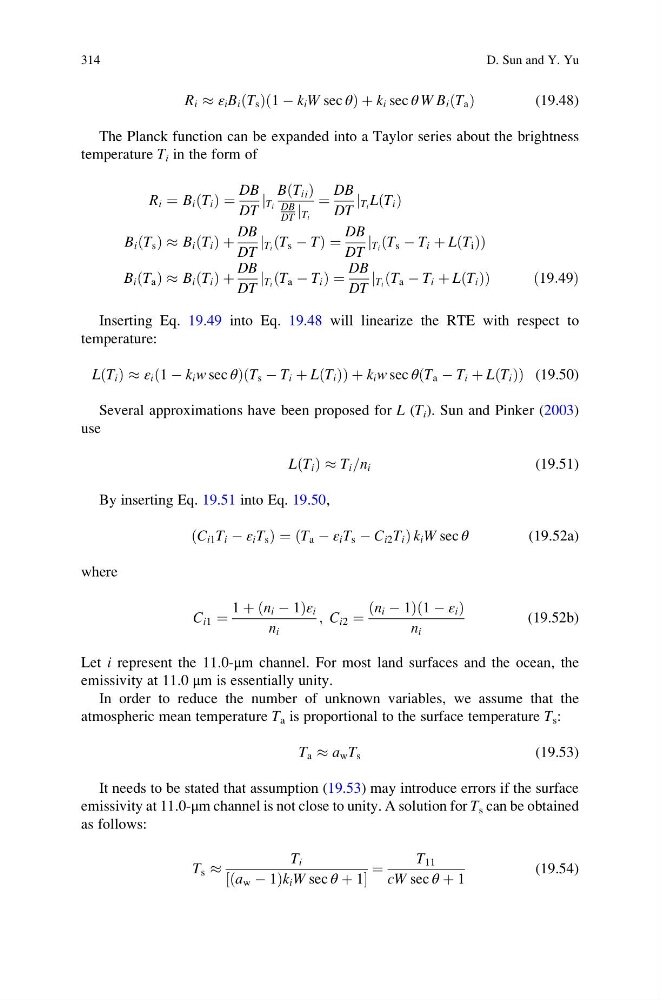
R i % ε i B i T s
ð Þð1 À k i W sec θÞ þ k i sec θ W B i T a
ð Þ
(19.48)
The Planck function can be expanded into a Taylor series about the brightness
temperature T i in the form of
R i ¼ B i T i
ð Þ ¼
DB
DT
T i
j
B T ii
ð Þ
DB
DT T i
j
¼
DB
DT
T i
j L T i
ð Þ
B i T s
ð Þ % B i T i
ð Þ þ
DB
DT
T i T s À T
ð
Þ
j
¼
DB
DT
T i
j T s À T i þ L T i
ð Þ
ð
Þ
B i T a
ð Þ % B i T i
ð Þ þ
DB
DT
T i T a À T i
ð
Þ
j
¼
DB
DT
T i
j T a À T i þ L T i
ð Þ
ð
Þ
ð 19:49Þ
Inserting Eq. 19.49 into Eq. 19.48 will linearize the RTE with respect to
temperature:
L T i
ð Þ % ε i 1 À k i w sec θ
ð
ÞT s À T i þ L T i
ð Þ
ð
Þ þ k i w sec θ T a À T i þ L T i
ð Þ
ð
Þ (19.50)
Several approximations have been proposed for L (T i ). Sun and Pinker (2003)
use
L T i
ð Þ % T i =n i
(19.51)
By inserting Eq. 19.51 into Eq. 19.50,
C i1 T i À ε i T s
ð
Þ¼ T a À ε i T s À C i2 T i
ð
Þ k i W sec θ
(19.52a)
where
C i1 ¼
1 þ n i À 1
ð
Þε i
n i
; C i2 ¼
n i À 1
ð
Þ 1 À ε i
ð
Þ
n i
(19.52b)
Let i represent the 11.0-μm channel. For most land surfaces and the ocean, the
emissivity at 11.0 μm is essentially unity.
In order to reduce the number of unknown variables, we assume that the
atmospheric mean temperature T a is proportional to the surface temperature T s :
T a % a w T s
(19.53)
It needs to be stated that assumption (19.53) may introduce errors if the surface
emissivity at 11.0-μm channel is not close to unity. A solution for T s can be obtained
as follows:
T s %
T i
a w À 1
ð
Þk i W sec θ þ 1
½
¼
T 11
cW sec θ þ 1
(19.54)
314
D. Sun and Y. Yu
ð Þð1 À k i W sec θÞ þ k i sec θ W B i T a
ð Þ
(19.48)
The Planck function can be expanded into a Taylor series about the brightness
temperature T i in the form of
R i ¼ B i T i
ð Þ ¼
DB
DT
T i
j
B T ii
ð Þ
DB
DT T i
j
¼
DB
DT
T i
j L T i
ð Þ
B i T s
ð Þ % B i T i
ð Þ þ
DB
DT
T i T s À T
ð
Þ
j
¼
DB
DT
T i
j T s À T i þ L T i
ð Þ
ð
Þ
B i T a
ð Þ % B i T i
ð Þ þ
DB
DT
T i T a À T i
ð
Þ
j
¼
DB
DT
T i
j T a À T i þ L T i
ð Þ
ð
Þ
ð 19:49Þ
Inserting Eq. 19.49 into Eq. 19.48 will linearize the RTE with respect to
temperature:
L T i
ð Þ % ε i 1 À k i w sec θ
ð
ÞT s À T i þ L T i
ð Þ
ð
Þ þ k i w sec θ T a À T i þ L T i
ð Þ
ð
Þ (19.50)
Several approximations have been proposed for L (T i ). Sun and Pinker (2003)
use
L T i
ð Þ % T i =n i
(19.51)
By inserting Eq. 19.51 into Eq. 19.50,
C i1 T i À ε i T s
ð
Þ¼ T a À ε i T s À C i2 T i
ð
Þ k i W sec θ
(19.52a)
where
C i1 ¼
1 þ n i À 1
ð
Þε i
n i
; C i2 ¼
n i À 1
ð
Þ 1 À ε i
ð
Þ
n i
(19.52b)
Let i represent the 11.0-μm channel. For most land surfaces and the ocean, the
emissivity at 11.0 μm is essentially unity.
In order to reduce the number of unknown variables, we assume that the
atmospheric mean temperature T a is proportional to the surface temperature T s :
T a % a w T s
(19.53)
It needs to be stated that assumption (19.53) may introduce errors if the surface
emissivity at 11.0-μm channel is not close to unity. A solution for T s can be obtained
as follows:
T s %
T i
a w À 1
ð
Þk i W sec θ þ 1
½
¼
T 11
cW sec θ þ 1
(19.54)
314
D. Sun and Y. Yu