

The coefficients in (19.41) may depend on surface type or emissivity, since the
surface bidirectional reflectivity is related to it. In the window channels, the major
absorbing gas is the water vapor, but neglect of absorption from CH 4 and N 2 O in the
GOES 3.9-μm channel can contribute to additional errors. Estimating atmospheric
CH 4 and N 2 O amounts is difficult. To allow for the effect of all absorbers in this
channel, we propose to use the brightness temperature T 3.9 to replace ρ b θ s ; θ
ð
Þus in
(19.41), by modifying the coefficients in this equation as follows:
T
0
3:9 % T 3:9 À c 0
0
ðlÞ þ c
0
1 ðlÞT 3:9 cos θ s
(19.42)
14
12
10
8
6
4
2
0
5
(T11−T3.9) (K)
(Ts−T11) (K)
10
0
−20 −15 −10
−5
Day
Night
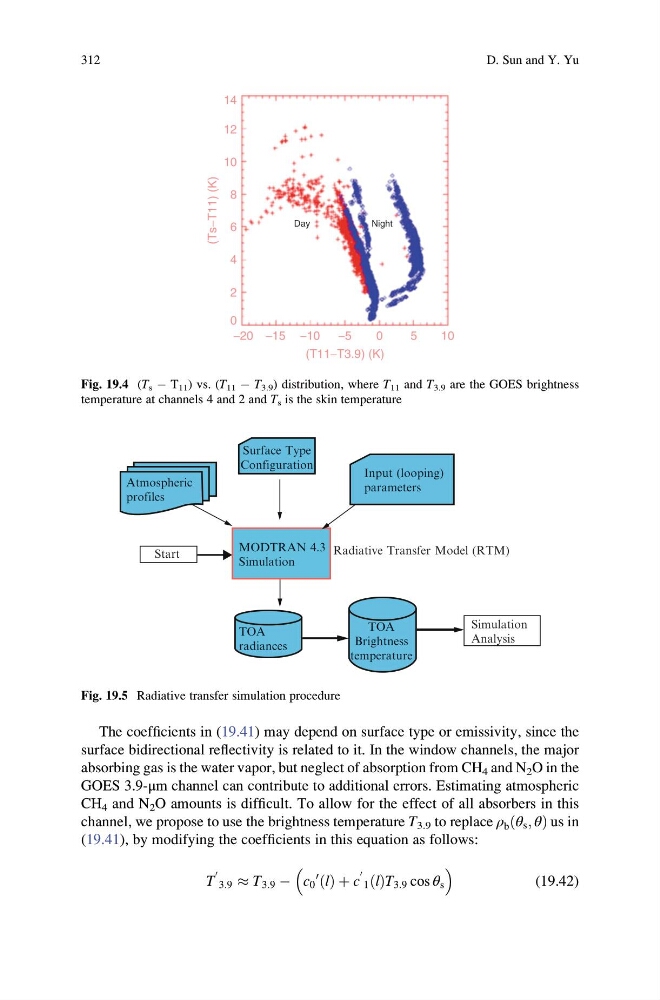
Fig. 19.4 (T s À T 11 ) vs. (T 11 À T 3.9 ) distribution, where T 11 and T 3.9 are the GOES brightness
temperature at channels 4 and 2 and T s is the skin temperature
TOA
radiances
Input (looping)
parameters
Simulation
Analysis
Start
Radiative Transfer Model (RTM)
TOA
Brightness
temperature
MODTRAN 4.3
Simulation
Surface Type
Configuration
Atmospheric
profiles
Fig. 19.5 Radiative transfer simulation procedure
312
D. Sun and Y. Yu
surface bidirectional reflectivity is related to it. In the window channels, the major
absorbing gas is the water vapor, but neglect of absorption from CH 4 and N 2 O in the
GOES 3.9-μm channel can contribute to additional errors. Estimating atmospheric
CH 4 and N 2 O amounts is difficult. To allow for the effect of all absorbers in this
channel, we propose to use the brightness temperature T 3.9 to replace ρ b θ s ; θ
ð
Þus in
(19.41), by modifying the coefficients in this equation as follows:
T
0
3:9 % T 3:9 À c 0
0
ðlÞ þ c
0
1 ðlÞT 3:9 cos θ s
(19.42)
14
12
10
8
6
4
2
0
5
(T11−T3.9) (K)
(Ts−T11) (K)
10
0
−20 −15 −10
−5
Day
Night
Fig. 19.4 (T s À T 11 ) vs. (T 11 À T 3.9 ) distribution, where T 11 and T 3.9 are the GOES brightness
temperature at channels 4 and 2 and T s is the skin temperature
TOA
radiances
Input (looping)
parameters
Simulation
Analysis
Start
Radiative Transfer Model (RTM)
TOA
Brightness
temperature
MODTRAN 4.3
Simulation
Surface Type
Configuration
Atmospheric
profiles
Fig. 19.5 Radiative transfer simulation procedure
312
D. Sun and Y. Yu