

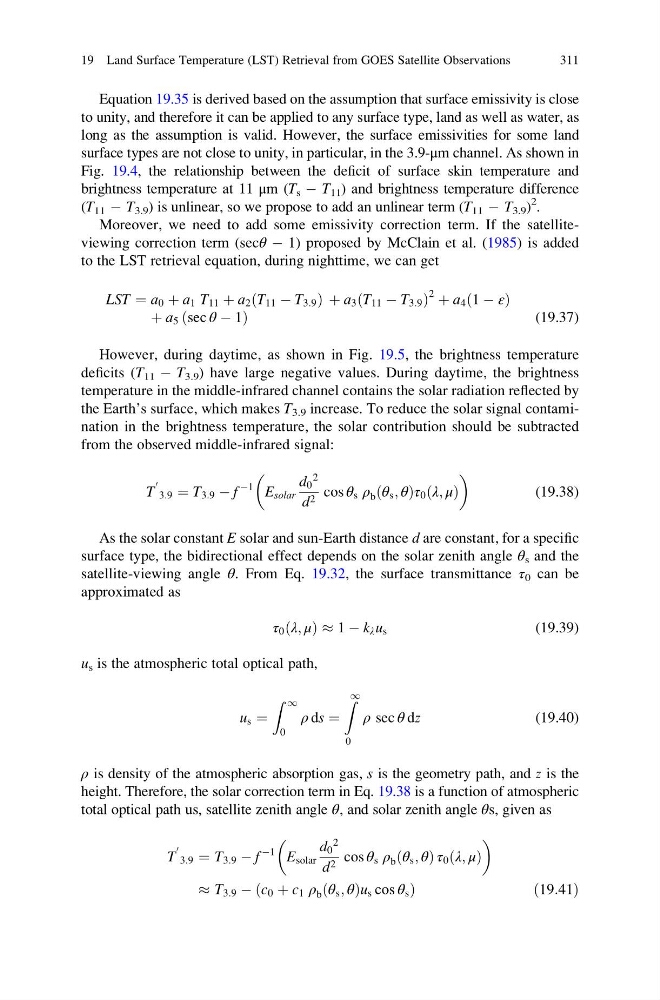
Equation 19.35 is derived based on the assumption that surface emissivity is close
to unity, and therefore it can be applied to any surface type, land as well as water, as
long as the assumption is valid. However, the surface emissivities for some land
surface types are not close to unity, in particular, in the 3.9-μm channel. As shown in
Fig. 19.4, the relationship between the deficit of surface skin temperature and
brightness temperature at 11 μm (T s À T 11 ) and brightness temperature difference
(T 11 À T 3.9 ) is unlinear, so we propose to add an unlinear term (T 11 À T 3.9 )
2
.
Moreover, we need to add some emissivity correction term. If the satelliteviewing correction term (secθ À 1) proposed by McClain et al. (1985) is added
to the LST retrieval equation, during nighttime, we can get
LST ¼ a 0 þ a 1 T 11 þ a 2 T 11 À T 3:9
ð
Þþa 3 T 11 À T 3:9
ð
Þ
2 þ a 4 ð1 À εÞ
þ a 5 ðsec θ À 1Þ
(19.37)
However, during daytime, as shown in Fig. 19.5, the brightness temperature
deficits (T 11 À T 3.9 ) have large negative values. During daytime, the brightness
temperature in the middle-infrared channel contains the solar radiation reflected by
the Earth’s surface, which makes T 3.9 increase. To reduce the solar signal contamination in the brightness temperature, the solar contribution should be subtracted
from the observed middle-infrared signal:
T
0
3:9 ¼ T 3:9 À f
À1 E solar
d 0
2
d 2 cos θ s ρ b θ s ; θ
ð
Þτ 0 ðλ; μÞ
(19.38)
As the solar constant E solar and sun-Earth distance d are constant, for a specific
surface type, the bidirectional effect depends on the solar zenith angle θ s and the
satellite-viewing angle θ. From Eq. 19.32, the surface transmittance τ 0 can be
approximated as
τ 0 ðλ; μÞ % 1 À k λ u s
(19.39)
u s is the atmospheric total optical path,
u s ¼
Z 1
0
ρ ds ¼
Z 1
0
ρ sec θ dz
(19.40)
ρ is density of the atmospheric absorption gas, s is the geometry path, and z is the
height. Therefore, the solar correction term in Eq. 19.38 is a function of atmospheric
total optical path us, satellite zenith angle θ, and solar zenith angle θs, given as
T
0
3:9 ¼ T 3:9 À f
À1 E solar
d 0
2
d 2 cos θ s ρ b θ s ; θ
ð
Þτ 0 ðλ; μÞ
% T 3:9 À c 0 þ c 1 ρ b θ s ; θ
ð
Þu s cos θ s
ð
Þ
ð 19:41Þ
19 Land Surface Temperature (LST) Retrieval from GOES Satellite Observations
311
to unity, and therefore it can be applied to any surface type, land as well as water, as
long as the assumption is valid. However, the surface emissivities for some land
surface types are not close to unity, in particular, in the 3.9-μm channel. As shown in
Fig. 19.4, the relationship between the deficit of surface skin temperature and
brightness temperature at 11 μm (T s À T 11 ) and brightness temperature difference
(T 11 À T 3.9 ) is unlinear, so we propose to add an unlinear term (T 11 À T 3.9 )
2
.
Moreover, we need to add some emissivity correction term. If the satelliteviewing correction term (secθ À 1) proposed by McClain et al. (1985) is added
to the LST retrieval equation, during nighttime, we can get
LST ¼ a 0 þ a 1 T 11 þ a 2 T 11 À T 3:9
ð
Þþa 3 T 11 À T 3:9
ð
Þ
2 þ a 4 ð1 À εÞ
þ a 5 ðsec θ À 1Þ
(19.37)
However, during daytime, as shown in Fig. 19.5, the brightness temperature
deficits (T 11 À T 3.9 ) have large negative values. During daytime, the brightness
temperature in the middle-infrared channel contains the solar radiation reflected by
the Earth’s surface, which makes T 3.9 increase. To reduce the solar signal contamination in the brightness temperature, the solar contribution should be subtracted
from the observed middle-infrared signal:
T
0
3:9 ¼ T 3:9 À f
À1 E solar
d 0
2
d 2 cos θ s ρ b θ s ; θ
ð
Þτ 0 ðλ; μÞ
(19.38)
As the solar constant E solar and sun-Earth distance d are constant, for a specific
surface type, the bidirectional effect depends on the solar zenith angle θ s and the
satellite-viewing angle θ. From Eq. 19.32, the surface transmittance τ 0 can be
approximated as
τ 0 ðλ; μÞ % 1 À k λ u s
(19.39)
u s is the atmospheric total optical path,
u s ¼
Z 1
0
ρ ds ¼
Z 1
0
ρ sec θ dz
(19.40)
ρ is density of the atmospheric absorption gas, s is the geometry path, and z is the
height. Therefore, the solar correction term in Eq. 19.38 is a function of atmospheric
total optical path us, satellite zenith angle θ, and solar zenith angle θs, given as
T
0
3:9 ¼ T 3:9 À f
À1 E solar
d 0
2
d 2 cos θ s ρ b θ s ; θ
ð
Þτ 0 ðλ; μÞ
% T 3:9 À c 0 þ c 1 ρ b θ s ; θ
ð
Þu s cos θ s
ð
Þ
ð 19:41Þ
19 Land Surface Temperature (LST) Retrieval from GOES Satellite Observations
311