

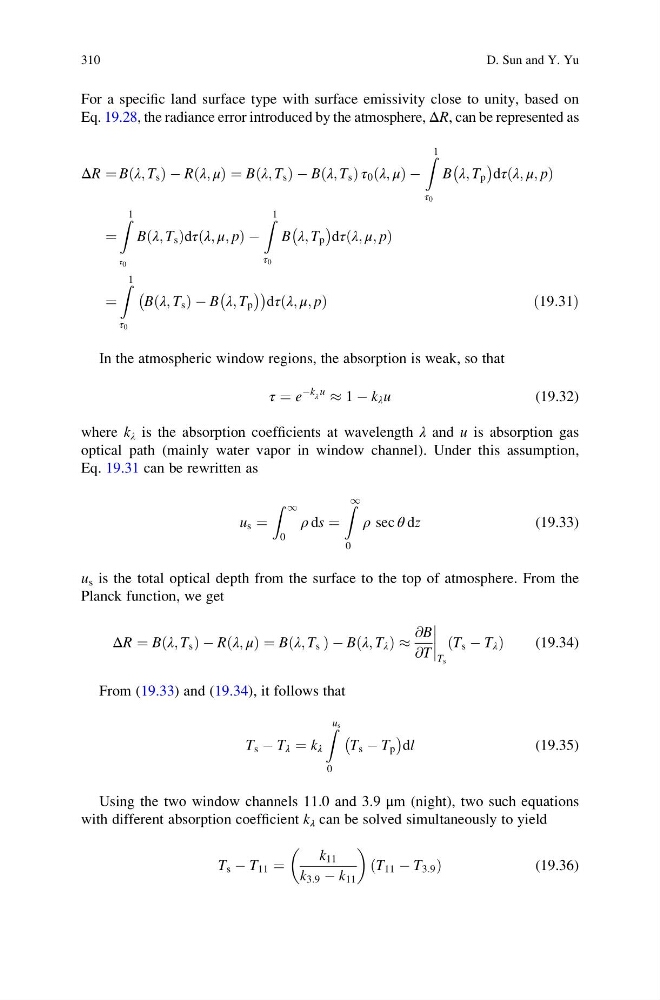
For a specific land surface type with surface emissivity close to unity, based on
Eq. 19.28, the radiance error introduced by the atmosphere, ΔR, can be represented as
ΔR ¼ B λ; T s
ð
ÞÀRðλ; μÞ ¼ B λ; T s
ð
ÞÀB λ; T s
ð
Þτ 0 ðλ; μÞ À
Z 1
τ 0
B λ; T p
À
Á
dτðλ; μ; pÞ
¼
Z 1
τ 0
B λ; T s
ð
Þdτðλ; μ; pÞ À
Z 1
τ 0
B λ; T p
À
Á
dτðλ; μ; pÞ
¼
Z 1
τ 0
B λ; T s
ð
ÞÀB λ; T p
À
Á
À
Á
dτðλ; μ; pÞ
ð 19:31Þ
In the atmospheric window regions, the absorption is weak, so that
τ ¼ e
Àk λ u
% 1 À k λ u
(19.32)
where k λ is the absorption coefficients at wavelength λ and u is absorption gas
optical path (mainly water vapor in window channel). Under this assumption,
Eq. 19.31 can be rewritten as
u s ¼
Z 1
0
ρ ds ¼
Z 1
0
ρ sec θ dz
(19.33)
u s is the total optical depth from the surface to the top of atmosphere. From the
Planck function, we get
ΔR ¼ B λ; T s
ð
ÞÀRðλ; μÞ ¼ B λ; T s
ð
ÞÀB λ; T λ
ð
Þ%
@B
@T
T s
T s À T λ
ð
Þ
(19.34)
From (19.33) and (19.34), it follows that
T s À T λ ¼ k λ
Z u s
0
T s À T p
À
Á
dl
(19.35)
Using the two window channels 11.0 and 3.9 μm (night), two such equations
with different absorption coefficient k λ can be solved simultaneously to yield
T s À T 11 ¼
k 11
k 3:9 À k 11
T 11 À T 3:9
ð
Þ
(19.36)
310
D. Sun and Y. Yu
Eq. 19.28, the radiance error introduced by the atmosphere, ΔR, can be represented as
ΔR ¼ B λ; T s
ð
ÞÀRðλ; μÞ ¼ B λ; T s
ð
ÞÀB λ; T s
ð
Þτ 0 ðλ; μÞ À
Z 1
τ 0
B λ; T p
À
Á
dτðλ; μ; pÞ
¼
Z 1
τ 0
B λ; T s
ð
Þdτðλ; μ; pÞ À
Z 1
τ 0
B λ; T p
À
Á
dτðλ; μ; pÞ
¼
Z 1
τ 0
B λ; T s
ð
ÞÀB λ; T p
À
Á
À
Á
dτðλ; μ; pÞ
ð 19:31Þ
In the atmospheric window regions, the absorption is weak, so that
τ ¼ e
Àk λ u
% 1 À k λ u
(19.32)
where k λ is the absorption coefficients at wavelength λ and u is absorption gas
optical path (mainly water vapor in window channel). Under this assumption,
Eq. 19.31 can be rewritten as
u s ¼
Z 1
0
ρ ds ¼
Z 1
0
ρ sec θ dz
(19.33)
u s is the total optical depth from the surface to the top of atmosphere. From the
Planck function, we get
ΔR ¼ B λ; T s
ð
ÞÀRðλ; μÞ ¼ B λ; T s
ð
ÞÀB λ; T λ
ð
Þ%
@B
@T
T s
T s À T λ
ð
Þ
(19.34)
From (19.33) and (19.34), it follows that
T s À T λ ¼ k λ
Z u s
0
T s À T p
À
Á
dl
(19.35)
Using the two window channels 11.0 and 3.9 μm (night), two such equations
with different absorption coefficient k λ can be solved simultaneously to yield
T s À T 11 ¼
k 11
k 3:9 À k 11
T 11 À T 3:9
ð
Þ
(19.36)
310
D. Sun and Y. Yu