

19.3.2.4 LST Algorithms for GOES M (12)-Q Series
In the absence of the 12-μm channel for the GOES M (12)-Q series, we proposed
two candidate approaches:
• Dual-window algorithm combining 3.9- and 11.0-μm channels
• One-channel algorithm using total precipitable water (TPW)
Dual-Window Algorithm
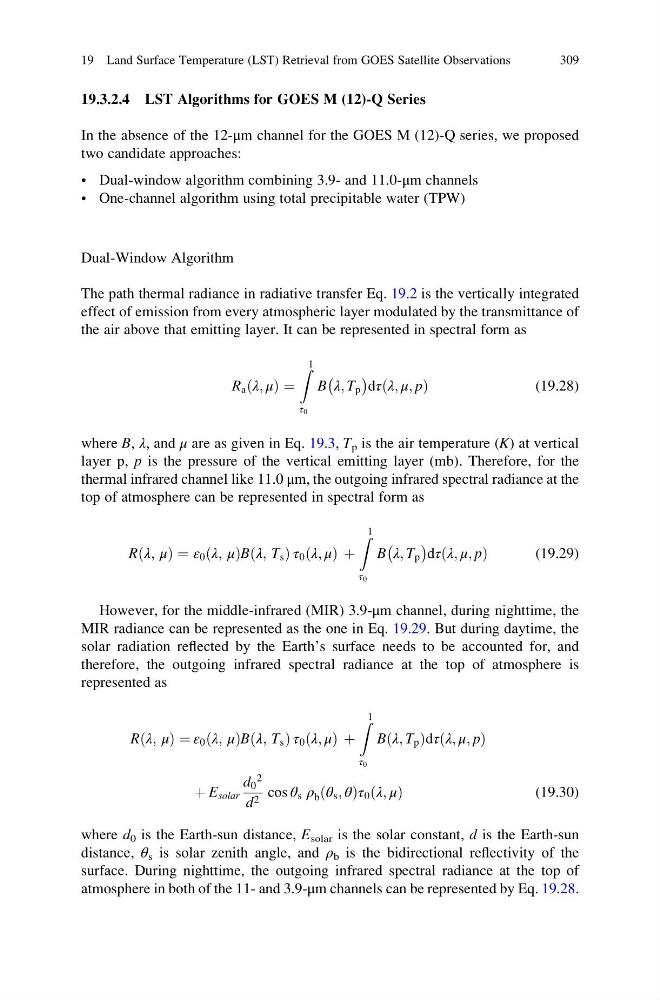
The path thermal radiance in radiative transfer Eq. 19.2 is the vertically integrated
effect of emission from every atmospheric layer modulated by the transmittance of
the air above that emitting layer. It can be represented in spectral form as
R a ðλ; μÞ ¼
Z 1
τ 0
B λ; T p
À
Á
dτðλ; μ; pÞ
(19.28)
where B, λ, and μ are as given in Eq. 19.3, T p is the air temperature (K) at vertical
layer p, p is the pressure of the vertical emitting layer (mb). Therefore, for the
thermal infrared channel like 11.0 μm, the outgoing infrared spectral radiance at the
top of atmosphere can be represented in spectral form as
Rðλ; μÞ ¼ ε 0 ðλ; μÞB λ; T s
ð
Þτ 0 ðλ; μÞ þ
Z 1
τ 0
B λ; T p
À
Á
dτðλ; μ; pÞ
(19.29)
However, for the middle-infrared (MIR) 3.9-μm channel, during nighttime, the
MIR radiance can be represented as the one in Eq. 19.29. But during daytime, the
solar radiation reflected by the Earth’s surface needs to be accounted for, and
therefore, the outgoing infrared spectral radiance at the top of atmosphere is
represented as
Rðλ; μÞ ¼ ε 0 ðλ; μÞB λ; T s
ð
Þτ 0 ðλ; μÞ þ
Z 1
τ 0
Bðλ; T p Þdτðλ; μ; pÞ
þ E solar
d 0
2
d 2 cos θ s ρ b θ s ; θ
ð
Þτ 0 ðλ; μÞ
(19.30)
where d 0 is the Earth-sun distance, E solar is the solar constant, d is the Earth-sun
distance, θ s is solar zenith angle, and ρ b is the bidirectional reflectivity of the
surface. During nighttime, the outgoing infrared spectral radiance at the top of
atmosphere in both of the 11- and 3.9-μm channels can be represented by Eq. 19.28.
19 Land Surface Temperature (LST) Retrieval from GOES Satellite Observations
309
In the absence of the 12-μm channel for the GOES M (12)-Q series, we proposed
two candidate approaches:
• Dual-window algorithm combining 3.9- and 11.0-μm channels
• One-channel algorithm using total precipitable water (TPW)
Dual-Window Algorithm
The path thermal radiance in radiative transfer Eq. 19.2 is the vertically integrated
effect of emission from every atmospheric layer modulated by the transmittance of
the air above that emitting layer. It can be represented in spectral form as
R a ðλ; μÞ ¼
Z 1
τ 0
B λ; T p
À
Á
dτðλ; μ; pÞ
(19.28)
where B, λ, and μ are as given in Eq. 19.3, T p is the air temperature (K) at vertical
layer p, p is the pressure of the vertical emitting layer (mb). Therefore, for the
thermal infrared channel like 11.0 μm, the outgoing infrared spectral radiance at the
top of atmosphere can be represented in spectral form as
Rðλ; μÞ ¼ ε 0 ðλ; μÞB λ; T s
ð
Þτ 0 ðλ; μÞ þ
Z 1
τ 0
B λ; T p
À
Á
dτðλ; μ; pÞ
(19.29)
However, for the middle-infrared (MIR) 3.9-μm channel, during nighttime, the
MIR radiance can be represented as the one in Eq. 19.29. But during daytime, the
solar radiation reflected by the Earth’s surface needs to be accounted for, and
therefore, the outgoing infrared spectral radiance at the top of atmosphere is
represented as
Rðλ; μÞ ¼ ε 0 ðλ; μÞB λ; T s
ð
Þτ 0 ðλ; μÞ þ
Z 1
τ 0
Bðλ; T p Þdτðλ; μ; pÞ
þ E solar
d 0
2
d 2 cos θ s ρ b θ s ; θ
ð
Þτ 0 ðλ; μÞ
(19.30)
where d 0 is the Earth-sun distance, E solar is the solar constant, d is the Earth-sun
distance, θ s is solar zenith angle, and ρ b is the bidirectional reflectivity of the
surface. During nighttime, the outgoing infrared spectral radiance at the top of
atmosphere in both of the 11- and 3.9-μm channels can be represented by Eq. 19.28.
19 Land Surface Temperature (LST) Retrieval from GOES Satellite Observations
309