

commercial use and, from 2000 onwards, we have noticed that maximum income is
coming from agriculture and consequently the land intensification is very high. The
domestication of wild medicinal and aromatic plants is new paradigm shift in the
Himalayan region. The people have adopted this activity as a problem-solving
component in their economics (Nautiyal 1998; Maikhuri et al. 1998; Nautiyal et al.
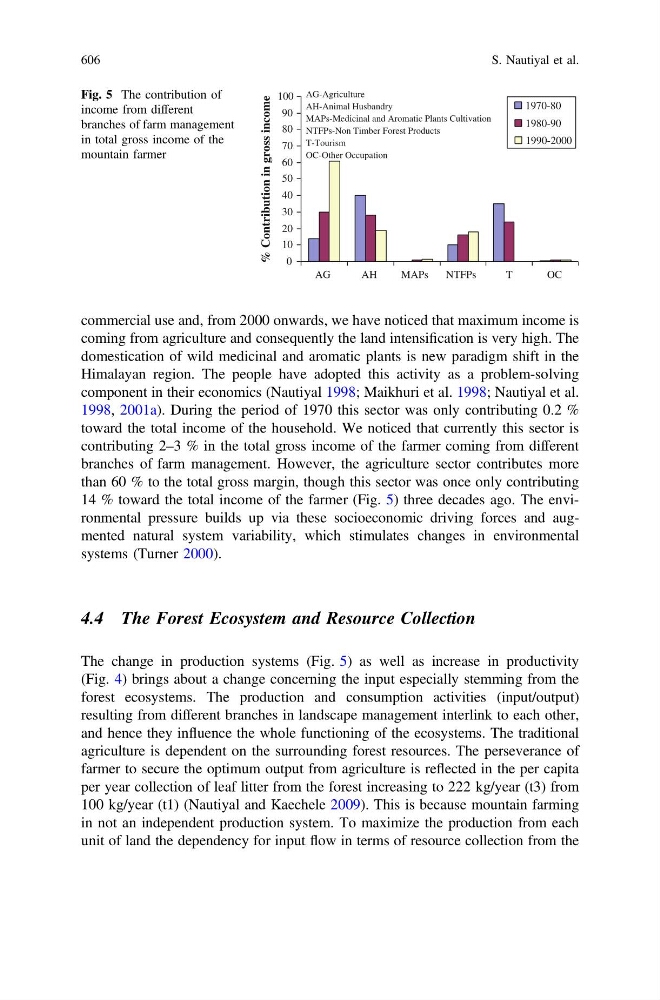
1998, 2001a). During the period of 1970 this sector was only contributing 0.2 %
toward the total income of the household. We noticed that currently this sector is
contributing 2–3 % in the total gross income of the farmer coming from different
branches of farm management. However, the agriculture sector contributes more
than 60 % to the total gross margin, though this sector was once only contributing
14 % toward the total income of the farmer (Fig. 5) three decades ago. The environmental pressure builds up via these socioeconomic driving forces and augmented natural system variability, which stimulates changes in environmental
systems (Turner 2000).
4.4 The Forest Ecosystem and Resource Collection
The change in production systems (Fig. 5) as well as increase in productivity
(Fig. 4) brings about a change concerning the input especially stemming from the
forest ecosystems. The production and consumption activities (input/output)
resulting from different branches in landscape management interlink to each other,
and hence they influence the whole functioning of the ecosystems. The traditional
agriculture is dependent on the surrounding forest resources. The perseverance of
farmer to secure the optimum output from agriculture is reflected in the per capita
per year collection of leaf litter from the forest increasing to 222 kg/year (t3) from
100 kg/year (t1) (Nautiyal and Kaechele 2009). This is because mountain farming
in not an independent production system. To maximize the production from each
unit of land the dependency for input flow in terms of resource collection from the
0
10
20
30
40
50
60
70
80
90
100
AG
AH
MAPs
NTFPs
T
OC
% Contribution in gross income
1970-80
1980-90
1990-2000
AG-Agriculture
AH-Animal Husbandry
MAPs-Medicinal and Aromatic Plants Cultivation
NTFPs-Non Timber Forest Products
T-Tourism
OC-Other Occupation
Fig. 5 The contribution of
income from different
branches of farm management
in total gross income of the
mountain farmer
606
S. Nautiyal et al.