

forests has increased tremendously (Sen et al. 2002; Semwal et al. 2004). There are
several other reasons, such as the fodder (crop by product) yield decreasing up to
35–70 % (Nautiyal et al. 2007). The replacement of traditional varieties with the
introduction of high yielding varieties is one of the factors found responsible for the
high exploitation of the forest resources (Maikhuri et al. 1996; Sen et al. 2002;
Bisht et al. 2006; Nautiyal and Kaechele 2009).
Other resource demands, such as non-timber forest product collection (NTFPs)
for the forests and alpine pastures, have been quantified and make a significant
contribution to the local economy. We have noticed that three decades ago (1970–
1980) the NTFPs collection in the form of medicinal and aromatic plants and other
wild edibles and for a variety of other uses was contributing 10 % toward the total
gross income of the farmers, which was reported 16 % during the period of 1980–
1990. Continual incremental change was further noticed from this sector/branch and
during 1990–2000 this sector is again making significant contribution, with 18 %
toward the total gross income of the local farmer.
4.5 Landscape Change and Scenario Development
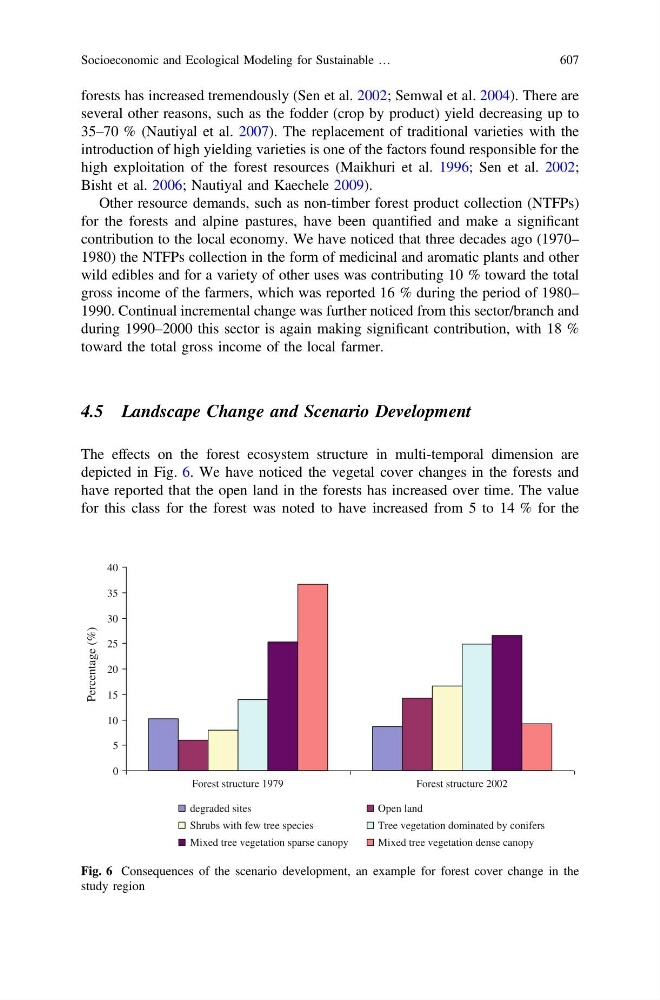
The effects on the forest ecosystem structure in multi-temporal dimension are
depicted in Fig. 6. We have noticed the vegetal cover changes in the forests and
have reported that the open land in the forests has increased over time. The value
for this class for the forest was noted to have increased from 5 to 14 % for the
0
5
10
15
20
25
30
35
40
Forest structure 1979
Forest structure 2002
Percentage (%)
degraded sites
Open land
Shrubs with few tree species
Tree vegetation dominated by conifers
Mixed tree vegetation sparse canopy
Mixed tree vegetation dense canopy
Fig. 6 Consequences of the scenario development, an example for forest cover change in the
study region
Socioeconomic and Ecological Modeling for Sustainable …
607