

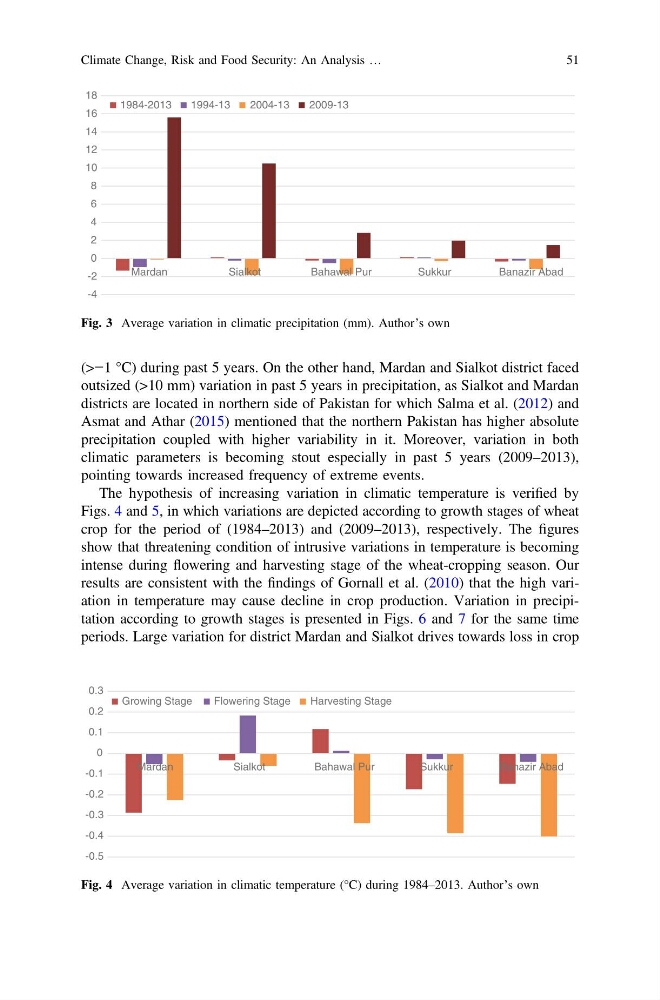
(>−1 °C) during past 5 years. On the other hand, Mardan and Sialkot district faced
outsized (>10 mm) variation in past 5 years in precipitation, as Sialkot and Mardan
districts are located in northern side of Pakistan for which Salma et al. (2012) and
Asmat and Athar (2015) mentioned that the northern Pakistan has higher absolute
precipitation coupled with higher variability in it. Moreover, variation in both
climatic parameters is becoming stout especially in past 5 years (2009–2013),
pointing towards increased frequency of extreme events.
The hypothesis of increasing variation in climatic temperature is verified by
Figs. 4 and 5, in which variations are depicted according to growth stages of wheat
crop for the period of (1984–2013) and (2009–2013), respectively. The figures
show that threatening condition of intrusive variations in temperature is becoming
intense during flowering and harvesting stage of the wheat-cropping season. Our
results are consistent with the findings of Gornall et al. (2010) that the high variation in temperature may cause decline in crop production. Variation in precipitation according to growth stages is presented in Figs. 6 and 7 for the same time
periods. Large variation for district Mardan and Sialkot drives towards loss in crop
-4
-2
0
2
4
6
8
10
12
14
16
18
Mardan
Sialkot
Bahawal Pur
Sukkur
Banazir Abad
1984-2013
1994-13
2004-13
2009-13
Fig. 3 Average variation in climatic precipitation (mm). Author’s own
-0.5
-0.4
-0.3
-0.2
-0.1
0
0.1
0.2
0.3
Mardan
Sialkot
Bahawal Pur
Sukkur
Banazir Abad
Growing Stage
Flowering Stage
Harvesting Stage
Fig. 4 Average variation in climatic temperature (°C) during 1984–2013. Author’s own
Climate Change, Risk and Food Security: An Analysis …
51
outsized (>10 mm) variation in past 5 years in precipitation, as Sialkot and Mardan
districts are located in northern side of Pakistan for which Salma et al. (2012) and
Asmat and Athar (2015) mentioned that the northern Pakistan has higher absolute
precipitation coupled with higher variability in it. Moreover, variation in both
climatic parameters is becoming stout especially in past 5 years (2009–2013),
pointing towards increased frequency of extreme events.
The hypothesis of increasing variation in climatic temperature is verified by
Figs. 4 and 5, in which variations are depicted according to growth stages of wheat
crop for the period of (1984–2013) and (2009–2013), respectively. The figures
show that threatening condition of intrusive variations in temperature is becoming
intense during flowering and harvesting stage of the wheat-cropping season. Our
results are consistent with the findings of Gornall et al. (2010) that the high variation in temperature may cause decline in crop production. Variation in precipitation according to growth stages is presented in Figs. 6 and 7 for the same time
periods. Large variation for district Mardan and Sialkot drives towards loss in crop
-4
-2
0
2
4
6
8
10
12
14
16
18
Mardan
Sialkot
Bahawal Pur
Sukkur
Banazir Abad
1984-2013
1994-13
2004-13
2009-13
Fig. 3 Average variation in climatic precipitation (mm). Author’s own
-0.5
-0.4
-0.3
-0.2
-0.1
0
0.1
0.2
0.3
Mardan
Sialkot
Bahawal Pur
Sukkur
Banazir Abad
Growing Stage
Flowering Stage
Harvesting Stage
Fig. 4 Average variation in climatic temperature (°C) during 1984–2013. Author’s own
Climate Change, Risk and Food Security: An Analysis …
51