

where P t
ð Þ depicts the population at time (t), PðoÞ is the initial population, t is the
number of years and r is the growth rate. Using calculated growth rate, population
of several years were estimated to compare with wheat crop production for the
respective years to evaluate per-capita availability level for analyzing the food
security conditions at national level.
3 Results and Discussion
This section is divided into three subsections according to defined study objectives.
First subsection describes the results of variability in climatic parameters across
latitudinal zones of Pakistan. Second subsection presents the results of regression
analysis explaining the risk in wheat yield due to change in climatic parameters.
The last subsection showed the self-sufficiency in wheat crop to assess wheat
availability at local level.
3.1 Variation in Climatic Parameters
Temperature and precipitation are two important climatic variables in crop production. Variability in these variables referred to variability in climatic parameters
was evaluated across different latitudinal zones of Pakistan. For a keen insight, both
seasonal variation and variation during different growth stages of wheat for different
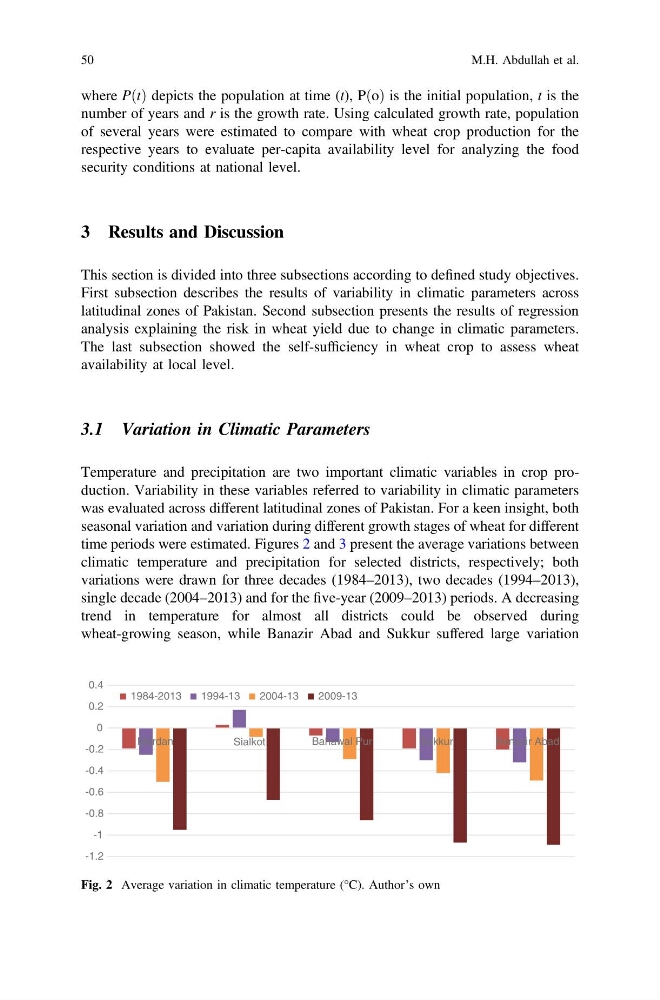
time periods were estimated. Figures 2 and 3 present the average variations between
climatic temperature and precipitation for selected districts, respectively; both
variations were drawn for three decades (1984–2013), two decades (1994–2013),
single decade (2004–2013) and for the five-year (2009–2013) periods. A decreasing
trend in temperature for almost all districts could be observed during
wheat-growing season, while Banazir Abad and Sukkur suffered large variation
-1.2
-1
-0.8
-0.6
-0.4
-0.2
0
0.2
0.4
Mardan
Bahawal Pur
Sukkur
Banazir Abad
1984-2013
1994-13
2004-13
2009-13
Sialkot
Fig. 2 Average variation in climatic temperature (°C). Author’s own
50
M.H. Abdullah et al.
ð Þ depicts the population at time (t), PðoÞ is the initial population, t is the
number of years and r is the growth rate. Using calculated growth rate, population
of several years were estimated to compare with wheat crop production for the
respective years to evaluate per-capita availability level for analyzing the food
security conditions at national level.
3 Results and Discussion
This section is divided into three subsections according to defined study objectives.
First subsection describes the results of variability in climatic parameters across
latitudinal zones of Pakistan. Second subsection presents the results of regression
analysis explaining the risk in wheat yield due to change in climatic parameters.
The last subsection showed the self-sufficiency in wheat crop to assess wheat
availability at local level.
3.1 Variation in Climatic Parameters
Temperature and precipitation are two important climatic variables in crop production. Variability in these variables referred to variability in climatic parameters
was evaluated across different latitudinal zones of Pakistan. For a keen insight, both
seasonal variation and variation during different growth stages of wheat for different
time periods were estimated. Figures 2 and 3 present the average variations between
climatic temperature and precipitation for selected districts, respectively; both
variations were drawn for three decades (1984–2013), two decades (1994–2013),
single decade (2004–2013) and for the five-year (2009–2013) periods. A decreasing
trend in temperature for almost all districts could be observed during
wheat-growing season, while Banazir Abad and Sukkur suffered large variation
-1.2
-1
-0.8
-0.6
-0.4
-0.2
0
0.2
0.4
Mardan
Bahawal Pur
Sukkur
Banazir Abad
1984-2013
1994-13
2004-13
2009-13
Sialkot
Fig. 2 Average variation in climatic temperature (°C). Author’s own
50
M.H. Abdullah et al.