

2.5 Stochastic Production Function
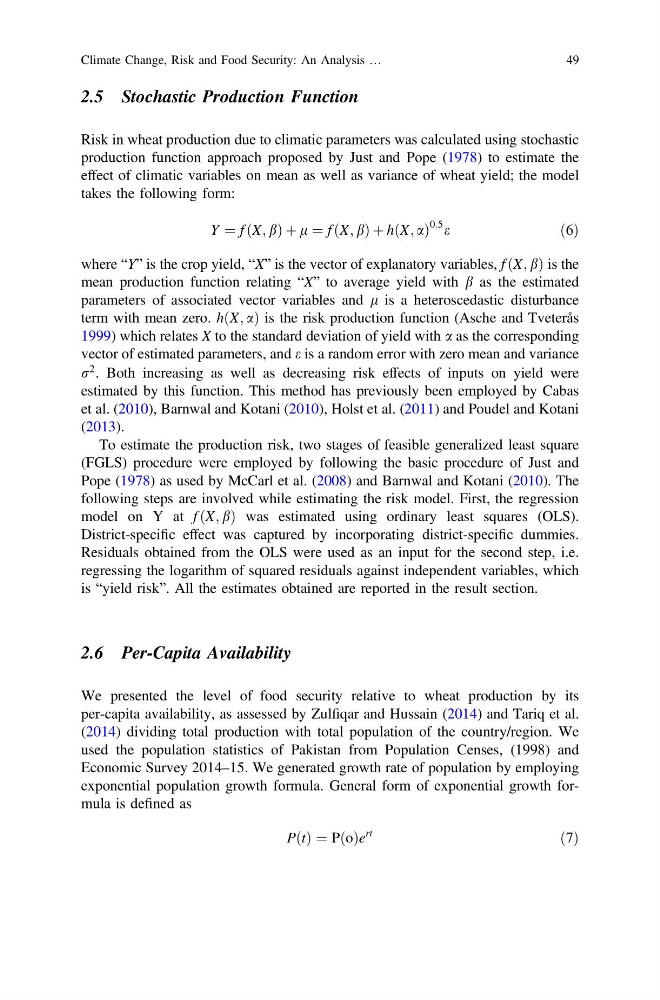
Risk in wheat production due to climatic parameters was calculated using stochastic
production function approach proposed by Just and Pope (1978) to estimate the
effect of climatic variables on mean as well as variance of wheat yield; the model
takes the following form:
Y ¼ f X; b
ð
Þþl ¼ f X; b
ð
Þþh X; a
ð
Þ
0:5 e
ð6Þ
where “Y” is the crop yield, “X” is the vector of explanatory variables, f X; b
ð
Þis the
mean production function relating “X” to average yield with b as the estimated
parameters of associated vector variables and l is a heteroscedastic disturbance
term with mean zero. hðX; aÞ is the risk production function (Asche and Tveterås
1999) which relates X to the standard deviation of yield with a as the corresponding
vector of estimated parameters, and e is a random error with zero mean and variance
r
2 . Both increasing as well as decreasing risk effects of inputs on yield were
estimated by this function. This method has previously been employed by Cabas
et al. (2010), Barnwal and Kotani (2010), Holst et al. (2011) and Poudel and Kotani
(2013).
To estimate the production risk, two stages of feasible generalized least square
(FGLS) procedure were employed by following the basic procedure of Just and
Pope (1978) as used by McCarl et al. (2008) and Barnwal and Kotani (2010). The
following steps are involved while estimating the risk model. First, the regression
model on Y at f X; b
ð
Þ was estimated using ordinary least squares (OLS).
District-specific effect was captured by incorporating district-specific dummies.
Residuals obtained from the OLS were used as an input for the second step, i.e.
regressing the logarithm of squared residuals against independent variables, which
is “yield risk”. All the estimates obtained are reported in the result section.
2.6 Per-Capita Availability
We presented the level of food security relative to wheat production by its
per-capita availability, as assessed by Zulfiqar and Hussain (2014) and Tariq et al.
(2014) dividing total production with total population of the country/region. We
used the population statistics of Pakistan from Population Censes, (1998) and
Economic Survey 2014–15. We generated growth rate of population by employing
exponential population growth formula. General form of exponential growth formula is defined as
PðtÞ ¼ PðoÞe
rt
ð7Þ
Climate Change, Risk and Food Security: An Analysis …
49
Risk in wheat production due to climatic parameters was calculated using stochastic
production function approach proposed by Just and Pope (1978) to estimate the
effect of climatic variables on mean as well as variance of wheat yield; the model
takes the following form:
Y ¼ f X; b
ð
Þþl ¼ f X; b
ð
Þþh X; a
ð
Þ
0:5 e
ð6Þ
where “Y” is the crop yield, “X” is the vector of explanatory variables, f X; b
ð
Þis the
mean production function relating “X” to average yield with b as the estimated
parameters of associated vector variables and l is a heteroscedastic disturbance
term with mean zero. hðX; aÞ is the risk production function (Asche and Tveterås
1999) which relates X to the standard deviation of yield with a as the corresponding
vector of estimated parameters, and e is a random error with zero mean and variance
r
2 . Both increasing as well as decreasing risk effects of inputs on yield were
estimated by this function. This method has previously been employed by Cabas
et al. (2010), Barnwal and Kotani (2010), Holst et al. (2011) and Poudel and Kotani
(2013).
To estimate the production risk, two stages of feasible generalized least square
(FGLS) procedure were employed by following the basic procedure of Just and
Pope (1978) as used by McCarl et al. (2008) and Barnwal and Kotani (2010). The
following steps are involved while estimating the risk model. First, the regression
model on Y at f X; b
ð
Þ was estimated using ordinary least squares (OLS).
District-specific effect was captured by incorporating district-specific dummies.
Residuals obtained from the OLS were used as an input for the second step, i.e.
regressing the logarithm of squared residuals against independent variables, which
is “yield risk”. All the estimates obtained are reported in the result section.
2.6 Per-Capita Availability
We presented the level of food security relative to wheat production by its
per-capita availability, as assessed by Zulfiqar and Hussain (2014) and Tariq et al.
(2014) dividing total production with total population of the country/region. We
used the population statistics of Pakistan from Population Censes, (1998) and
Economic Survey 2014–15. We generated growth rate of population by employing
exponential population growth formula. General form of exponential growth formula is defined as
PðtÞ ¼ PðoÞe
rt
ð7Þ
Climate Change, Risk and Food Security: An Analysis …
49