

Although depletion of groundwater resources can be caused by a number of
other hydrological factors or overextraction for irrigation purposes, the above
evidences suggest that eucalyptus plantations can aggravate the water depletion
much earlier than expected by other reasons. Respondents observed that eucalyptus
was introduced in their village’s way back in the 1980s by the government with
seedlings provided by the Forest Department. Earlier, a very few households were
cultivating eucalyptus in all villages, but currently majority of households have
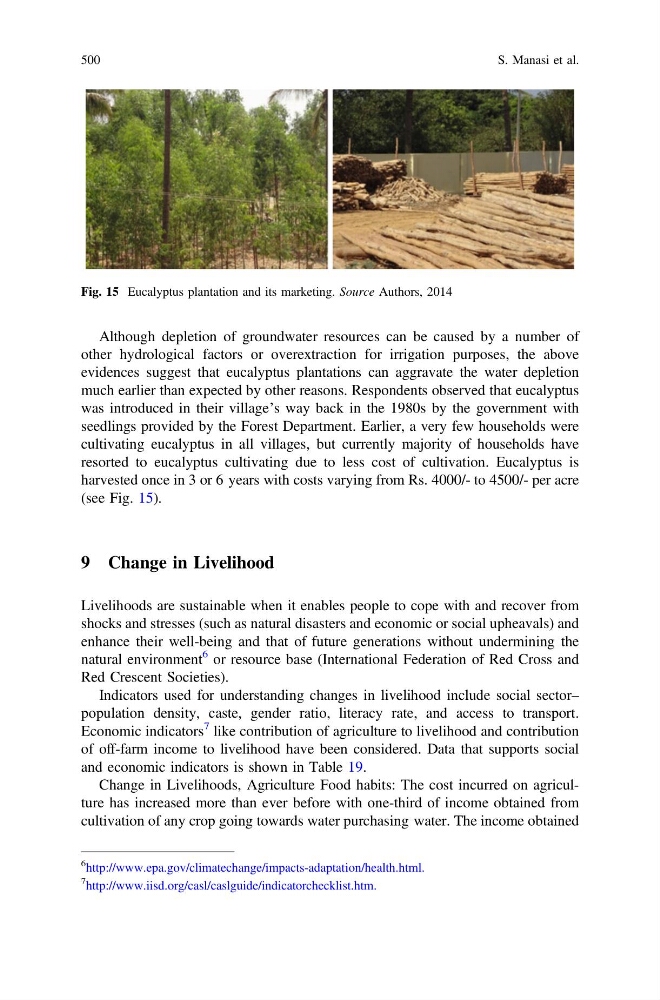
resorted to eucalyptus cultivating due to less cost of cultivation. Eucalyptus is
harvested once in 3 or 6 years with costs varying from Rs. 4000/- to 4500/- per acre
(see Fig. 15).
9 Change in Livelihood
Livelihoods are sustainable when it enables people to cope with and recover from
shocks and stresses (such as natural disasters and economic or social upheavals) and
enhance their well-being and that of future generations without undermining the
natural environment
6 or resource base (International Federation of Red Cross and
Red Crescent Societies).
Indicators used for understanding changes in livelihood include social sector–
population density, caste, gender ratio, literacy rate, and access to transport.
Economic indicators
7 like contribution of agriculture to livelihood and contribution
of off-farm income to livelihood have been considered. Data that supports social
and economic indicators is shown in Table 19.
Change in Livelihoods, Agriculture Food habits: The cost incurred on agriculture has increased more than ever before with one-third of income obtained from
cultivation of any crop going towards water purchasing water. The income obtained
Fig. 15 Eucalyptus plantation and its marketing. Source Authors, 2014
6
http://www.epa.gov/climatechange/impacts-adaptation/health.html.
7
http://www.iisd.org/casl/caslguide/indicatorchecklist.htm.
500
S. Manasi et al.
other hydrological factors or overextraction for irrigation purposes, the above
evidences suggest that eucalyptus plantations can aggravate the water depletion
much earlier than expected by other reasons. Respondents observed that eucalyptus
was introduced in their village’s way back in the 1980s by the government with
seedlings provided by the Forest Department. Earlier, a very few households were
cultivating eucalyptus in all villages, but currently majority of households have
resorted to eucalyptus cultivating due to less cost of cultivation. Eucalyptus is
harvested once in 3 or 6 years with costs varying from Rs. 4000/- to 4500/- per acre
(see Fig. 15).
9 Change in Livelihood
Livelihoods are sustainable when it enables people to cope with and recover from
shocks and stresses (such as natural disasters and economic or social upheavals) and
enhance their well-being and that of future generations without undermining the
natural environment
6 or resource base (International Federation of Red Cross and
Red Crescent Societies).
Indicators used for understanding changes in livelihood include social sector–
population density, caste, gender ratio, literacy rate, and access to transport.
Economic indicators
7 like contribution of agriculture to livelihood and contribution
of off-farm income to livelihood have been considered. Data that supports social
and economic indicators is shown in Table 19.
Change in Livelihoods, Agriculture Food habits: The cost incurred on agriculture has increased more than ever before with one-third of income obtained from
cultivation of any crop going towards water purchasing water. The income obtained
Fig. 15 Eucalyptus plantation and its marketing. Source Authors, 2014
6
http://www.epa.gov/climatechange/impacts-adaptation/health.html.
7
http://www.iisd.org/casl/caslguide/indicatorchecklist.htm.
500
S. Manasi et al.