

from ragi cultivation amounts to 9100 rupees, the cost incurred on water purchasing
to 2250 rupees per yield per 3 months, and the same is the case with other crops.
Although income obtained from cultivating ragi amounts to 2000 rupees per yield,
still they grow it asbecause it is their staple food. Thus, income obtained from
cultivation has decreased and so also the contribution of agriculture to livelihood
has come down over the years, forcing people to seek off-farm occupations.
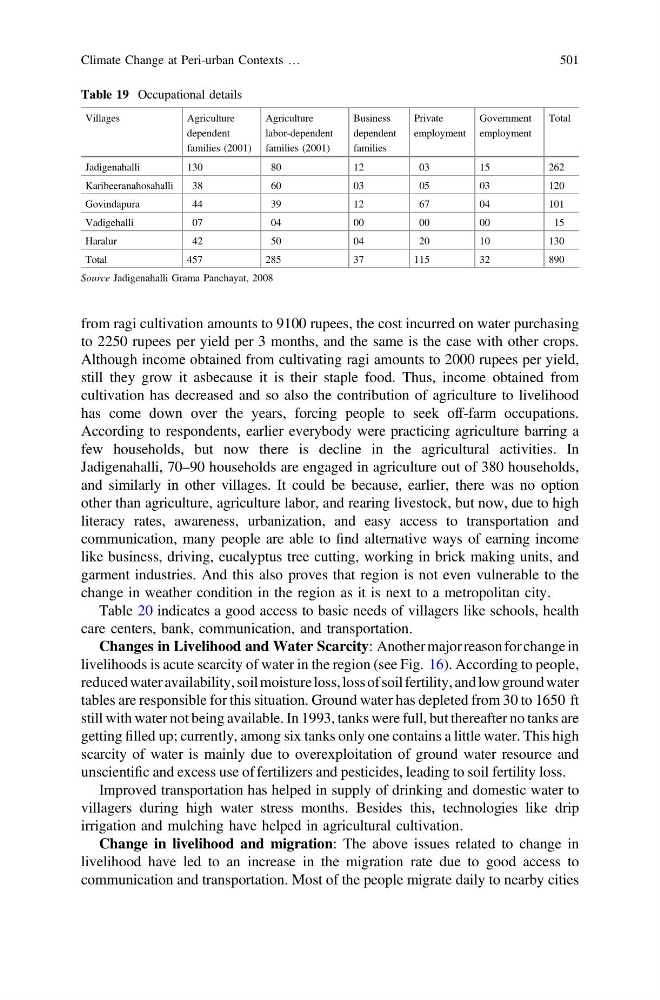
According to respondents, earlier everybody were practicing agriculture barring a
few households, but now there is decline in the agricultural activities. In
Jadigenahalli, 70–90 households are engaged in agriculture out of 380 households,
and similarly in other villages. It could be because, earlier, there was no option
other than agriculture, agriculture labor, and rearing livestock, but now, due to high
literacy rates, awareness, urbanization, and easy access to transportation and
communication, many people are able to find alternative ways of earning income
like business, driving, eucalyptus tree cutting, working in brick making units, and
garment industries. And this also proves that region is not even vulnerable to the
change in weather condition in the region as it is next to a metropolitan city.
Table 20 indicates a good access to basic needs of villagers like schools, health
care centers, bank, communication, and transportation.
Changes in Livelihood and Water Scarcity: Another major reason for change in
livelihoods is acute scarcity of water in the region (see Fig. 16). According to people,
reduced water availability, soil moisture loss, loss of soil fertility, and low ground water
tables are responsible for this situation. Ground water has depleted from 30 to 1650 ft
still with water not being available. In 1993, tanks were full, but thereafter no tanks are
getting filled up; currently, among six tanks only one contains a little water. This high
scarcity of water is mainly due to overexploitation of ground water resource and
unscientific and excess use of fertilizers and pesticides, leading to soil fertility loss.
Improved transportation has helped in supply of drinking and domestic water to
villagers during high water stress months. Besides this, technologies like drip
irrigation and mulching have helped in agricultural cultivation.
Change in livelihood and migration: The above issues related to change in
livelihood have led to an increase in the migration rate due to good access to
communication and transportation. Most of the people migrate daily to nearby cities
Table 19 Occupational details
Villages
Agriculture
dependent
families (2001)
Agriculture
labor-dependent
families (2001)
Business
dependent
families
Private
employment
Government
employment
Total
Jadigenahalli
130
80
12
03
15
262
Karibeeranahosahalli
38
60
03
05
03
120
Govindapura
44
39
12
67
04
101
Vadigehalli
07
04
00
00
00
15
Haralur
42
50
04
20
10
130
Total
457
285
37
115
32
890
Source Jadigenahalli Grama Panchayat, 2008
Climate Change at Peri-urban Contexts …
501
to 2250 rupees per yield per 3 months, and the same is the case with other crops.
Although income obtained from cultivating ragi amounts to 2000 rupees per yield,
still they grow it asbecause it is their staple food. Thus, income obtained from
cultivation has decreased and so also the contribution of agriculture to livelihood
has come down over the years, forcing people to seek off-farm occupations.
According to respondents, earlier everybody were practicing agriculture barring a
few households, but now there is decline in the agricultural activities. In
Jadigenahalli, 70–90 households are engaged in agriculture out of 380 households,
and similarly in other villages. It could be because, earlier, there was no option
other than agriculture, agriculture labor, and rearing livestock, but now, due to high
literacy rates, awareness, urbanization, and easy access to transportation and
communication, many people are able to find alternative ways of earning income
like business, driving, eucalyptus tree cutting, working in brick making units, and
garment industries. And this also proves that region is not even vulnerable to the
change in weather condition in the region as it is next to a metropolitan city.
Table 20 indicates a good access to basic needs of villagers like schools, health
care centers, bank, communication, and transportation.
Changes in Livelihood and Water Scarcity: Another major reason for change in
livelihoods is acute scarcity of water in the region (see Fig. 16). According to people,
reduced water availability, soil moisture loss, loss of soil fertility, and low ground water
tables are responsible for this situation. Ground water has depleted from 30 to 1650 ft
still with water not being available. In 1993, tanks were full, but thereafter no tanks are
getting filled up; currently, among six tanks only one contains a little water. This high
scarcity of water is mainly due to overexploitation of ground water resource and
unscientific and excess use of fertilizers and pesticides, leading to soil fertility loss.
Improved transportation has helped in supply of drinking and domestic water to
villagers during high water stress months. Besides this, technologies like drip
irrigation and mulching have helped in agricultural cultivation.
Change in livelihood and migration: The above issues related to change in
livelihood have led to an increase in the migration rate due to good access to
communication and transportation. Most of the people migrate daily to nearby cities
Table 19 Occupational details
Villages
Agriculture
dependent
families (2001)
Agriculture
labor-dependent
families (2001)
Business
dependent
families
Private
employment
Government
employment
Total
Jadigenahalli
130
80
12
03
15
262
Karibeeranahosahalli
38
60
03
05
03
120
Govindapura
44
39
12
67
04
101
Vadigehalli
07
04
00
00
00
15
Haralur
42
50
04
20
10
130
Total
457
285
37
115
32
890
Source Jadigenahalli Grama Panchayat, 2008
Climate Change at Peri-urban Contexts …
501