

climates, but heat stress has a detrimental effect on the reproduction of buffaloes
(Tailor and Nagda 2005). From the FGDs, it becomes evident that the number of
households with buffalo has decreased overtime. This is due to scarcity of fodder and
labor, water, and grazing lands which have been converted into agricultural lands.
And in all the study villages, the cost of livestock has increased, 30 years ago,
the cost of local cows (local variety) was from Rs. 500/- to 1000/-, and for hybrid
from Rs. 50,000 to Rs. 80,000/- (because of their high milk yielding capacity). For
buffaloes, earlier the cost range was from Rs. 300 to Rs. 700, but now it is from Rs.
15,000 to Rs. 25,000.
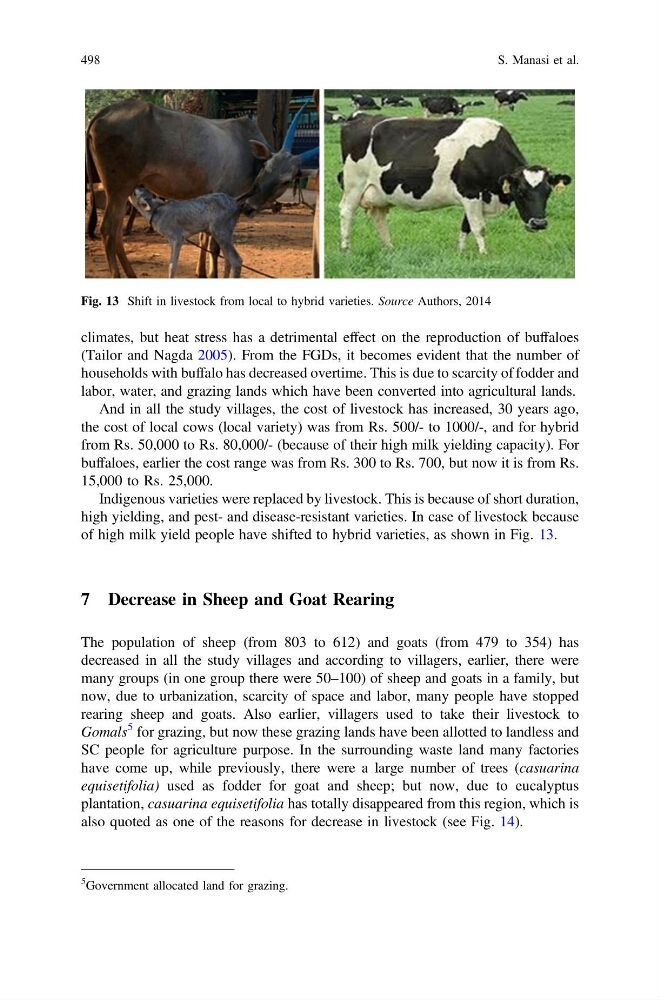
Indigenous varieties were replaced by livestock. This is because of short duration,
high yielding, and pest- and disease-resistant varieties. In case of livestock because
of high milk yield people have shifted to hybrid varieties, as shown in Fig. 13.
7 Decrease in Sheep and Goat Rearing
The population of sheep (from 803 to 612) and goats (from 479 to 354) has
decreased in all the study villages and according to villagers, earlier, there were
many groups (in one group there were 50–100) of sheep and goats in a family, but
now, due to urbanization, scarcity of space and labor, many people have stopped
rearing sheep and goats. Also earlier, villagers used to take their livestock to
Gomals
5 for grazing, but now these grazing lands have been allotted to landless and
SC people for agriculture purpose. In the surrounding waste land many factories
have come up, while previously, there were a large number of trees (casuarina
equisetifolia) used as fodder for goat and sheep; but now, due to eucalyptus
plantation, casuarina equisetifolia has totally disappeared from this region, which is
also quoted as one of the reasons for decrease in livestock (see Fig. 14).
Fig. 13 Shift in livestock from local to hybrid varieties. Source Authors, 2014
5
Government allocated land for grazing.
498
S. Manasi et al.
(Tailor and Nagda 2005). From the FGDs, it becomes evident that the number of
households with buffalo has decreased overtime. This is due to scarcity of fodder and
labor, water, and grazing lands which have been converted into agricultural lands.
And in all the study villages, the cost of livestock has increased, 30 years ago,
the cost of local cows (local variety) was from Rs. 500/- to 1000/-, and for hybrid
from Rs. 50,000 to Rs. 80,000/- (because of their high milk yielding capacity). For
buffaloes, earlier the cost range was from Rs. 300 to Rs. 700, but now it is from Rs.
15,000 to Rs. 25,000.
Indigenous varieties were replaced by livestock. This is because of short duration,
high yielding, and pest- and disease-resistant varieties. In case of livestock because
of high milk yield people have shifted to hybrid varieties, as shown in Fig. 13.
7 Decrease in Sheep and Goat Rearing
The population of sheep (from 803 to 612) and goats (from 479 to 354) has
decreased in all the study villages and according to villagers, earlier, there were
many groups (in one group there were 50–100) of sheep and goats in a family, but
now, due to urbanization, scarcity of space and labor, many people have stopped
rearing sheep and goats. Also earlier, villagers used to take their livestock to
Gomals
5 for grazing, but now these grazing lands have been allotted to landless and
SC people for agriculture purpose. In the surrounding waste land many factories
have come up, while previously, there were a large number of trees (casuarina
equisetifolia) used as fodder for goat and sheep; but now, due to eucalyptus
plantation, casuarina equisetifolia has totally disappeared from this region, which is
also quoted as one of the reasons for decrease in livestock (see Fig. 14).
Fig. 13 Shift in livestock from local to hybrid varieties. Source Authors, 2014
5
Government allocated land for grazing.
498
S. Manasi et al.