

6 Livestock: Local to Hybrid
It has been observed from the FGDs that earlier all households were rearing local
breeds (Hallikar), but now they are replaced with hybrid varieties like Holstein
Friesian, Jersey (Imported Cattle breed), Jamunapari, and Bijapur varieties (Goat).
From the secondary data it is evident (see graph) that Holstein Friesian
(cow) population in all the villages has increased (from 348 to 375) as compared to
other livestock. This is due to more milk yield from hybrid varieties (15–
25 l/day/cow) as compared to local cultivars (2–3 l/day/cow). As a result, villagers
are able to earn additional income from milk sale.
Interestingly, the population of ox shows a rapid decrease; in Vadigehalli and
Haralur there is no presence of ox pairs, but in Jadigenahalli there are 3–5 pairs and in
Govindapura and KB Hoshalli 2 and 4 pairs of ox, respectively. And also the cost has
increased from Rs 40,000 to 80,000. This is due to urbanization and mechanization of
agriculture and many are dependent on tractors for plowing, as a way of time saving.
This could also be due to a variety of socioeconomic factors like low returns from
agriculture, high input cost, changing occupational preferences, and so on.
Another important species in India are buffaloes. The morphological and
anatomical characteristics of buffaloes make them well suited to hot and humid
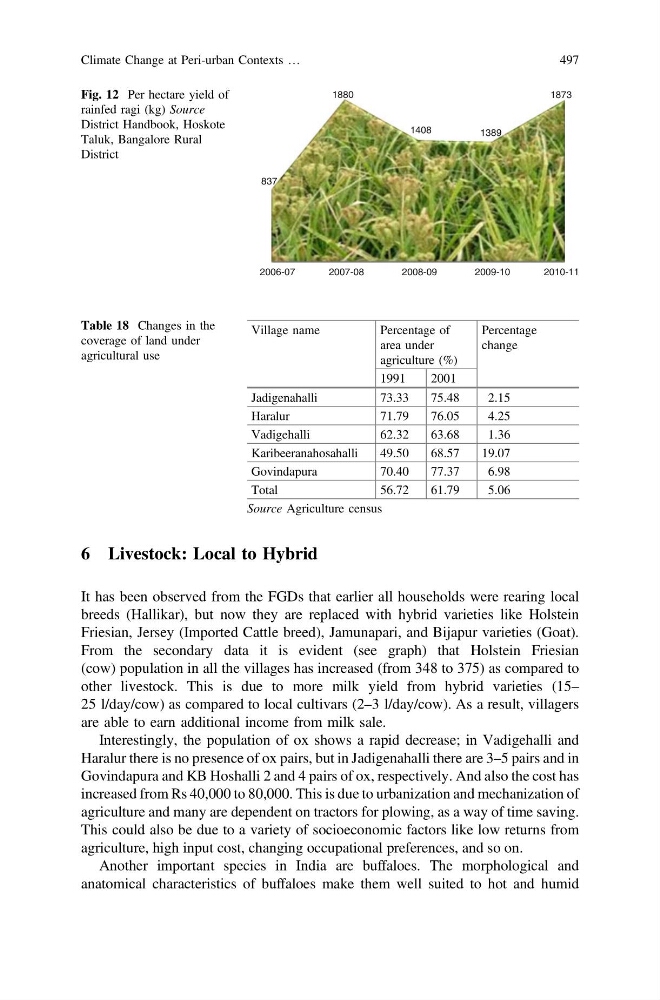
837
1880
1408
1389
1873
2006-07
2007-08
2008-09
2009-10
2010-11
Fig. 12 Per hectare yield of
rainfed ragi (kg) Source
District Handbook, Hoskote
Taluk, Bangalore Rural
District
Table 18 Changes in the
coverage of land under
agricultural use
Village name
Percentage of
area under
agriculture (%)
Percentage
change
1991
2001
Jadigenahalli
73.33
75.48
2.15
Haralur
71.79
76.05
4.25
Vadigehalli
62.32
63.68
1.36
Karibeeranahosahalli
49.50
68.57
19.07
Govindapura
70.40
77.37
6.98
Total
56.72
61.79
5.06
Source Agriculture census
Climate Change at Peri-urban Contexts …
497
It has been observed from the FGDs that earlier all households were rearing local
breeds (Hallikar), but now they are replaced with hybrid varieties like Holstein
Friesian, Jersey (Imported Cattle breed), Jamunapari, and Bijapur varieties (Goat).
From the secondary data it is evident (see graph) that Holstein Friesian
(cow) population in all the villages has increased (from 348 to 375) as compared to
other livestock. This is due to more milk yield from hybrid varieties (15–
25 l/day/cow) as compared to local cultivars (2–3 l/day/cow). As a result, villagers
are able to earn additional income from milk sale.
Interestingly, the population of ox shows a rapid decrease; in Vadigehalli and
Haralur there is no presence of ox pairs, but in Jadigenahalli there are 3–5 pairs and in
Govindapura and KB Hoshalli 2 and 4 pairs of ox, respectively. And also the cost has
increased from Rs 40,000 to 80,000. This is due to urbanization and mechanization of
agriculture and many are dependent on tractors for plowing, as a way of time saving.
This could also be due to a variety of socioeconomic factors like low returns from
agriculture, high input cost, changing occupational preferences, and so on.
Another important species in India are buffaloes. The morphological and
anatomical characteristics of buffaloes make them well suited to hot and humid
837
1880
1408
1389
1873
2006-07
2007-08
2008-09
2009-10
2010-11
Fig. 12 Per hectare yield of
rainfed ragi (kg) Source
District Handbook, Hoskote
Taluk, Bangalore Rural
District
Table 18 Changes in the
coverage of land under
agricultural use
Village name
Percentage of
area under
agriculture (%)
Percentage
change
1991
2001
Jadigenahalli
73.33
75.48
2.15
Haralur
71.79
76.05
4.25
Vadigehalli
62.32
63.68
1.36
Karibeeranahosahalli
49.50
68.57
19.07
Govindapura
70.40
77.37
6.98
Total
56.72
61.79
5.06
Source Agriculture census
Climate Change at Peri-urban Contexts …
497