

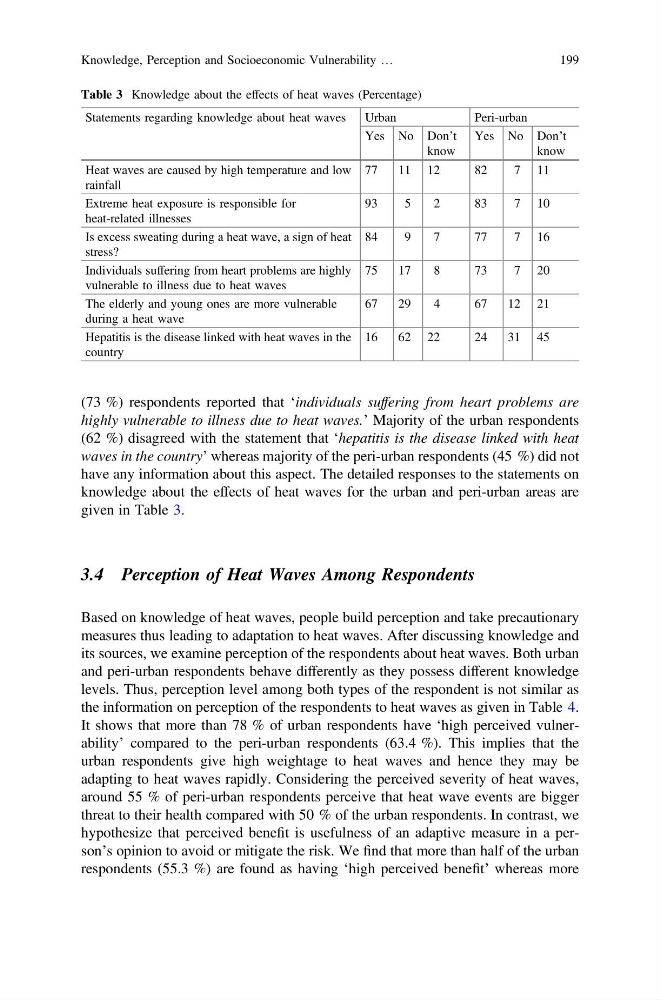
(73 %) respondents reported that ‘individuals suffering from heart problems are
highly vulnerable to illness due to heat waves.’ Majority of the urban respondents
(62 %) disagreed with the statement that ‘hepatitis is the disease linked with heat
waves in the country’ whereas majority of the peri-urban respondents (45 %) did not
have any information about this aspect. The detailed responses to the statements on
knowledge about the effects of heat waves for the urban and peri-urban areas are
given in Table 3.
3.4 Perception of Heat Waves Among Respondents
Based on knowledge of heat waves, people build perception and take precautionary
measures thus leading to adaptation to heat waves. After discussing knowledge and
its sources, we examine perception of the respondents about heat waves. Both urban
and peri-urban respondents behave differently as they possess different knowledge
levels. Thus, perception level among both types of the respondent is not similar as
the information on perception of the respondents to heat waves as given in Table 4.
It shows that more than 78 % of urban respondents have ‘high perceived vulnerability’ compared to the peri-urban respondents (63.4 %). This implies that the
urban respondents give high weightage to heat waves and hence they may be
adapting to heat waves rapidly. Considering the perceived severity of heat waves,
around 55 % of peri-urban respondents perceive that heat wave events are bigger
threat to their health compared with 50 % of the urban respondents. In contrast, we
hypothesize that perceived benefit is usefulness of an adaptive measure in a person’s opinion to avoid or mitigate the risk. We find that more than half of the urban
respondents (55.3 %) are found as having ‘high perceived benefit’ whereas more
Table 3 Knowledge about the effects of heat waves (Percentage)
Statements regarding knowledge about heat waves Urban
Peri-urban
Yes No Don’t
know
Yes No Don’t
know
Heat waves are caused by high temperature and low
rainfall
77
11 12
82
7 11
Extreme heat exposure is responsible for
heat-related illnesses
93
5
2
83
7 10
Is excess sweating during a heat wave, a sign of heat
stress?
84
9
7
77
7 16
Individuals suffering from heart problems are highly
vulnerable to illness due to heat waves
75
17
8
73
7 20
The elderly and young ones are more vulnerable
during a heat wave
67
29
4
67
12 21
Hepatitis is the disease linked with heat waves in the
country
16
62 22
24
31 45
Knowledge, Perception and Socioeconomic Vulnerability …
199
highly vulnerable to illness due to heat waves.’ Majority of the urban respondents
(62 %) disagreed with the statement that ‘hepatitis is the disease linked with heat
waves in the country’ whereas majority of the peri-urban respondents (45 %) did not
have any information about this aspect. The detailed responses to the statements on
knowledge about the effects of heat waves for the urban and peri-urban areas are
given in Table 3.
3.4 Perception of Heat Waves Among Respondents
Based on knowledge of heat waves, people build perception and take precautionary
measures thus leading to adaptation to heat waves. After discussing knowledge and
its sources, we examine perception of the respondents about heat waves. Both urban
and peri-urban respondents behave differently as they possess different knowledge
levels. Thus, perception level among both types of the respondent is not similar as
the information on perception of the respondents to heat waves as given in Table 4.
It shows that more than 78 % of urban respondents have ‘high perceived vulnerability’ compared to the peri-urban respondents (63.4 %). This implies that the
urban respondents give high weightage to heat waves and hence they may be
adapting to heat waves rapidly. Considering the perceived severity of heat waves,
around 55 % of peri-urban respondents perceive that heat wave events are bigger
threat to their health compared with 50 % of the urban respondents. In contrast, we
hypothesize that perceived benefit is usefulness of an adaptive measure in a person’s opinion to avoid or mitigate the risk. We find that more than half of the urban
respondents (55.3 %) are found as having ‘high perceived benefit’ whereas more
Table 3 Knowledge about the effects of heat waves (Percentage)
Statements regarding knowledge about heat waves Urban
Peri-urban
Yes No Don’t
know
Yes No Don’t
know
Heat waves are caused by high temperature and low
rainfall
77
11 12
82
7 11
Extreme heat exposure is responsible for
heat-related illnesses
93
5
2
83
7 10
Is excess sweating during a heat wave, a sign of heat
stress?
84
9
7
77
7 16
Individuals suffering from heart problems are highly
vulnerable to illness due to heat waves
75
17
8
73
7 20
The elderly and young ones are more vulnerable
during a heat wave
67
29
4
67
12 21
Hepatitis is the disease linked with heat waves in the
country
16
62 22
24
31 45
Knowledge, Perception and Socioeconomic Vulnerability …
199