

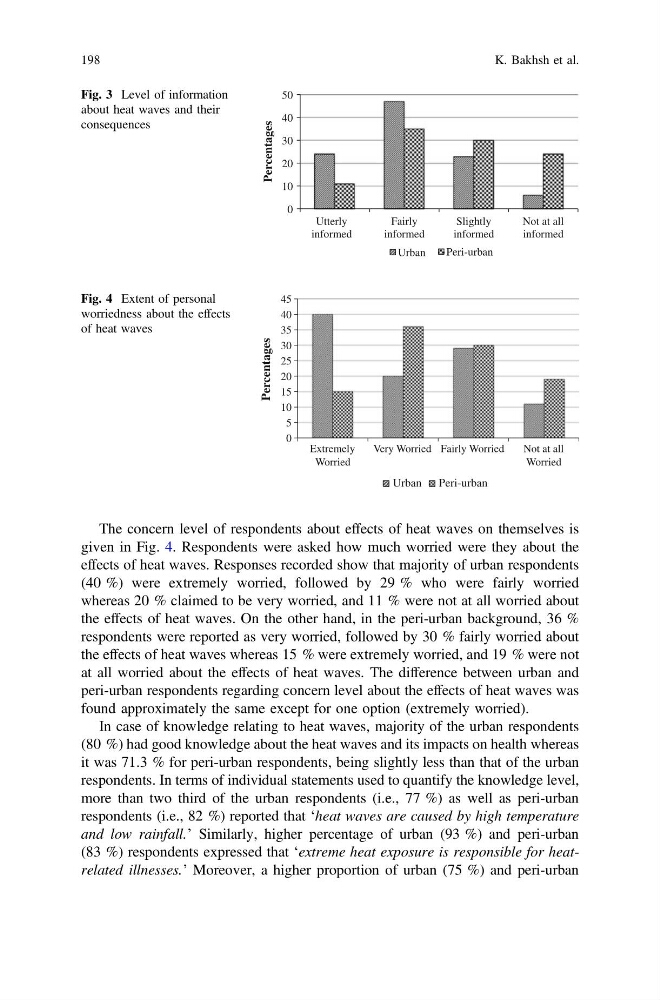
The concern level of respondents about effects of heat waves on themselves is
given in Fig. 4. Respondents were asked how much worried were they about the
effects of heat waves. Responses recorded show that majority of urban respondents
(40 %) were extremely worried, followed by 29 % who were fairly worried
whereas 20 % claimed to be very worried, and 11 % were not at all worried about
the effects of heat waves. On the other hand, in the peri-urban background, 36 %
respondents were reported as very worried, followed by 30 % fairly worried about
the effects of heat waves whereas 15 % were extremely worried, and 19 % were not
at all worried about the effects of heat waves. The difference between urban and
peri-urban respondents regarding concern level about the effects of heat waves was
found approximately the same except for one option (extremely worried).
In case of knowledge relating to heat waves, majority of the urban respondents
(80 %) had good knowledge about the heat waves and its impacts on health whereas
it was 71.3 % for peri-urban respondents, being slightly less than that of the urban
respondents. In terms of individual statements used to quantify the knowledge level,
more than two third of the urban respondents (i.e., 77 %) as well as peri-urban
respondents (i.e., 82 %) reported that ‘heat waves are caused by high temperature
and low rainfall.’ Similarly, higher percentage of urban (93 %) and peri-urban
(83 %) respondents expressed that ‘extreme heat exposure is responsible for heatrelated illnesses.’ Moreover, a higher proportion of urban (75 %) and peri-urban
0
10
20
30
40
50
Utterly
informed
Fairly
informed
Slightly
informed
Not at all
informed
Percentages
Urban
Peri-urban
Fig. 3 Level of information
about heat waves and their
consequences
0
5
10
15
20
25
30
35
40
45
Extremely
Worried
Very Worried Fairly Worried
Not at all
Worried
Percentages
Urban Peri-urban
Fig. 4 Extent of personal
worriedness about the effects
of heat waves
198
K. Bakhsh et al.
given in Fig. 4. Respondents were asked how much worried were they about the
effects of heat waves. Responses recorded show that majority of urban respondents
(40 %) were extremely worried, followed by 29 % who were fairly worried
whereas 20 % claimed to be very worried, and 11 % were not at all worried about
the effects of heat waves. On the other hand, in the peri-urban background, 36 %
respondents were reported as very worried, followed by 30 % fairly worried about
the effects of heat waves whereas 15 % were extremely worried, and 19 % were not
at all worried about the effects of heat waves. The difference between urban and
peri-urban respondents regarding concern level about the effects of heat waves was
found approximately the same except for one option (extremely worried).
In case of knowledge relating to heat waves, majority of the urban respondents
(80 %) had good knowledge about the heat waves and its impacts on health whereas
it was 71.3 % for peri-urban respondents, being slightly less than that of the urban
respondents. In terms of individual statements used to quantify the knowledge level,
more than two third of the urban respondents (i.e., 77 %) as well as peri-urban
respondents (i.e., 82 %) reported that ‘heat waves are caused by high temperature
and low rainfall.’ Similarly, higher percentage of urban (93 %) and peri-urban
(83 %) respondents expressed that ‘extreme heat exposure is responsible for heatrelated illnesses.’ Moreover, a higher proportion of urban (75 %) and peri-urban
0
10
20
30
40
50
Utterly
informed
Fairly
informed
Slightly
informed
Not at all
informed
Percentages
Urban
Peri-urban
Fig. 3 Level of information
about heat waves and their
consequences
0
5
10
15
20
25
30
35
40
45
Extremely
Worried
Very Worried Fairly Worried
Not at all
Worried
Percentages
Urban Peri-urban
Fig. 4 Extent of personal
worriedness about the effects
of heat waves
198
K. Bakhsh et al.