

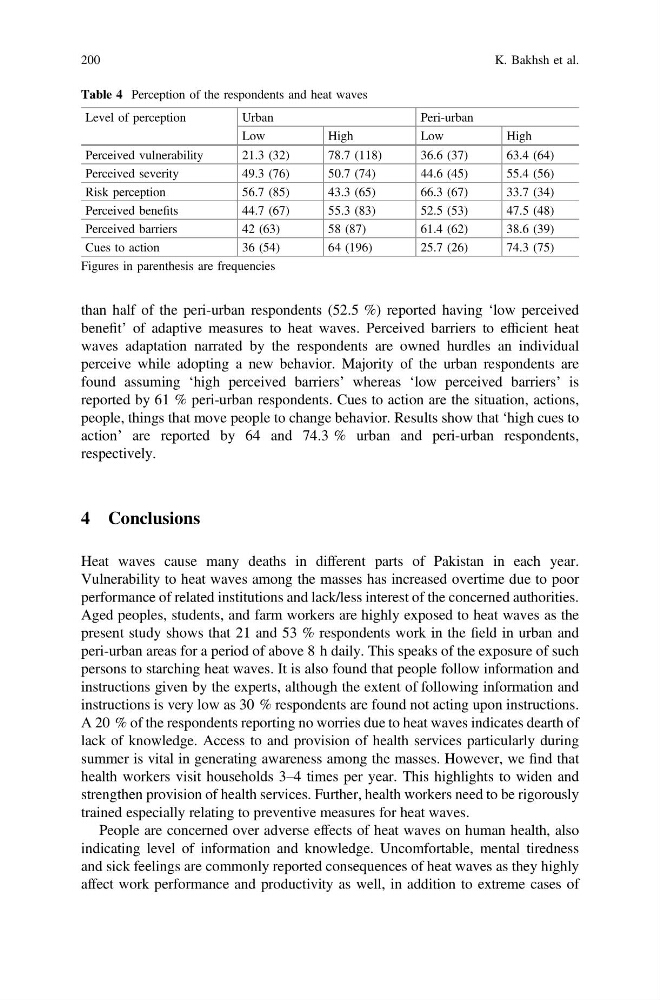
than half of the peri-urban respondents (52.5 %) reported having ‘low perceived
benefit’ of adaptive measures to heat waves. Perceived barriers to efficient heat
waves adaptation narrated by the respondents are owned hurdles an individual
perceive while adopting a new behavior. Majority of the urban respondents are
found assuming ‘high perceived barriers’ whereas ‘low perceived barriers’ is
reported by 61 % peri-urban respondents. Cues to action are the situation, actions,
people, things that move people to change behavior. Results show that ‘high cues to
action’ are reported by 64 and 74.3 % urban and peri-urban respondents,
respectively.
4 Conclusions
Heat waves cause many deaths in different parts of Pakistan in each year.
Vulnerability to heat waves among the masses has increased overtime due to poor
performance of related institutions and lack/less interest of the concerned authorities.
Aged peoples, students, and farm workers are highly exposed to heat waves as the
present study shows that 21 and 53 % respondents work in the field in urban and
peri-urban areas for a period of above 8 h daily. This speaks of the exposure of such
persons to starching heat waves. It is also found that people follow information and
instructions given by the experts, although the extent of following information and
instructions is very low as 30 % respondents are found not acting upon instructions.
A 20 % of the respondents reporting no worries due to heat waves indicates dearth of
lack of knowledge. Access to and provision of health services particularly during
summer is vital in generating awareness among the masses. However, we find that
health workers visit households 3–4 times per year. This highlights to widen and
strengthen provision of health services. Further, health workers need to be rigorously
trained especially relating to preventive measures for heat waves.
People are concerned over adverse effects of heat waves on human health, also
indicating level of information and knowledge. Uncomfortable, mental tiredness
and sick feelings are commonly reported consequences of heat waves as they highly
affect work performance and productivity as well, in addition to extreme cases of
Table 4 Perception of the respondents and heat waves
Level of perception
Urban
Peri-urban
Low
High
Low
High
Perceived vulnerability
21.3 (32)
78.7 (118)
36.6 (37)
63.4 (64)
Perceived severity
49.3 (76)
50.7 (74)
44.6 (45)
55.4 (56)
Risk perception
56.7 (85)
43.3 (65)
66.3 (67)
33.7 (34)
Perceived benefits
44.7 (67)
55.3 (83)
52.5 (53)
47.5 (48)
Perceived barriers
42 (63)
58 (87)
61.4 (62)
38.6 (39)
Cues to action
36 (54)
64 (196)
25.7 (26)
74.3 (75)
Figures in parenthesis are frequencies
200
K. Bakhsh et al.
benefit’ of adaptive measures to heat waves. Perceived barriers to efficient heat
waves adaptation narrated by the respondents are owned hurdles an individual
perceive while adopting a new behavior. Majority of the urban respondents are
found assuming ‘high perceived barriers’ whereas ‘low perceived barriers’ is
reported by 61 % peri-urban respondents. Cues to action are the situation, actions,
people, things that move people to change behavior. Results show that ‘high cues to
action’ are reported by 64 and 74.3 % urban and peri-urban respondents,
respectively.
4 Conclusions
Heat waves cause many deaths in different parts of Pakistan in each year.
Vulnerability to heat waves among the masses has increased overtime due to poor
performance of related institutions and lack/less interest of the concerned authorities.
Aged peoples, students, and farm workers are highly exposed to heat waves as the
present study shows that 21 and 53 % respondents work in the field in urban and
peri-urban areas for a period of above 8 h daily. This speaks of the exposure of such
persons to starching heat waves. It is also found that people follow information and
instructions given by the experts, although the extent of following information and
instructions is very low as 30 % respondents are found not acting upon instructions.
A 20 % of the respondents reporting no worries due to heat waves indicates dearth of
lack of knowledge. Access to and provision of health services particularly during
summer is vital in generating awareness among the masses. However, we find that
health workers visit households 3–4 times per year. This highlights to widen and
strengthen provision of health services. Further, health workers need to be rigorously
trained especially relating to preventive measures for heat waves.
People are concerned over adverse effects of heat waves on human health, also
indicating level of information and knowledge. Uncomfortable, mental tiredness
and sick feelings are commonly reported consequences of heat waves as they highly
affect work performance and productivity as well, in addition to extreme cases of
Table 4 Perception of the respondents and heat waves
Level of perception
Urban
Peri-urban
Low
High
Low
High
Perceived vulnerability
21.3 (32)
78.7 (118)
36.6 (37)
63.4 (64)
Perceived severity
49.3 (76)
50.7 (74)
44.6 (45)
55.4 (56)
Risk perception
56.7 (85)
43.3 (65)
66.3 (67)
33.7 (34)
Perceived benefits
44.7 (67)
55.3 (83)
52.5 (53)
47.5 (48)
Perceived barriers
42 (63)
58 (87)
61.4 (62)
38.6 (39)
Cues to action
36 (54)
64 (196)
25.7 (26)
74.3 (75)
Figures in parenthesis are frequencies
200
K. Bakhsh et al.