

Desert Aerosol in the Mediterranean
313
,......
"I E
I:
N
I E
3=
........
w
U
z
«
0
«
~
~
2.0
1.5
1.0
0.5
r ' , , , , , I , I ' , , , , , , , , I ' , , '~~~'~~~~~~,' '3'~.~~~ , 1 ~~~~~ 1
40
D
solar zenith angle
~- May 27, 1999
~
--- J,ne 2, 1999
r
t
500
700
900
1100
WAVELENGTH (nm)
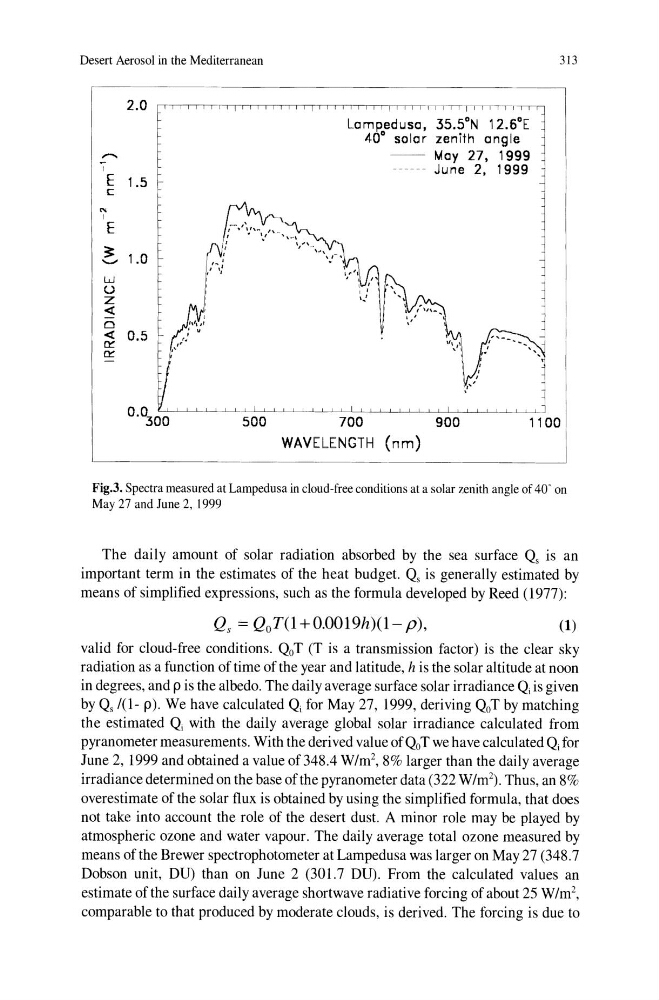
Fig.3. Spectra measured at Lampedusa in cloud-free conditions at a solar zenith angle of 40 0 on
May 27 and June 2, 1999
The daily amount of solar radiation absorbed by the sea surface Qs is an
important term in the estimates of the heat budget. Qs is generally estimated by
means of simplified expressions, such as the formula developed by Reed (1977):
Q, = QoT(1+0.o019h)(1-p),
(1)
valid for cloud-free conditions. QaT (T is a transmission factor) is the clear sky
radiation as a function of time of the year and latitude, h is the solar altitude at noon
in degrees, and p is the albedo. The daily average surface solar irradiance Qi is given
by Qs 1(1- p). We have calculated Qi for May 27, 1999, deriving QaT by matching
the estimated Qi with the daily average global solar irradiance calculated from
pyranometer measurements. With the derived value of QaT we have calculated Qi for
June 2, 1999 and obtained a value of348.4 W/m2, 8% larger than the daily average
irradiance determined on the base of the pyranometer data (322 W/m2). Thus, an 8%
overestimate of the solar flux is obtained by using the simplified formula, that does
not take into account the role of the desert dust. A minor role may be played by
atmospheric ozone and water vapour. The daily average total ozone measured by
means of the Brewer spectrophotometer at Lampedusa was larger on May 27 (348.7
Dobson unit, DU) than on June 2 (301.7 DU). From the calculated values an
estimate of the surface daily average shortwave radiative forcing of about 25 W/m 2 ,
comparable to that produced by moderate clouds, is derived. The forcing is due to
313
,......
"I E
I:
N
I E
3=
........
w
U
z
«
0
«
~
~
2.0
1.5
1.0
0.5
r ' , , , , , I , I ' , , , , , , , , I ' , , '~~~'~~~~~~,' '3'~.~~~ , 1 ~~~~~ 1
40
D
solar zenith angle
~- May 27, 1999
~
--- J,ne 2, 1999
r
t
500
700
900
1100
WAVELENGTH (nm)
Fig.3. Spectra measured at Lampedusa in cloud-free conditions at a solar zenith angle of 40 0 on
May 27 and June 2, 1999
The daily amount of solar radiation absorbed by the sea surface Qs is an
important term in the estimates of the heat budget. Qs is generally estimated by
means of simplified expressions, such as the formula developed by Reed (1977):
Q, = QoT(1+0.o019h)(1-p),
(1)
valid for cloud-free conditions. QaT (T is a transmission factor) is the clear sky
radiation as a function of time of the year and latitude, h is the solar altitude at noon
in degrees, and p is the albedo. The daily average surface solar irradiance Qi is given
by Qs 1(1- p). We have calculated Qi for May 27, 1999, deriving QaT by matching
the estimated Qi with the daily average global solar irradiance calculated from
pyranometer measurements. With the derived value of QaT we have calculated Qi for
June 2, 1999 and obtained a value of348.4 W/m2, 8% larger than the daily average
irradiance determined on the base of the pyranometer data (322 W/m2). Thus, an 8%
overestimate of the solar flux is obtained by using the simplified formula, that does
not take into account the role of the desert dust. A minor role may be played by
atmospheric ozone and water vapour. The daily average total ozone measured by
means of the Brewer spectrophotometer at Lampedusa was larger on May 27 (348.7
Dobson unit, DU) than on June 2 (301.7 DU). From the calculated values an
estimate of the surface daily average shortwave radiative forcing of about 25 W/m 2 ,
comparable to that produced by moderate clouds, is derived. The forcing is due to