

256
E. Piervitali, M. Colacino
I S; 10 desert or almost desert
10 < I S; 15 almost-arid; continuous irrigation is requested
15 < I S; 20 sub-humid; irrigation is requested
20 < I S; 30 almost-humid; well-timed irrigation is requested
30 < I
moist soil; seasonal irrigation
The GISS model of NASA (Hansen et al. 1988) was adopted to evaluate the
future evolution of the temperature. It shows three possible future scenarios:
a. pessimistic scenario - business as usual,
b. realistic scenario - global emissions partly limited,
c. optimistic scenario - global emissions limited at the actual level.
In De Martonne's index calculation P is the precipitation value predicted by
Winter's statistical model and T is the temperature value of the GISS realistic
scenario b), which forecasts an increase of the global temperature ofO.9'C for 2010
and of 1.4 cC for 2030, with respect to
the reference mean 1951-1980.
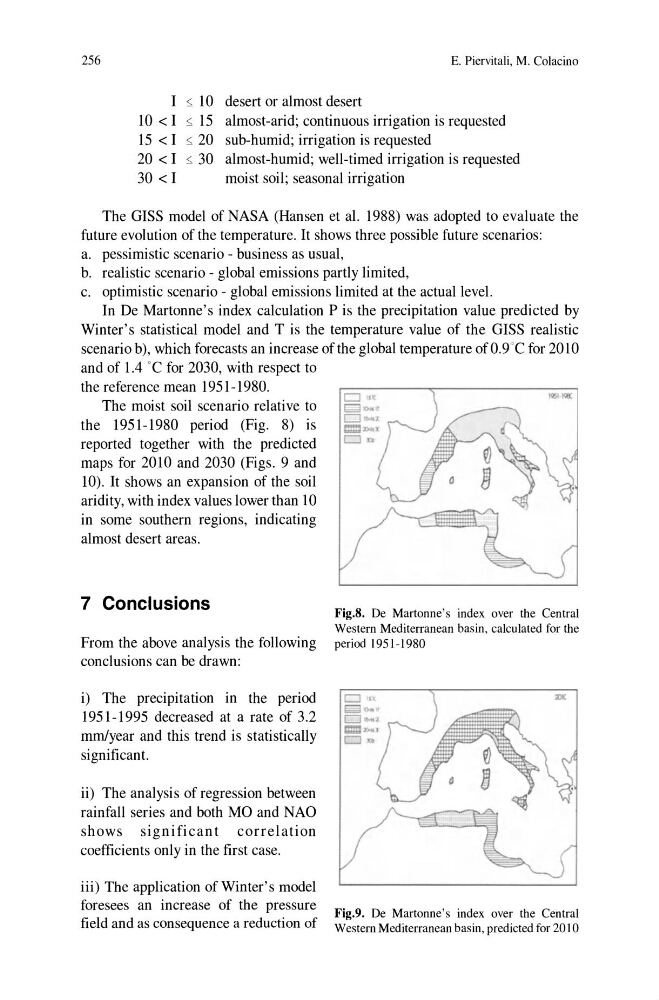
The moist soil scenario relative to
the 1951-1980 period (Fig. 8) is
reported together with the predicted
maps for 2010 and 2030 (Figs. 9 and
10). It shows an expansion of the soil
aridity, with index values lower than 10
in some southern regions, indicating
almost desert areas.
7 Conclusions
From the above analysis the following
conclusions can be drawn:
i) The precipitation in the period
1951-1995 decreased at a rate of 3.2
mm/year and this trend is statistically
significant.
ii) The analysis of regression between
rainfall series and both MO and NAO
shows significant correlation
coefficients only in the first case.
iii) The application of Winter's model
foresees an increase of the pressure
field and as consequence a reduction of
Fig.S. De Martonne's index over the Central
Western Mediterranean basin, calculated for the
period 1951-1980
Fig.9. De Martonne's index over the Central
Western Mediterranean basin, predicted for 2010
E. Piervitali, M. Colacino
I S; 10 desert or almost desert
10 < I S; 15 almost-arid; continuous irrigation is requested
15 < I S; 20 sub-humid; irrigation is requested
20 < I S; 30 almost-humid; well-timed irrigation is requested
30 < I
moist soil; seasonal irrigation
The GISS model of NASA (Hansen et al. 1988) was adopted to evaluate the
future evolution of the temperature. It shows three possible future scenarios:
a. pessimistic scenario - business as usual,
b. realistic scenario - global emissions partly limited,
c. optimistic scenario - global emissions limited at the actual level.
In De Martonne's index calculation P is the precipitation value predicted by
Winter's statistical model and T is the temperature value of the GISS realistic
scenario b), which forecasts an increase of the global temperature ofO.9'C for 2010
and of 1.4 cC for 2030, with respect to
the reference mean 1951-1980.
The moist soil scenario relative to
the 1951-1980 period (Fig. 8) is
reported together with the predicted
maps for 2010 and 2030 (Figs. 9 and
10). It shows an expansion of the soil
aridity, with index values lower than 10
in some southern regions, indicating
almost desert areas.
7 Conclusions
From the above analysis the following
conclusions can be drawn:
i) The precipitation in the period
1951-1995 decreased at a rate of 3.2
mm/year and this trend is statistically
significant.
ii) The analysis of regression between
rainfall series and both MO and NAO
shows significant correlation
coefficients only in the first case.
iii) The application of Winter's model
foresees an increase of the pressure
field and as consequence a reduction of
Fig.S. De Martonne's index over the Central
Western Mediterranean basin, calculated for the
period 1951-1980
Fig.9. De Martonne's index over the Central
Western Mediterranean basin, predicted for 2010