

102
Enne G., Zucca c., Zanolla C.
relevance of the criteria summarised below (for more detail, please refer to the
volume):
- Accurate definition of the indicator;
Position within the logical framework (DPSIR);
Target and political pertinence (position within the Agenda 21, importance with
respect to sustainable development, to the Conventions and to the international
agreements);
Methodological description and basic definitions, with particular reference to the
methods of measurement and to the characteristics and operational limits of the
indicator;
Necessary data to calculate the indicator and evaluation of data availability;
Additional information, authors and bibliographical references.
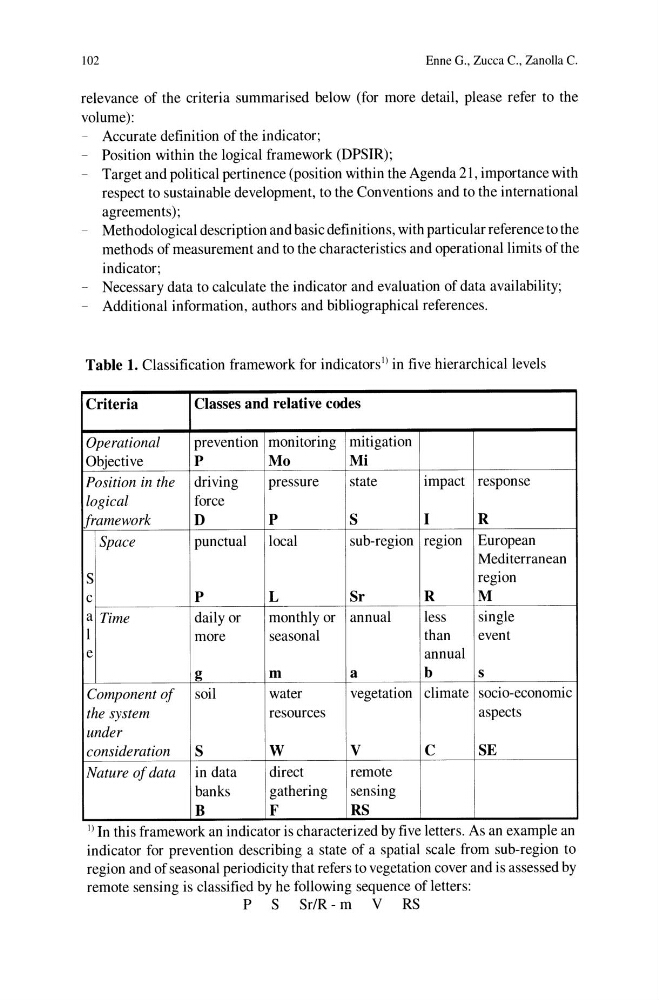
Table 1. Classification framework for indicators l ) in five hierarchical levels
Criteria
Classes and relative codes
Operational
prevention monitoring mitigation
Objective
P
Mo
Mi
Position in the driving
pressure
state
impact response
logical
force
framework
D
P
S
I
R
Space
punctual
local
sub-region region European
Mediterranean
S
region
c
p
L
Sr
R
M
a Time
daily or
monthly or annual
less
single
I
more
seasonal
than
event
e
annual
g
m
a
b
s
Component of soil
water
vegetation climate socio-economic
the system
resources
aspects
under
consideration
S
W
V
C
SE
Nature of data in data
direct
remote
banks
gathering
sensing
B
F
RS
I) In this framework an indicator is characterized by five letters. As an example an
indicator for prevention describing a state of a spatial scale from sub-region to
region and of seasonal periodicity that refers to vegetation cover and is assessed by
remote sensing is classified by he following sequence of letters:
P S Sr/R - m V RS
Enne G., Zucca c., Zanolla C.
relevance of the criteria summarised below (for more detail, please refer to the
volume):
- Accurate definition of the indicator;
Position within the logical framework (DPSIR);
Target and political pertinence (position within the Agenda 21, importance with
respect to sustainable development, to the Conventions and to the international
agreements);
Methodological description and basic definitions, with particular reference to the
methods of measurement and to the characteristics and operational limits of the
indicator;
Necessary data to calculate the indicator and evaluation of data availability;
Additional information, authors and bibliographical references.
Table 1. Classification framework for indicators l ) in five hierarchical levels
Criteria
Classes and relative codes
Operational
prevention monitoring mitigation
Objective
P
Mo
Mi
Position in the driving
pressure
state
impact response
logical
force
framework
D
P
S
I
R
Space
punctual
local
sub-region region European
Mediterranean
S
region
c
p
L
Sr
R
M
a Time
daily or
monthly or annual
less
single
I
more
seasonal
than
event
e
annual
g
m
a
b
s
Component of soil
water
vegetation climate socio-economic
the system
resources
aspects
under
consideration
S
W
V
C
SE
Nature of data in data
direct
remote
banks
gathering
sensing
B
F
RS
I) In this framework an indicator is characterized by five letters. As an example an
indicator for prevention describing a state of a spatial scale from sub-region to
region and of seasonal periodicity that refers to vegetation cover and is assessed by
remote sensing is classified by he following sequence of letters:
P S Sr/R - m V RS