

Indicators and Information Requirements for Combatting Desertification
101
The major methodological contributions are summarised below.
a) Operational definition of desertification indicators.
b) Characterisation system for the desertification indicators.
c) Classification system for the desertification indicators.
d) Definition of the indicators development procedure.
e) Proposal of an implementation indicators matrix for the Italian National Action
Programme.
The first 4 methodological contributions, in particular, are worth further
clarification.
a) Operational definition of the indicator.
What identifies a parameter or an index as an indicator (for a specific, well defined
use) is a set of characteristics, amongst which are the following:
Objective: An indicator is such if it serves tocharacterise/measure/monitor a
state or process in a determined context, for a specific purpose.
Method: The method of measurement and/or calculation of the value of a
parameter/index. Required is the level of accuracy, number of repetitions,
periodicity, statistical processing, fields and contexts of application, spatial scale at
which it is significant.
Benchmarks of the parameterlindex: Threshold values, reference intervals.
Type and quality of the final information: Site-specific or distributed spatially;
spatial density of the sampling; specific techniques for spaceltime interpolation of
point data (data from a single site are often interpolated with undiscerning use of
geostatistical algorithms, whereas the choice of a suitable method is an important
aspect).
To conclude, it can be said that an environmental indicator is not a
parameter/index, but a set defined by at least five elements: parameter/index;
objective; method of measurement; benchmarks; type and quality of information
output. The following formula borrowed from vector algebra may be applied:
indicator = {parameter, objective,
method, benchmark, spatial
scale/type of spatial extension}
b) Framework for characterising
desertification indicators
It was obtained by adopting a
conceptual frame of reference (the
well-known DPSIR also adopted by
the European Environment Agency)
and by elaborating a technicalmethodological chart that lists all the
necessary information that should
accompany a ready-for-use indicator.
In particular, it highlights the
CCO
Impact
Indicator
Desertification
Indicators
CCO
Implementation
Indicators
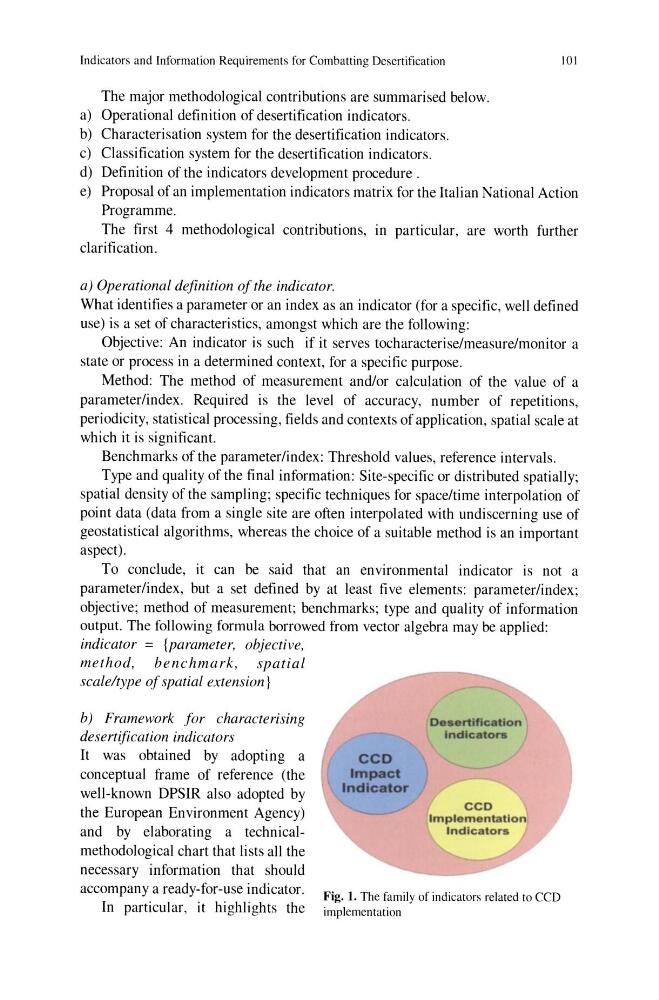
Fig. 1. The family of indicators related to CCD
implementation
101
The major methodological contributions are summarised below.
a) Operational definition of desertification indicators.
b) Characterisation system for the desertification indicators.
c) Classification system for the desertification indicators.
d) Definition of the indicators development procedure.
e) Proposal of an implementation indicators matrix for the Italian National Action
Programme.
The first 4 methodological contributions, in particular, are worth further
clarification.
a) Operational definition of the indicator.
What identifies a parameter or an index as an indicator (for a specific, well defined
use) is a set of characteristics, amongst which are the following:
Objective: An indicator is such if it serves tocharacterise/measure/monitor a
state or process in a determined context, for a specific purpose.
Method: The method of measurement and/or calculation of the value of a
parameter/index. Required is the level of accuracy, number of repetitions,
periodicity, statistical processing, fields and contexts of application, spatial scale at
which it is significant.
Benchmarks of the parameterlindex: Threshold values, reference intervals.
Type and quality of the final information: Site-specific or distributed spatially;
spatial density of the sampling; specific techniques for spaceltime interpolation of
point data (data from a single site are often interpolated with undiscerning use of
geostatistical algorithms, whereas the choice of a suitable method is an important
aspect).
To conclude, it can be said that an environmental indicator is not a
parameter/index, but a set defined by at least five elements: parameter/index;
objective; method of measurement; benchmarks; type and quality of information
output. The following formula borrowed from vector algebra may be applied:
indicator = {parameter, objective,
method, benchmark, spatial
scale/type of spatial extension}
b) Framework for characterising
desertification indicators
It was obtained by adopting a
conceptual frame of reference (the
well-known DPSIR also adopted by
the European Environment Agency)
and by elaborating a technicalmethodological chart that lists all the
necessary information that should
accompany a ready-for-use indicator.
In particular, it highlights the
CCO
Impact
Indicator
Desertification
Indicators
CCO
Implementation
Indicators
Fig. 1. The family of indicators related to CCD
implementation