

469
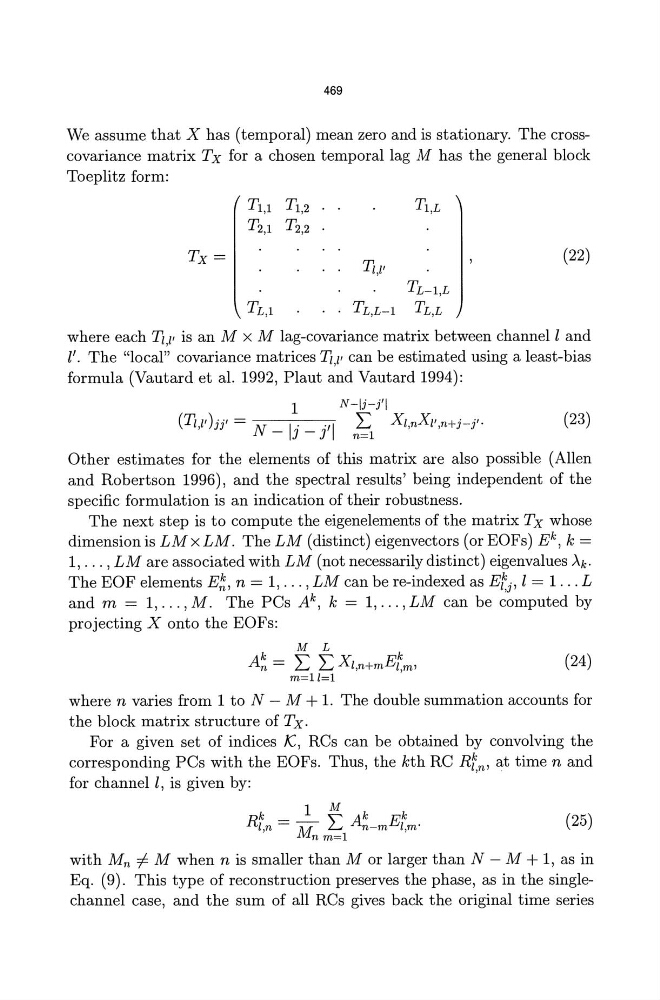
We assume that X has (temporal) mean zero and is stationary. The crosscovariance matrix Tx for a chosen temporal lag M has the general block
Toeplitz form:
Tl,1 T1,2
T1,L
T2,1 T2,2
Tx=
Tz,ll
(22)
TL-1,L
TL,l
TL,L-l TL,L
where each Tz,l' is an M x M lag-covariance matrix between channell and
I'. The "local" covariance matrices Tz,l' can be estimated using a least-bias
formula (Vautard et al. 1992, Plaut and Vautard 1994):
1
N-Ij-J'I
(T",ll)jjl = N I' "1 I: X1,nXI1,n+j-j"
- J - J
n=l
(23)
Other estimates for the elements of this matrix are also possible (Allen
and Robertson 1996), and the spectral results' being independent of the
specific formulation is an indication of their robustness.
The next step is to compute the eigenelements of the matrix Tx whose
dimension is L M x L M. The L M (distinct) eigenvectors (or EO Fs) Ek, k =
1, ... , LM are associated with LM (not necessarily distinct) eigenvalues Ak.
The EOF elements E~, n = 1, ... , LM can be re-indexed as E~j' I = 1 ... L
and m = 1, ... , M. The PCs Ak, k = 1, ... , LM can be computed by
projecting X onto the EOFs:
M
L
A~ = I: I: X1,n+mEtm,
m=ll=l
(24)
where n varies from 1 to N - M + 1. The double summation accounts for
the block matrix structure of Tx.
For a given set of indices K, Res can be obtained by convolving the
corresponding PCs with the EOFs. Thus, the kth RC R7,n, at time nand
for channel I, is given by:
(25)
with Mn i= M when n is smaller than M or larger than N - M + 1, as in
Eq. (9). This type of reconstruction preserves the phase, as in the singlechannel case, and the sum of all RCs gives back the original time series
We assume that X has (temporal) mean zero and is stationary. The crosscovariance matrix Tx for a chosen temporal lag M has the general block
Toeplitz form:
Tl,1 T1,2
T1,L
T2,1 T2,2
Tx=
Tz,ll
(22)
TL-1,L
TL,l
TL,L-l TL,L
where each Tz,l' is an M x M lag-covariance matrix between channell and
I'. The "local" covariance matrices Tz,l' can be estimated using a least-bias
formula (Vautard et al. 1992, Plaut and Vautard 1994):
1
N-Ij-J'I
(T",ll)jjl = N I' "1 I: X1,nXI1,n+j-j"
- J - J
n=l
(23)
Other estimates for the elements of this matrix are also possible (Allen
and Robertson 1996), and the spectral results' being independent of the
specific formulation is an indication of their robustness.
The next step is to compute the eigenelements of the matrix Tx whose
dimension is L M x L M. The L M (distinct) eigenvectors (or EO Fs) Ek, k =
1, ... , LM are associated with LM (not necessarily distinct) eigenvalues Ak.
The EOF elements E~, n = 1, ... , LM can be re-indexed as E~j' I = 1 ... L
and m = 1, ... , M. The PCs Ak, k = 1, ... , LM can be computed by
projecting X onto the EOFs:
M
L
A~ = I: I: X1,n+mEtm,
m=ll=l
(24)
where n varies from 1 to N - M + 1. The double summation accounts for
the block matrix structure of Tx.
For a given set of indices K, Res can be obtained by convolving the
corresponding PCs with the EOFs. Thus, the kth RC R7,n, at time nand
for channel I, is given by:
(25)
with Mn i= M when n is smaller than M or larger than N - M + 1, as in
Eq. (9). This type of reconstruction preserves the phase, as in the singlechannel case, and the sum of all RCs gives back the original time series