

436
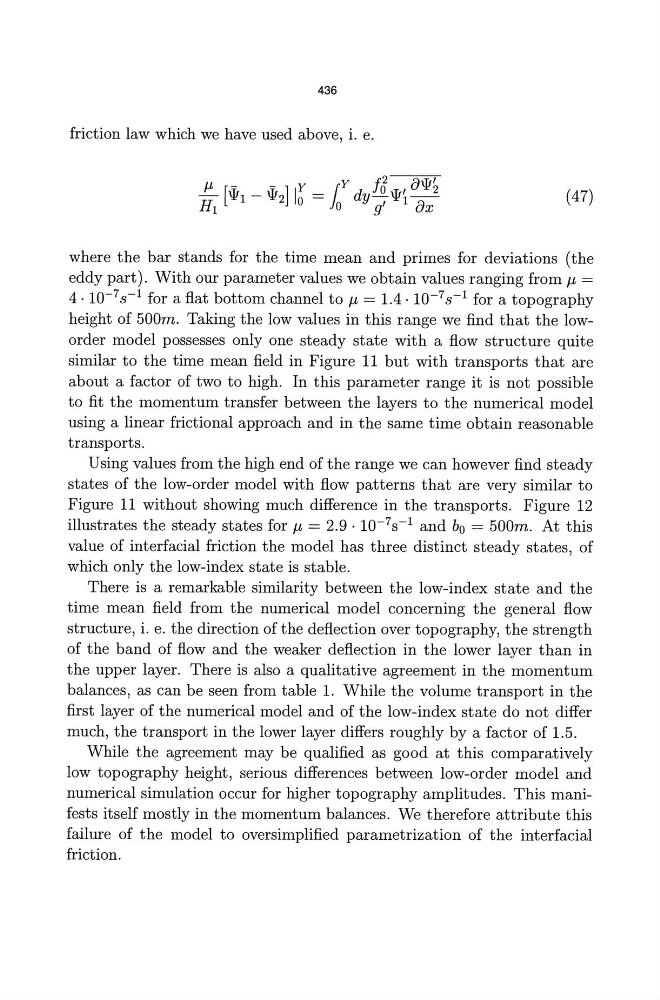
friction law which we have used above, i. e.
~ [~ - ~ ]I Y = r Y d i6 'It' o'It~
HI 1
2 0
10 Y g' 1 AX
(47)
where the bar stands for the time mean and primes for deviations (the
eddy part). With our parameter values we obtain values ranging from f..l =
4· 10- 7 8- 1 for a flat bottom channel to f..l = 1.4· 10- 7 8- 1 for a topography
height of 500m. Taking the low values in this range we find that the loworder model possesses only one steady state with a flow structure quite
similar to the time mean field in Figure 11 but with transports that are
about a factor of two to high. In this parameter range it is not possible
to fit the momentum transfer between the layers to the numerical model
using a linear frictional approach and in the same time obtain reasonable
transports.
Using values from the high end of the range we can however find steady
states of the low-order model with flow patterns that are very similar to
Figure 11 without showing much difference in the transports. Figure 12
illustrates the steady states for f..l = 2.9· 1O- 7 s- 1 and bo = 500m. At this
value of interfacial friction the model has three distinct steady states, of
which only the low-index state is stable.
There is a remarkable similarity between the low-index state and the
time mean field from the numerical model concerning the general flow
structure, i. e. the direction of the deflection over topography, the strength
of the band of flow and the weaker deflection in the lower layer than in
the upper layer. There is also a qualitative agreement in the momentum
balances, as can be seen from table 1. While the volume transport in the
first layer of the numerical model and of the low-index state do not differ
much, the transport in the lower layer differs roughly by a factor of 1.5.
While the agreement may be qualified as good at this comparatively
low topography height, serious differences between low-order model and
numerical simulation occur for higher topography amplitudes. This manifests itself mostly in the momentum balances. We therefore attribute this
failure of the model to oversimplified parametrization of the interfacial
friction.
friction law which we have used above, i. e.
~ [~ - ~ ]I Y = r Y d i6 'It' o'It~
HI 1
2 0
10 Y g' 1 AX
(47)
where the bar stands for the time mean and primes for deviations (the
eddy part). With our parameter values we obtain values ranging from f..l =
4· 10- 7 8- 1 for a flat bottom channel to f..l = 1.4· 10- 7 8- 1 for a topography
height of 500m. Taking the low values in this range we find that the loworder model possesses only one steady state with a flow structure quite
similar to the time mean field in Figure 11 but with transports that are
about a factor of two to high. In this parameter range it is not possible
to fit the momentum transfer between the layers to the numerical model
using a linear frictional approach and in the same time obtain reasonable
transports.
Using values from the high end of the range we can however find steady
states of the low-order model with flow patterns that are very similar to
Figure 11 without showing much difference in the transports. Figure 12
illustrates the steady states for f..l = 2.9· 1O- 7 s- 1 and bo = 500m. At this
value of interfacial friction the model has three distinct steady states, of
which only the low-index state is stable.
There is a remarkable similarity between the low-index state and the
time mean field from the numerical model concerning the general flow
structure, i. e. the direction of the deflection over topography, the strength
of the band of flow and the weaker deflection in the lower layer than in
the upper layer. There is also a qualitative agreement in the momentum
balances, as can be seen from table 1. While the volume transport in the
first layer of the numerical model and of the low-index state do not differ
much, the transport in the lower layer differs roughly by a factor of 1.5.
While the agreement may be qualified as good at this comparatively
low topography height, serious differences between low-order model and
numerical simulation occur for higher topography amplitudes. This manifests itself mostly in the momentum balances. We therefore attribute this
failure of the model to oversimplified parametrization of the interfacial
friction.